• Skip to main content
  • Skip to secondary menu
  • Skip to primary sidebar
  • Skip to secondary sidebar
  • Skip to footer
  • DroneRacingLife
  • DroneFlyers
  • Newsletter
DroneLife

DRONELIFE

Stay up to date on all the latest Drone News

  • News
  • Products
  • Industries
    • Agriculture
    • Construction
    • Delivery
    • Dual Use
    • Inspection
    • Public Safety
    • Surveying
  • Enthusiasts
  • Regulations
  • Business
  • Video
  • Podcasts

Archaeologists Are Using Drones to Find Good Places to Dig: The Search for Potsherds.

September 30, 2019 by staff 6 Comments


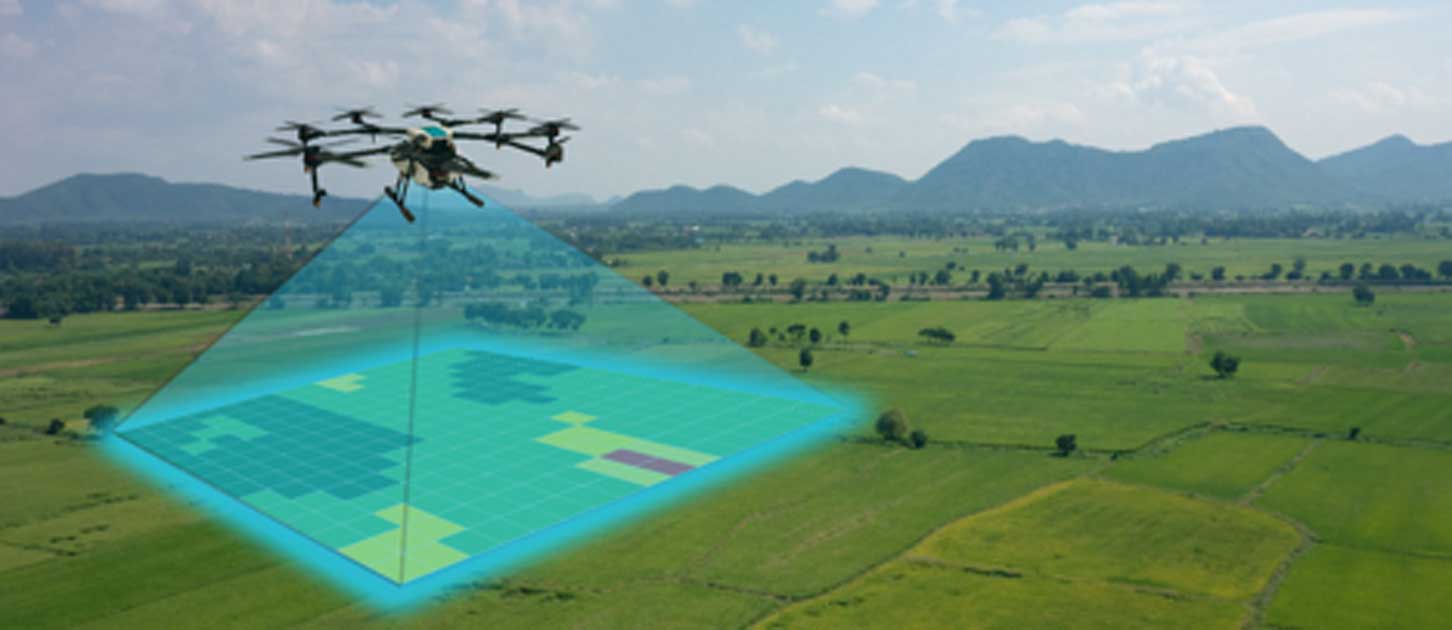
Drones are becoming useful new tools for archaeologists. Source: Monopoly919 / Adobe Stock
Drones are becoming useful new tools for archaeologists. Source: Monopoly919 / Adobe Stock.”

The following piece is reprinted with permission from Ancient-Origins.  Originally published on September, 26, 2019 and written by Alicia McDermott.

Drones are becoming ever more present tools for archaeologists looking to add to their survey and excavation toolkits. They’ve been used to get some great aerial views of archaeological sites and features and sometimes even to discover them! And researchers have now teamed up high-res drone pictures with some nifty machine learning to detect one of an archaeologist’s go to first finds – potsherds!

Fieldwalking and Aerial Photographs

Most archaeologists have had the pleasure of fieldwalking, aka ‘pedestrian surveying’ at some point in their career. This is a survey technique employed by a group of archaeologists, or archaeology students, who head out as a team to walk across a large area of open land they think may be of archaeological interest. Usually the land of choice for this survey method is a recently plowed farmer’s field , best if it’s rained not too long ago.

The team spreads out in a methodical grid-like manner, usually parallel lines of a set distance apart, to see if they can find any archaeological material that has been pushed to the surface – often that means pottery fragments ( potsherds). Flint tools and other artifacts are also found sometimes with this method.
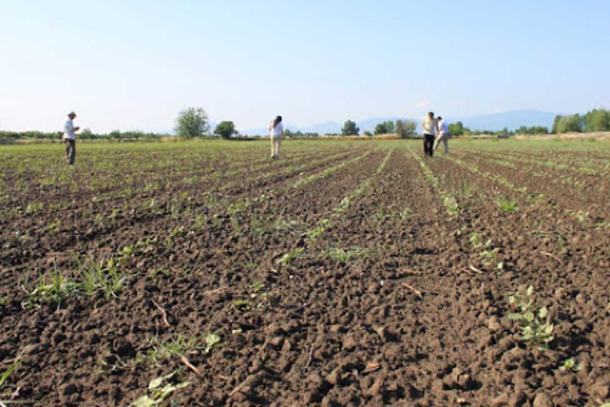
A team conducting a pedestrian archaeological survey aka “fieldwalking.” (Anna Karligioti)

A team conducting a pedestrian archaeological survey aka “fieldwalking.” (Anna Karligioti)

It’s notoriously long, hard, and sometimes tedious work, but fieldwalking has been a traditional practice since archaeology’s early days as a discipline.

Simplifying the Detection of Potsherds and More!

But new research published in the Journal of Archaeological Science suggests there may be a better way.

Dr. Hector A. Orengo of the Catalan Institute of Classical Archaeology and Dr. Arnau Garcia-Molsosa of the McDonald Institute for Archaeological Research at the University of Cambridge think they may have the answer to the fieldwalking headache, or at least the beginning of a solution. A University of Cambridge press release states that the researchers aim “to alleviate labor-intensive archaeological field surveying by combining machine learning and high-resolution drone imagery.”
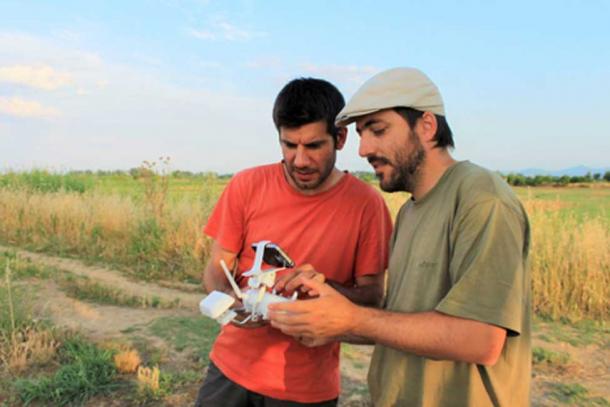
Dr. Arnau Garcia-Molsosa and Dr. Hector A. Orengo watching the drone. (Anna Karligioti)

Dr. Arnau Garcia-Molsosa and Dr. Hector A. Orengo watching the drone. (Anna Karligioti)

What they have tested out is a new archaeological survey method – flying a pre-programmed drone over the area of interest and taking overlapping pictures. The images are then joined together to create what they call “a single very large high-resolution image.”

That high-res image is then analyzed by a machine learning (AI) algorithm that is meant to find all the specified archaeological material that is present in the image. The researchers tested out their method by setting the algorithm to identify potsherds through color and pixel texture, but say that it could “be trained to identify different types of material culture as well.” They’ve suggested stone tools and other lithics or metal could also be suitable materials of interest for this method.

You may be wondering why they started with potsherds – which are essentially busted up pieces of ceramic. Orengo provides this explanation:

“The distribution of potsherds is a good indication of the intensity of human occupation and the location of archaeological sites, but traditional survey methods can be quite costly and labor-intensive. Some of our projects in the Mediterranean involved the collection and recording of large quantities of pottery, but a single relatively small site could take our 6-people team three days to record! Automated survey was something we used to fantasize about while in the field.”

Garcia-Molsosa continues the idea:

“Under ideal circumstances this method is more accurate and faster than standard survey approaches. This is a complementary method to traditional pedestrian survey and has the potential to transform the way landscape survey is done. The automated recording of surface material culture has enormous possibilities to contribute to a wide array of projects working on academic research and heritage management. We hope that this technique can be employed, adapted and improved by other teams so we can understand better its potential application.”

This new method may be an interesting alternative to three days of walking across open fields, which is certainly time-consuming and often a costly matter (people are sometimes paid for the task and at least they need food and shelter if they’ll be trekking the fields for a few days).

‘The Lonesome Archaeologist’ Fieldwalking in 2014. (Paul Wood/CC BY SA 2.0)

‘The Lonesome Archaeologist’ Fieldwalking in 2014. (Paul Wood/ CC BY SA 2.0 )

Possibilities and Limitations

However, it is not perfect and the researchers also realize that there are some limitations to the method as it stands right now.

For example, they found the algorithm may provide false positives if the settings are more stringent and incorrectly suggest that modern brick fragments are pottery. Or, conversely, less strict settings could mean the algorithm misses some of the potsherds. Thankfully, this type of technical issue could probably be ironed out in the future. But until that happens, there is the question of how much time may really be saved – people still need to check the algorithms work and possibly go out and find and then pick up the potsherds by hand.

Upper image showing a drone-acquired image of the ground. Lower image showing the sherds detected by the machine learning algorithm. (Arnau Garcia-Molsosa and Hector A. Orengo)

Upper image showing a drone-acquired image of the ground. Lower image showing the sherds detected by the machine learning algorithm. (Arnau Garcia-Molsosa and Hector A. Orengo)

A much larger limitation is that the method is currently still restricted to the same conditions as traditional fieldwalking – flat, plowed soils that are vegetation-free. However, the researchers say they “are now working on developing drone technologies that can better adapt to irregular terrain, avoid trees, and other barriers and extend the drone flight times that are currently available.” Now that could be a more useful surveying tool, but still means restrictions to land that is relatively plant-free.

Orengo and Garcia-Molsosa state they are also working on creating “new artificial intelligence-based methods to improve the algorithm detection ratio and extend its identification abilities to other types of material culture, such as lithics and metal.” This would be a nice addition to the current focus on potsherds.

Another cause of concern is how viable this method will be in the future. Drones are still relatively new technology, but legislation is changing and restrictions on drone usage are emerging. If too much red tape is added, it may be easier for archaeologists to just stick with the old ways than wait for permission to use their aerial tools.
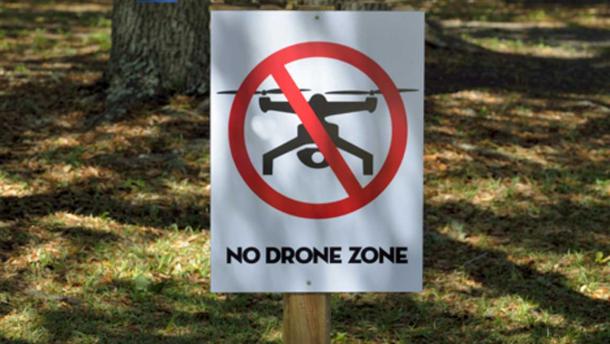
Drones may not be permitted in some areas of archaeological interest. (CC0)

Drones may not be permitted in some areas of archaeological interest. ( CC0)

But in the end the researchers still see their drone-machine learning set up as a complementary method to the good old-fashioned ways of or archaeological forebears – fieldwalking. It seems that even while archaeology is taking technological steps into the future with drones and scans, there is still one foot in the past and keeping some (useful) traditions alive.

Top Image: 
Filed Under: Applications, Conservation, Data analytics, Featured - Surveying, News, Products Tagged With: Ancient Origins, Drones and Archaeology

Reader Interactions

Trackbacks

  1. Increíbles formas en que la tecnología moderna ha ayudado a la arqueología – internetsano.do says:
    June 5, 2021 at 2:25 am

    […] Ciertos sitios arqueológicos están en sitios peligrosos que tienen la posibilidad de poner arqueólogos bajo riesgo. A través de la utilización de automóviles aéreos no tripulados y otros géneros de […]

    Reply
  2. A Drone Helped Unearth Ancient Skeletons on Gran Canaria - Tech Center Guam UAS says:
    March 9, 2020 at 5:07 pm

    […] looking to add to their survey and excavation toolkits,” anthropologist Alicia McDermott reported in a recent DroneLife […]

    Reply
  3. A Drone Helped Unearth Ancient Skeletons on Gran Canaria | 10Drones says:
    March 8, 2020 at 6:59 pm

    […] looking to add to their survey and excavation toolkits,” anthropologist Alicia McDermott reported in a recent DroneLife […]

    Reply
  4. A Drone Helped Unearth Ancient Skeletons on Gran Canaria - taktik(z) Staging says:
    March 8, 2020 at 5:38 pm

    […] to add to their survey and exca­va­tion toolk­its,” anthro­pol­o­gist Alicia McDermott report­ed in a recent DroneLife […]

    Reply
  5. Archaeologists Are Utilizing Drones to Discover Good Locations to Dig: The Seek for Potsherds. - Drone Stuff Pro says:
    September 30, 2019 at 2:39 pm

    […] Supply hyperlink […]

    Reply
  6. Archaeologists Are Using Drones to Find Good Places to Dig: The Search for Potsherds. | Drone Magazine says:
    September 30, 2019 at 1:31 pm

    […] Source […]

    Reply

Leave a Reply Cancel reply

Your email address will not be published. Required fields are marked *

Primary Sidebar

LATEST

Robodex and Tokyu Land Open Japan’s First Hydrogen Drone Port in Hiroshima

This article published in collaboration with JUIDA, the Japan UAS Industrial Development Association.     Robodex and Tokyu Land Corporation are…

Continue Reading Robodex and Tokyu Land Open Japan’s First Hydrogen Drone Port in Hiroshima

Designed to Fly Like a Falcon, RoBird Takes Aim at Crop-Damaging Birds

From Airports to Agriculture: RoBird Finds New Role Protecting Crops Flapping-wing drone technology expands from bird-strike prevention to agricultural crop…

Continue Reading Designed to Fly Like a Falcon, RoBird Takes Aim at Crop-Damaging Birds

DHS Secretary: U.S. Still Building Counter-Drone Defenses for World Cup

Mullin says feds still ‘a little behind’ in counter-UAS prep By DRONELIFE Features Editor Jim Magill (Editor’s note: This story…

Continue Reading DHS Secretary: U.S. Still Building Counter-Drone Defenses for World Cup

Ondas Unveils New Autonomous Counter-Drone and Robotic Combat Systems

MODUS and IRON WAVE aim to help military forces counter drone threats and deploy robotic systems ahead of frontline troop…

Continue Reading Ondas Unveils New Autonomous Counter-Drone and Robotic Combat Systems

Congress Introduces GUARD Act, Extending FCC Covered List Framework to Robotics

Proposed legislation would require national security review of certain foreign-made humanoid and quadruped robots A bipartisan group of lawmakers has…

Continue Reading Congress Introduces GUARD Act, Extending FCC Covered List Framework to Robotics

Blueflite Added to FAA Section 44807 Approved UAS List: Why it Matters

Cargo drone platform joins FAA-reviewed aircraft list, potentially streamlining future operator approvals Michigan-based drone manufacturer blueflite announced that its Cobalt…

Continue Reading Blueflite Added to FAA Section 44807 Approved UAS List: Why it Matters

Aeronext Unveils ActiveWing Logistics Drone Prototype for Long-Range Delivery

This article published in collaboration with JUIDA, the Japan UAS Industrial Development Association.     The Tokyo company’s new multicopter pairs…

Continue Reading Aeronext Unveils ActiveWing Logistics Drone Prototype for Long-Range Delivery

FBI, Atlanta PD Stress Need for ‘No-Drone Zone’ Compliance

By Dronelife Features Editor Jim Magill (Editor’s note: This story is part of a series of reports on efforts to…

Continue Reading FBI, Atlanta PD Stress Need for ‘No-Drone Zone’ Compliance

Building a Resilient Supply Chain: Regional Security Leaders Focus on Industrial Readiness

Northeast National Security Conference examines how the U.S. can strengthen its defense industrial base Supply chain security has become a…

Continue Reading Building a Resilient Supply Chain: Regional Security Leaders Focus on Industrial Readiness

Defense Leaders Call for Faster Paths from Innovation to the Field

Remarks at the Northeast National Security Conference highlight growing demand for rapid, commercially informed defense solutions The 2026 Northeast National…

Continue Reading Defense Leaders Call for Faster Paths from Innovation to the Field

Secondary Sidebar

Footer

SPONSORED

Inspired Flight Gremsy IF800 VIO F1 drones geo week

What Will It Take to Strengthen U.S. Drone Manufacturing? A Conversation with Inspired Flight’s CEO

Global Mapper Mobile data collection

Collection Ground Control Points with Global Mapper Mobile

Military Drone Mapping Solutions

How SimActive’s Correlator3D™ is Revolutionizing Military Mapping: An Exclusive Interview with CEO Philippe Simard

Photogrammetry Accuracy Standards

SimActive Photogrammetry Software: Enabling Users to Meet Accuracy Standards for Over 20 Years

NACT Engineering Parrot ANAFI tether indoor shot

Smart Tether for Parrot ANAFI USA from NACT Engineering

Blue Marble, features global mapper, features Blue Marble

Check Out These New Features in Global Mapper v25 from Blue Marble

About Us | Contact Us | Advertise With Us | Write for Us | Privacy Policy | Terms of Service

The Trusted Source for the Business of Drones.

This website uses cookies and third party services. By clicking OK, you are agreeing to our privacy policy. ACCEPT

Manage consent

Privacy Overview

This website uses cookies to improve your experience while you navigate through the website. Out of these, the cookies that are categorized as necessary are stored on your browser as they are essential for the working of basic functionalities of the website. We also use third-party cookies that help us analyze and understand how you use this website. These cookies will be stored in your browser only with your consent. You also have the option to opt-out of these cookies. But opting out of some of these cookies may affect your browsing experience.
Necessary
Always Enabled
Necessary cookies are absolutely essential for the website to function properly. These cookies ensure basic functionalities and security features of the website, anonymously.
CookieDurationDescription
cookielawinfo-checkbox-analytics11 monthsThis cookie is set by GDPR Cookie Consent plugin. The cookie is used to store the user consent for the cookies in the category "Analytics".
cookielawinfo-checkbox-functional11 monthsThe cookie is set by GDPR cookie consent to record the user consent for the cookies in the category "Functional".
cookielawinfo-checkbox-necessary11 monthsThis cookie is set by GDPR Cookie Consent plugin. The cookies is used to store the user consent for the cookies in the category "Necessary".
cookielawinfo-checkbox-others11 monthsThis cookie is set by GDPR Cookie Consent plugin. The cookie is used to store the user consent for the cookies in the category "Other.
cookielawinfo-checkbox-performance11 monthsThis cookie is set by GDPR Cookie Consent plugin. The cookie is used to store the user consent for the cookies in the category "Performance".
viewed_cookie_policy11 monthsThe cookie is set by the GDPR Cookie Consent plugin and is used to store whether or not user has consented to the use of cookies. It does not store any personal data.
Functional
Functional cookies help to perform certain functionalities like sharing the content of the website on social media platforms, collect feedbacks, and other third-party features.
Performance
Performance cookies are used to understand and analyze the key performance indexes of the website which helps in delivering a better user experience for the visitors.
Analytics
Analytical cookies are used to understand how visitors interact with the website. These cookies help provide information on metrics the number of visitors, bounce rate, traffic source, etc.
Advertisement
Advertisement cookies are used to provide visitors with relevant ads and marketing campaigns. These cookies track visitors across websites and collect information to provide customized ads.
Others
Other uncategorized cookies are those that are being analyzed and have not been classified into a category as yet.
SAVE & ACCEPT