
The National Autonomy and Drone Innovation Centre, backed by £2.25 million (about $3 million) from Buckinghamshire Council, will give UK companies a place to generate regulator-grade safety evidence under controlled, repeatable conditions.
The Satellite Applications Catapult announced investment in a new national drone testing center at Westcott Venture Park in Buckinghamshire on September 29, 2026. Buckinghamshire Council is backing the project with £2.25 million (about $3 million). Unveiled at the DroneX trade show in London, the National Autonomy and Drone Innovation Centre (NADIC) will expand the Catapult’s existing Drone Test and Development Centre at Westcott. The goal is to address one of the biggest practical barriers facing the UK drone industry: a shortage of accessible places where companies can prove their technology is safe.
Capabilities at the national drone testing center
NADIC will include position, navigation and timing (PNT) test facilities for assessing how systems perform when satellite navigation signals are unavailable, disrupted or manipulated. A Satellite Communications Integration and Test Lab will validate drones and autonomous systems across satellite, terrestrial and hybrid networks to support long-distance and BVLOS operations. In addition, a Remote Operations Control Centre will let operators train, simulate missions and validate remote command-and-control procedures.
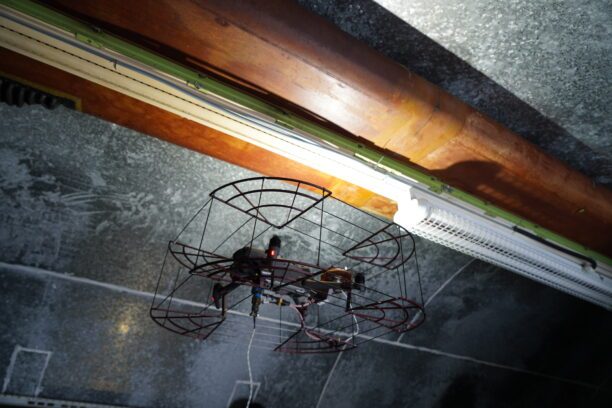
For physical testing, a Windshaper system will generate precise, repeatable indoor wind conditions, so testing will not depend on the weather. Meanwhile, a robotic arm will automate repeatable drone tests, and a motion platform will recreate operations on moving vessels, vehicles and uneven terrain. The robotic arm, motion platform and control room are expected to come online this autumn, with the full facility anticipated in the second half of 2027.
The centre primarily serves small and medium-sized companies and component builders. These firms develop the navigation, sensing, communications and autonomy systems the wider sector depends on, and they face the evidence burden first because operators will not design in their equipment until it is proven safe.
Closing the UK drone evidence gap
The UK government has set a target of routine BVLOS flight by 2027, and forecasts put the value of the UK drone economy at up to £45 billion (about $60 billion) by 2030. However, almost every commercial drone flight in the UK still runs as an individually authorized, time-limited exception. Companies must prove with evidence that each specific operation is safe, and facilities able to produce evidence to a standard the regulator recognizes remain limited, particularly for smaller firms. In its Airspace Architecture Concept of Operations, published in July, the Civil Aviation Authority stated that today’s bespoke approvals “are not designed to support the volume of operations needed for widespread commercial use.”
“Britain is very good at proving that drones can work. What we have never built is the shared infrastructure that turns a promising system into a proven one. Companies come to us with technology that works and a gap in their evidence, and there has been nowhere accessible for many of them to close it,” said John Abbott, chief executive of the Satellite Applications Catapult. “A company should be able to arrive with a system, establish its operational limits under controlled conditions, and leave with data that goes straight into a regulatory application. This facility offers a serious step forward for the sector.”
NADIC will also sit alongside the Catapult’s Future Networks Development Centre at Westcott, which works on resilient communications that combine satellite and terrestrial networks.
“This is about investing in Buckinghamshire’s future economy and making sure residents benefit from the skilled jobs, training opportunities and wider prosperity that successful innovation sectors can bring,” said Steven Broadbent, leader of Buckinghamshire Council. “The Buckinghamshire Growth Fund was created for exactly this purpose – to invest in projects that bring long-term value to our economy, communities, businesses, residents and I am delighted that this first major funding decision does exactly that.”
More information is available at Satellite Applications Catapult.
Read More
-
Smarter Drone Searches May Require Less Replanning, Not More
-
Teledyne FLIR Launches AI-Enabled Air-to-Ground Tracking Software for UAS
-
Drone Industry Insights Launches ASTRA Intelligence Matchmaking Platform for Drones and Robots

Ian McNabb is a journalist focusing on drone technology and lifestyle content at Dronelife. He is based between Boston and NH and, when not writing, enjoys hiking and Boston area sports.

Leave a Reply