
Strategic partnership will bring Zipline drone delivery to Uber Eats customers, starting in existing U.S. markets later this year
Uber and Zipline have announced a strategic partnership aimed at bringing drone delivery to millions of Uber Eats customers across the United States. The companies plan to begin deployments later this year and target one million drone deliveries per day by the end of 2029.
As part of the agreement, Uber will also make a strategic investment in Zipline. The companies did not disclose the size or terms of the investment.
The partnership connects one of the world’s largest delivery platforms with the world’s largest commercial drone delivery network. It also gives Zipline a new path to reach consumers through the widely used Uber Eats platform.
“Zipline has built incredible technology, and Uber connects many millions of people with local merchants every day,” said Dara Khosrowshahi, CEO of Uber. “Together, we’re shaping the future of delivery by creating a faster, more sustainable way for people to get what they need. We look forward to bringing this technology to more communities and making autonomous delivery part of everyday life.”
Starting in Existing Zipline Markets
The first Uber Eats deployments will begin later this year in markets where Zipline already operates. The companies specifically identify Dallas and Houston among those markets. From there, they plan to expand into dozens of U.S. cities as Zipline adds service.
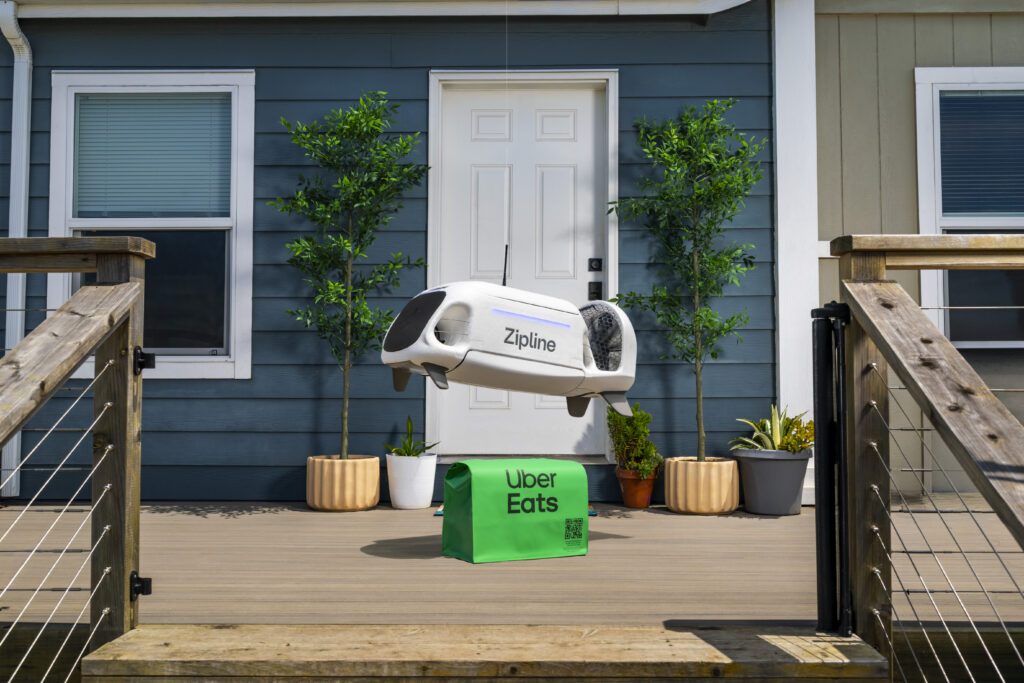
Customers in participating areas will have the option to select drone delivery for eligible Uber Eats orders. Zipline says its autonomous system can deliver orders within minutes.
The agreement represents a significant expansion of Zipline’s consumer delivery strategy. The company spent much of its first decade building medical logistics networks internationally. It now operates on four continents and serves more than 5,000 hospitals and health facilities.
Zipline reports more than 2.7 million deliveries, involving more than 20 million items. It has also flown more than 135 million commercial autonomous miles. The company currently makes a delivery somewhere in its network about every 20 seconds.
In the U.S., Zipline has increasingly expanded beyond healthcare into food and retail delivery. Its Texas marketplace includes major brands and local restaurants. Walmart has also been expanding its Zipline delivery network in the Dallas-Fort Worth area.
DRONELIFE recently reported that roughly 70% of Zipline flights now take place in the United States. The company’s U.S. expansion has also included new healthcare operations and plans for additional consumer markets.
A Push Toward Mainstream Drone Delivery
The scale of the Uber agreement could make drone delivery available to a much broader group of consumers without requiring them to use a separate drone delivery marketplace.
Uber describes the partnership as part of a broader effort to build a hybrid delivery network. That network can use human couriers, sidewalk robots or drones depending on the delivery.
For Zipline, access to Uber Eats brings its aircraft together with an established platform connecting millions of consumers and hundreds of thousands of merchants.
“Teleportation isn’t science fiction anymore. It’s becoming part of everyday life,” said Keller Cliffton, Co-Founder of Zipline. “Every great transportation revolution has changed where people live, how businesses operate, and how economies grow. Together with Uber, we’re taking the next step toward building a world where getting what you need is as fast and effortless as sending a text, no matter where you are.”
The one-million-deliveries-per-day figure remains a target rather than the companies’ current operating scale. Reaching it by the end of 2029 would require a major expansion from Zipline’s existing network.
However, the partnership comes as commercial drone delivery is already moving beyond limited pilot programs in several U.S. markets. Zipline, Wing, Flytrex and other operators have expanded routine operations, particularly in Texas. Zipline has also broadened its U.S. footprint into Arkansas and Ohio.
The Uber partnership could accelerate that shift by placing drone delivery inside an app that consumers already use for everyday orders. For the drone industry, the agreement represents another step toward integrating autonomous aircraft into mainstream delivery networks rather than treating drone delivery as a separate service.
Read more:
- Zipline U.S. Expansion Adds Cleveland Clinic Home Delivery and Austin Launch
- Uber Invests in Flytrex to Launch Drone Delivery
- DoorDash Is Building More Than a Drone Delivery Service

Miriam McNabb is the Editor-in-Chief of DRONELIFE and CEO of JobForDrones, a professional drone services marketplace, and a fascinated observer of the emerging drone industry and the regulatory environment for drones. Miriam has penned over 3,000 articles focused on the commercial drone space and is an international speaker and recognized figure in the industry. Miriam has a degree from the University of Chicago and over 20 years of experience in high tech sales and marketing for new technologies.
For drone industry consulting or writing, Email Miriam.
TWITTER:@spaldingbarker
Subscribe to DroneLife here.
Leave a Reply