
With its own aircraft, FAA air carrier certificate, and delivery platform, DoorDash is taking a vertically integrated approach that echoes Amazon’s strategy.
DoorDash has earned an FAA Part 135 air carrier certificate and launched DoorDash Air, its in-house drone delivery program.
The certification makes DoorDash the eighth drone operator in the United States to earn Part 135 approval, according to the company. It allows DoorDash to operate its own drones for commercial deliveries.
That milestone is important. However, the larger story may be DoorDash’s decision to build and operate the system itself.
DoorDash already had another option. The company has spent four years working with drone delivery partners and has supported tens of thousands of deliveries. Instead of relying only on those partnerships, DoorDash is now building its own aircraft, airline operations, ground infrastructure, routing systems, and merchant tools.
That decision places DoorDash on a path similar to Amazon, which has also developed its own aircraft and drone delivery operations. Both companies appear to see drones not as separate services, but as transportation modes within much larger commerce networks.
From Drone Customer to Air Carrier
DoorDash developed DoorDash Air through DoorDash Labs, its in-house robotics and autonomy team. The same group created Dot, the company’s ground delivery robot.
DoorDash says its aircraft will address gaps it sees in local delivery. The drone is American-designed and built, with most components made in the United States.
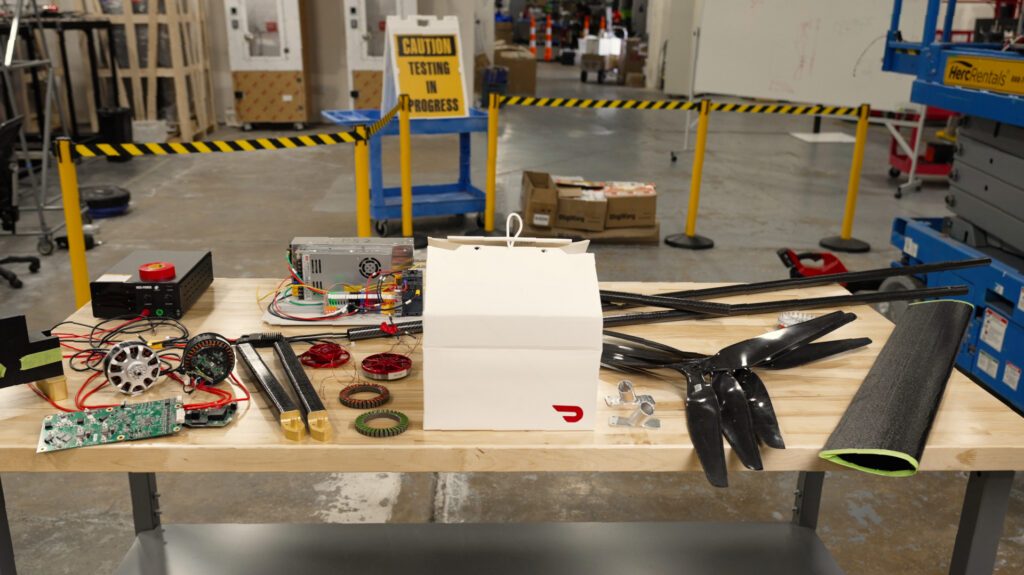
Still, the company is placing less emphasis on the aircraft than might be expected from a drone program announcement.
Instead, DoorDash repeatedly points to the systems surrounding the aircraft. Those include merchant handoffs, loading infrastructure, inventory management, dispatch, routing, safety systems, and customer orders.
“We want drone delivery to work for any merchant, anywhere. We’re building the full stack to make that possible from the ground infrastructure to the drone itself, and the handoff systems that make it work together seamlessly,” said Harrison Shih, Head of DoorDash Air. “Advances in hardware, compute, and AI are creating extraordinary new capabilities for local commerce, and becoming a certified air carrier accelerates everything we’re building.”
The message is clear: DoorDash does not view the drone as a standalone product. It sees the aircraft as one part of a larger delivery network.
The Harder Problem Is on the Ground
DoorDash says it has completed more than 10 billion lifetime deliveries across its network. That experience gives the company detailed information about how orders move through local markets.
In a post on X, cofounder Stanley Tang said more than 20% of DoorDash orders in 2025 traveled between three and five miles. Those orders took nearly 25% longer than shorter trips, largely because they required more time to match with the right driver.
DoorDash says drones can complete deliveries under five miles in an average of less than 25 minutes.
Some businesses involved in its partner drone pilots also saw DoorDash order volume rise by roughly 30%. The company said that increase continued during the nine weeks after launch.
These results help explain why DoorDash is investing directly in drone operations. Mid-range orders may be well suited for aircraft, while human drivers remain better suited for apartment buildings, large orders, and deliveries that require more complex handoffs.
The challenge is deciding which delivery method should handle each order.
One Network for Every Delivery Mode
DoorDash’s Autonomous Delivery Platform makes that decision in real time.
The system can assign an order to a Dasher, Dot, a drone, or an outside delivery partner. It considers the order, route, delivery conditions, and available transportation options.
DoorDash describes the platform as an operating layer for physical delivery. It connects customer demand, merchant systems, dispatch, and autonomous vehicles through the same network.
The company is also building tools such as SmartScale, which helps merchants confirm order accuracy and weight. That information can be especially important when deciding whether an order is suitable for drone delivery.
This orchestration layer may be DoorDash’s strongest advantage. A drone company can build an aircraft and flight operation. DoorDash already controls the marketplace where customers place orders and merchants receive them.
Its bet is that combining those systems will make drone delivery easier to scale.
An Approach That Echoes Amazon
DoorDash’s strategy has clear similarities to Amazon Prime Air.
Amazon has developed its own aircraft, received Part 135 certification, and integrated drone delivery into its broader logistics network. DoorDash is now taking a comparable approach within local commerce.
There are also important differences.
Amazon controls warehouses, inventory, fulfillment, and much of the delivery chain. DoorDash connects independent restaurants, retailers, drivers, technology providers, and customers.
That may make DoorDash’s operating challenge more complex. Its system must work across many types of merchants, locations, products, and delivery methods.
DoorDash is also not abandoning partnerships. Its autonomous delivery platform is designed to support both company-owned systems and outside providers.
Right now, DoorDash Air therefore appears to expand the company’s options rather than replace Wing, Flytrex, Manna, or other partners.
Vertical Integration Brings More Control and More Responsibility
Building an internal drone operation gives DoorDash more control over aircraft design, routing, merchant integration, and the customer experience.
It also creates significant new responsibilities.
As a Part 135 air carrier, DoorDash must maintain approved operating procedures, maintenance programs, safety systems, training, and regulatory compliance. It is no longer simply buying drone delivery services from another operator.
That makes DoorDash Air a larger and more difficult undertaking than a technology partnership.
The company is building what it calls the entire airline, not only the aircraft.
Drone Delivery Enters Its Next Phase
Recent expansion by Amazon, Wing, Flytrex, Zipline, and other operators shows that drone delivery is moving beyond limited demonstrations.
The central question is also changing.
For years, the industry focused on whether drones could deliver products safely and reliably. That work continues, but leading companies are now confronting another challenge: how to integrate aircraft into existing commerce and logistics networks.
That requires more than flight technology. It requires merchant infrastructure, order management, dispatch, routing, loading systems, customer support, and regulatory oversight.
DoorDash’s Part 135 certificate is an important achievement. Its decision to build its own aircraft and operate its own air carrier may be even more significant.
DoorDash is betting that the future of drone delivery will belong not only to companies that can fly aircraft, but also to those that can connect every part of the delivery system.
Read more:
- Flytrex and Nash Partner to Route Drone and Courier Deliveries Across Dallas-Fort Worth
- Zipline U.S. Expansion Adds Cleveland Clinic Home Delivery and Austin Launch
- Wing and Walmart Add Seven New Drone Delivery Markets

Miriam McNabb is the Editor-in-Chief of DRONELIFE and CEO of JobForDrones, a professional drone services marketplace, and a fascinated observer of the emerging drone industry and the regulatory environment for drones. Miriam has penned over 3,000 articles focused on the commercial drone space and is an international speaker and recognized figure in the industry. Miriam has a degree from the University of Chicago and over 20 years of experience in high tech sales and marketing for new technologies.
For drone industry consulting or writing, Email Miriam.
TWITTER:@spaldingbarker
Subscribe to DroneLife here.

Leave a Reply