
Texas-based company expands offshore cargo operations while preparing for the next phase of U.S. BVLOS regulations
By DRONELIFE Features Editor Jim Magill
While many drone service providers like to tout their latest innovations and brag on the abilities of their aircraft to handle a variety of missions, Austin-based Skyways Aviation has spent the better part of the last decade quietly developing the world’s largest unmanned aircraft fleet, providing heavy-duty drone delivery service to customers on three continents.
“Most of you probably have never even heard of us,” Bill Wimberley, Skyways’ chief commercial officer, told an audience of drone company employees and representatives of the energy, construction and software development industries, at the recent InnovateEnergy Week conference held in The Woodlands, Texas.
Wimberley said the company focuses largely on the international market for long-distance, heavy-duty autonomous drone deliveries to the maritime industry. The company’s premier aircraft is the V3, a long-range, autonomous vertical takeoff and landing (VTOL) vehicle with a range of over 1,000 miles. With 7 cubic feet of cargo space, the aircraft is capable of carrying payloads of up to 100 pounds.
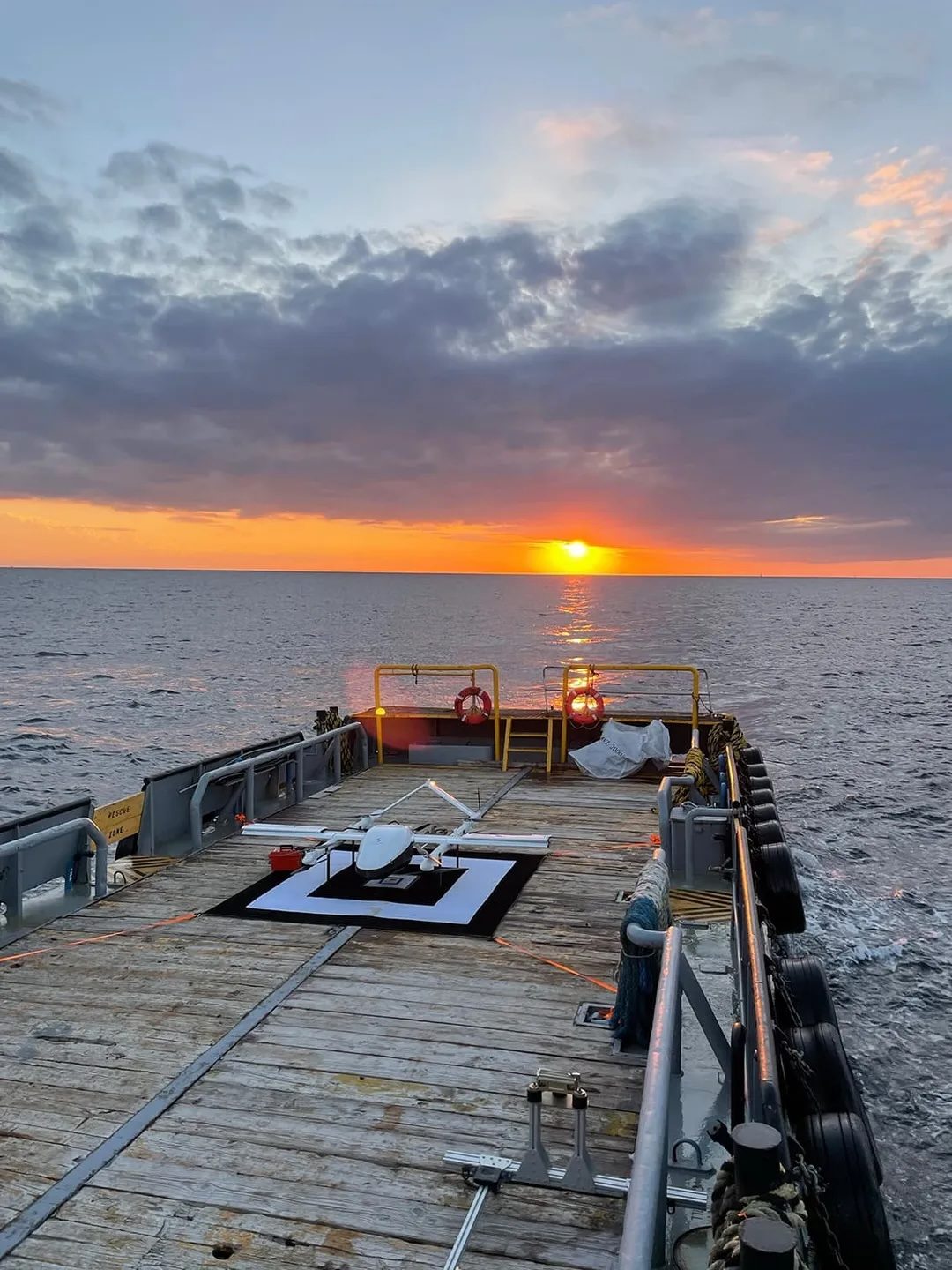
The dual-fuel UAS uses electric propulsion to provide vertical lift, and it has a jet-fuel engine to power its horizontal flight. “We have an electric generator on the back of that motor, and it can generate enough power to run any sensor that anybody in this room has, or probably any sensor ever made,” Wimberley said. “I can fly EO/IR [Electro-Optical/Infrared]. I can fly LiDAR.”
Yet, despite its impressive list of attributes, Wimberley was reluctant to spend too much time talking about the virtues of the V3. “A lot of people are putting emphasis on the actual aircraft and not so much on the customer’s needs. We completely reversed that when we built Skyways. Our approach is no one cares about the aircraft,” he said.
While much of the company’s business projects are concentrated on overseas markets, Wimberley said Skyways is currently developing a deal to provide cargo delivery and inspection services to customers with assets in the Gulf of Mexico. He said the company hopes to be able to release more information on that project in the next several months.
“I can’t really say a whole lot about it, or who our partners are. But I can just tell you that we’re working with some of the largest oil companies in the US, and we’re working with some of the largest oil companies in the world overseas,” he said.
Maintaining a low profile is part of Skyways’ DNA, established when CEO Charles Atkin started the company nine years ago. “He founded the company on the principle of solving problems and building aircraft that fit those problems. He also decided from the very beginning that he was not going to do any marketing whatsoever,” Wimberley said.
“Up until one year ago, we had no marketing people. We did no advertisement. We did no promotion,” he said. “Prior to that, we just quietly went about the work of building aircraft that would actually solve problems, and that would have an impact.”
Focus on international projects
In the pursuit of its international business strategy, Airways entered into a strategic partnership with Japan’s All Nippon Airways (ANA), the largest airline and the largest cargo carrier in the Pacific Rim. The American company operates out a hub in Okinawa, from which it flies cargo missions to the surrounding islands as well as to the military vessels at sea.
“We have a huge project that’s kicking off this summer with the Japanese Navy, which is really cool because I got to go to the base and meet some of the military leaders and talk about delivering critical cargo to not only ships, but also to submarines,” Wimberly said.
Skyways also has plans to begin conducting flights with Danish transport company DSV A/S, the world’s largest logistics company. All told, Skyways and its various partners soon will be flying offshore delivery missions in three to four different countries, he said.
Wimberley said the secret to his company’s success has been to operate with Integrity, honesty and transparency, and to never offer to perform a service for a prospective client that Skyways officials were not reasonably sure that they could deliver.
“The advanced air mobility space has already got a boneyard of companies that promised certain things and just never delivered them.” He said he and his colleagues recently met with one of Skyways’ most valued investors, who asked if the drone delivery company could perform a certain difficult-to-accomplish service.
“We said, ‘Actually, no, we can’t. We could probably attempt it, but we don’t think we’re the right company for that.’ Now, I think he appreciated that, and I don’t think that took the deal sideways,” Wimberley said.
He said the company would not take on a dubious project just to snag a deal with a client or to attract investors. “We would rather remain small and that’s been the case.”
Familiar with the regulatory landscape
Wimberley also said Skyways’ wealth of experience in dealing with different regulatory environments has prepared the company to be able to handle anticipated changes to U.S. drone regulations, particularly the approaching implement by the FAA of its much-anticipated BVLOS rule, Part 108.
“We’ll be able to do some things that I don’t know of another company in this particular space being able to do,” he said. For example, Skyways is getting ready to satisfy the new rule’s proposed requirements regarding the need for commercial drones to be equipped with detect-and-avoid technology.
“There are ways that you can de-conflict in 108 using an ADS-B in-and-out and some other layered capabilities. That’s going to open up some airspace for us that you can’t get into unless you know what you’re doing and you’ve got lots of flight hours with it.”
In addition, because most of the company’s work is focused on the offshore arena, Skyways largely doesn’t have to worry about the FAA’s prohibitions against flying over people, he said.
One of the company’s most significant goals involves developing the ability to comply with regulations that would allow the carrier to operate multiple aircraft using a single pilot.
“It’s important that we get to that final autonomous level. But that is not an easy thing to do, and it’s obviously not from a regulatory perspective,” he said.
Another goal is for Skyways to be able to fly its drones offshore beyond the 12-nautical-mile limit.
“I’m highly optimistic — my boss would say I’m too optimistic — that we will be able to fly in the high seas in the not-too-distant future.”
Read more:
- Skyways Secures $5 Million to Boost Production of Autonomous Cargo Drones
- Don’t Miss Skyways on the Drone Radio Show: Autonomous Cargo Drones
- Skyways Completes Historic Cargo Drone Flights for U.S. Military

Jim Magill is a Houston-based writer with almost a quarter-century of experience covering technical and economic developments in the oil and gas industry. After retiring in December 2019 as a senior editor with S&P Global Platts, Jim began writing about emerging technologies, such as artificial intelligence, robots and drones, and the ways in which they’re contributing to our society. In addition to DroneLife, Jim is a contributor to Forbes.com and his work has appeared in the Houston Chronicle, U.S. News & World Report, and Unmanned Systems, a publication of the Association for Unmanned Vehicle Systems International

Leave a Reply