
Utilities face challenges in establishing drone programs
By DRONELIFE Features Editor Jim Magill
While the owners of electric utility assets were some of the earliest adopters of drone technology, they are facing new challenges and opportunities – such as the expected adoption of new beyond visual line of sight (BVLOS) regulations and government pressures to adapt their drone fleets to eliminate the use of some foreign-made drones.
Speaking on the sidelines of the InnovateEnergy Week conference held this week in The Woodlands, Texas, two representatives of the electric power industry addressed some of the major issues they’ve encountered in developing a drone-based program that best serves the needs of their utility business at an economical cost.
In one of the major regulatory changes expected to be implemented soon, the FAA is currently going through the process of formulating the long-awaited Part 108 rule, to establish the comprehensive regulation designed to standardize BVLOS operations for commercial drone operations.
Jason Goodick, UAS manager for Entergy, said his company, a major electric utility company with generation, transmission and distribution businesses, has already mapped out how it expects to react to the implementation of Part 108. He said that the regulations allowing extended BVLOS flights would have a limited positive effect on Entergy in one of its principle uses of UAVs, inspecting long-distance power lines and other assets in the wake of a tropical storm or other disaster.
“BVLOS doesn’t help us because of the problem with the data management,” he said. “We’re taking so much imagery.”
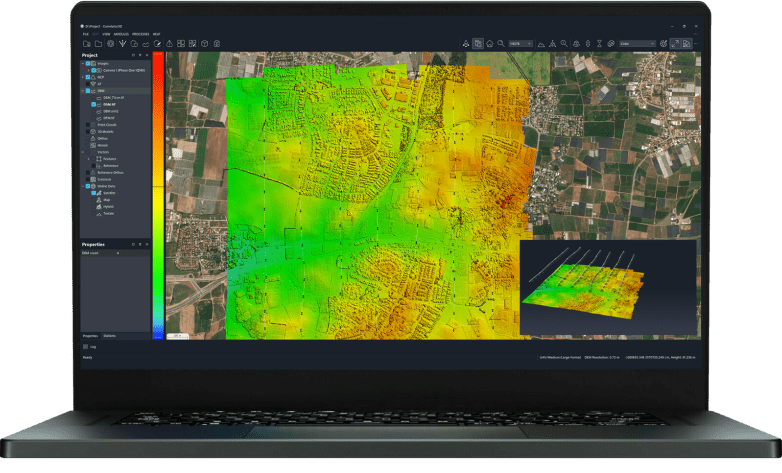
Because of the large volumes of data captured by the inspection drone – a flight of 20 miles can yield a terabyte of information – processing and reviewing that stream of data takes a lot of time, time that might not be available if the aim is to bring power back on line quickly following a storm.
“Somebody now has to go back and look at this terabyte of data, and then review it, and then say, ‘Okay at this location, we have damage,’ and send that report back,” he said.
Instead, in a storm-recovery situation, Entergy typically deploys inspection flights of shorter distances, of two to three miles. “Flying in the shorter ranges, BVLOS or not in BVLOS, during a storm application actually saves time and money because we’re not delaying or having to call people back out and have someone go out and redo any of that damage restoration work,” Goodick said.
Entergy has about 100 trained UAS pilots, on whom it relies to do most of its line-inspection work. Goodick said this system of in-house inspections produces much better results than relying on the services of third-party drone contractors, as is the case with some other utility companies.
“It’s much more efficient. We’re able to minimize our cost because if we’re doing internal employee work, we’re not getting charged an uptick fee for having a contractor come out and do storm-damage assessment,” he said. “We’re already paying these guys.”
Southern Company maintains large UAS operations
Like Goodick, Tim Hadaway, UAS operations lead for Southern Company, said his company also relies on its own employees to handle its drone-related tasks. He said the utility company, which serves about 9 million electric and natural gas customers across a broad swath of the country, employs about 190 UAV pilots.
“As full-time employees, they are actually an invested part of the company,” he said. “Every project we go on, it’s a very family atmosphere. “Everybody is concerned and cares about every project that we do. In my experience, contractors have not shown the same care or diligence to do the job correctly.”
Southern Company flies commercial enterprise drones. Hadaway said that in the past, the company had flown DJI drones, but is moving away from DJI, largely because of the federal regulatory concerns surrounding the Chinese-made UAVs.
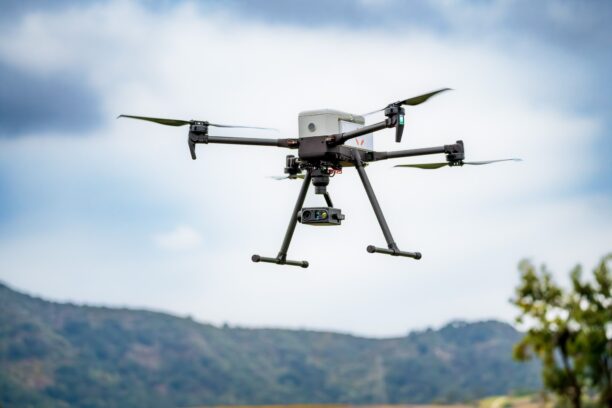
“Currently, we are flying the Skydio X10s, both in our manual operations and dock operations. And we also are flying the Alta X,” he said. The company also deploys two SwissDrones, long-range, heavy-lift unmanned VTOL helicopter-like UAVs, which it uses for LiDAR collection missions.
Hadaway said one of the biggest challenges his company faces in conducting post-storm inspections is the acquisition of airspace over disaster areas.
Typically, in the aftermath of a major storm or other disaster, the FAA will post temporary flight restriction (TFR) over the impacted area. He said the company usually has to file a Certificate of Authorization (COA) in order to be allowed to fly within the TFR to assess the damage to its infrastructure.
Another challenge the company faces in the aftermath of a disaster is reaching remote rural areas inaccessible by roads. One benefit for Southern of flying Skydio vehicles, is the company has secured a broad BVLOS waiver that allows it to fly its X10 aircraft over any of its infrastructure nationwide.
“If I’m in South Georgia, I can fly that thing two-and-a-half miles out and maintain a signal. If I’m in Atlanta or in the mountains of North Georgia, the trees and the mountainous terrain is not going to allow me to fly that far out, but I can still fly beyond visual line of sight with that drone,” Hadaway said.
Entergy also transitioning away from DJI
Like Southern Company, Entergy also is in the process of transitioning away from the use of DJI drones, Goodick said.
“We’re still using DJI equipment, but we’re working towards finding that right replacement for our utility,” he said. “I know a lot of other utilities have moved on from DJI but we’re continuing with DJI right now to keep the cost low.”
He cited the ease of use of DJI’s drones, “and their optics are probably the best out on the market right now.”
Goodick said he is not concerned that the use of DJI products represents a cybersecurity threat for Entergy.
“We’ve air-gapped all of our systems to where our DJI equipment doesn’t touch any of our network infrastructure. Any of the imagery that we collect from the drone, we’re running it through another system that checks it for viruses or any kind of malware or anything being attached to the SD card or imagery,” he said.
He added that DJI had also made some changes on the company’s own cybersecurity systems to ensure that users are able to isolate those products from the American communication system, in an unsuccessful attempt to avoid what occurred last year when the Federal Communications Commission put DJI on its banned list for new products.
“But we haven’t had any issues in the past, and we don’t foresee any issues now as we try to transition away from those products,” Goodick said.
Read more:
- AirData Marks Energy and Utility Growth Milestone as BVLOS Rule Nears
- Commercial Drone Alliance BVLOS Summit Highlights Key Issues for Part 108 Rulemaking
- 10 Initial Takeaways from the FAA’s BVLOS Drone NPRM: What Operators Need to Know

Jim Magill is a Houston-based writer with almost a quarter-century of experience covering technical and economic developments in the oil and gas industry. After retiring in December 2019 as a senior editor with S&P Global Platts, Jim began writing about emerging technologies, such as artificial intelligence, robots and drones, and the ways in which they’re contributing to our society. In addition to DroneLife, Jim is a contributor to Forbes.com and his work has appeared in the Houston Chronicle, U.S. News & World Report, and Unmanned Systems, a publication of the Association for Unmanned Vehicle Systems International
Jim
Could you expand your comment about the utility company having a “broad waiver” from the FAA for BVLOS flights?
Thank you Sir