
MODUS and IRON WAVE aim to help military forces counter drone threats and deploy robotic systems ahead of frontline troop
Ondas Holdings has unveiled two new autonomous defense systems designed to address some of the most significant challenges facing modern military forces: the rapid growth of drone threats and the increasing use of robotic systems on the battlefield.
The company introduced the systems, called MODUS and IRON WAVE, ahead of the Eurosatory defense exhibition in Paris. According to Ondas, both platforms use artificial intelligence to help military units detect threats, coordinate responses, and operate more effectively in complex combat environments.
Responding to New Battlefield Threats
Recent conflicts have highlighted the growing impact of first-person-view (FPV) drones, drone swarms, and other low-cost autonomous systems. These technologies can challenge traditional air defense systems and create new risks for ground forces.
Ondas says its new platforms are designed to help military units respond more quickly by combining sensing, decision-making, and autonomous operations into integrated systems. The company describes the approach as moving away from stand-alone technologies toward connected combat ecosystems that can adapt to changing threats.
MODUS Focuses on Counter-Drone Protection
The first system, MODUS, is a mobile counter-UAS platform intended to protect maneuver forces operating in contested environments.

According to Ondas, the system combines multiple technologies into a single platform. These include radar, electro-optical sensors, cyber detection capabilities, GNSS disruption tools, autonomous interceptors, and other counter-drone effectors. The goal is to create a sensor-to-shooter system that can detect and respond to threats with minimal operator workload.
The platform is specifically designed to address emerging threats such as fiber-optic-guided drones, which cannot be defeated through traditional radio-frequency jamming methods. Ondas says MODUS uses real-time sensor fusion to continuously assess the threat environment and coordinate the most appropriate response.
The system is also designed to move alongside military units, providing protection in environments where GPS signals may be unavailable or communications are heavily contested.
IRON WAVE Brings Robots Forward
The second system, IRON WAVE, is a robotic combat support suite built around what Ondas calls a “Bots Before Boots” concept.
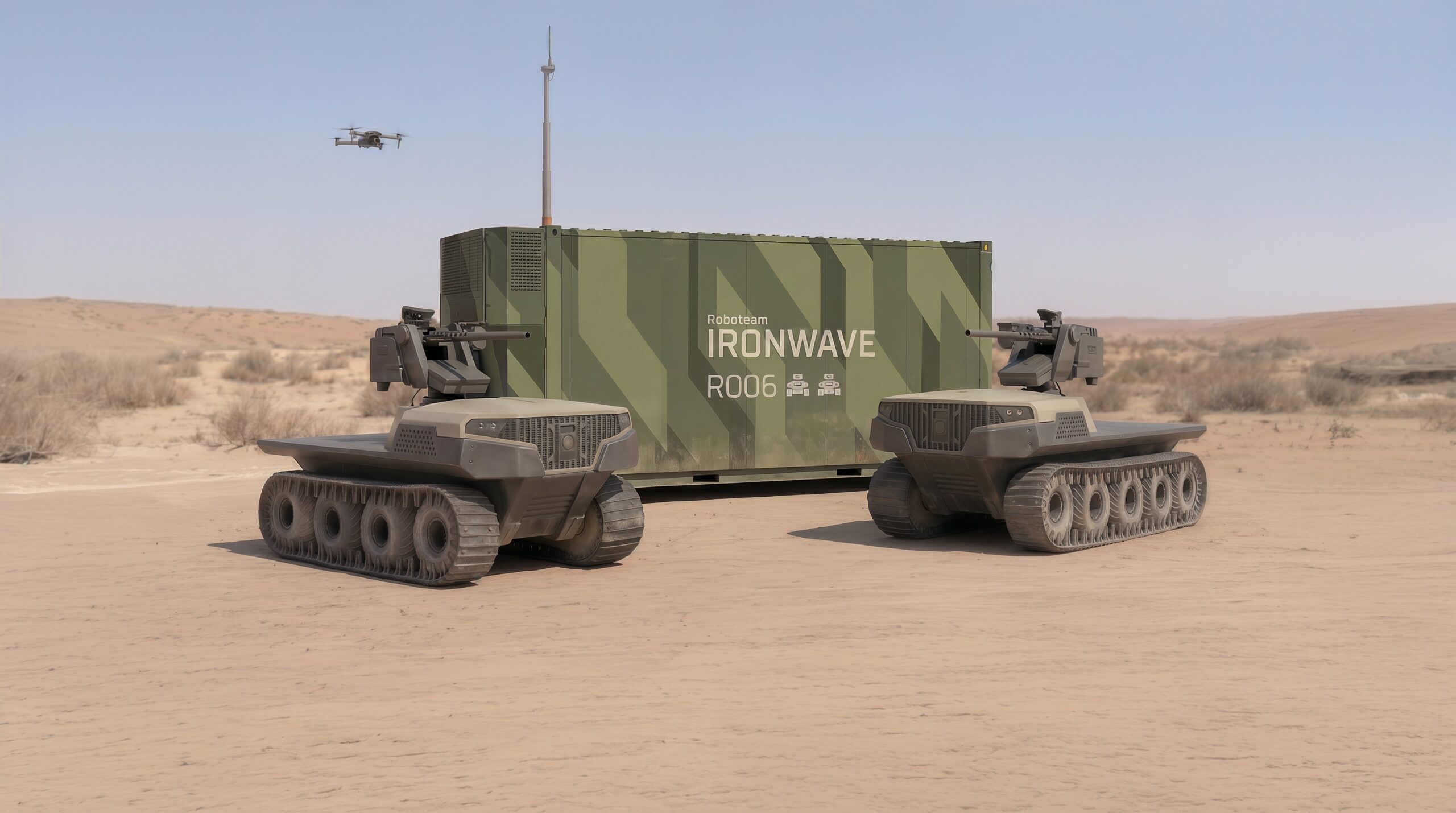
Rather than sending personnel into high-risk areas first, the system allows robotic platforms to conduct reconnaissance, identify threats, and support missions before exposing troops to danger.
The suite includes robotic combat vehicles, operator control stations, mission-control infrastructure, and a deployable command unit. Ondas says small teams can use AI-assisted coordination tools to control multiple robotic systems at the same time.
Potential missions include route clearance, explosive ordnance disposal, reconnaissance, logistics support, and forward operational missions. The company says the system is already undergoing operational evaluation.
Accelerating Deployment Cycles
A key theme behind both systems is speed. Military organizations increasingly face threats that evolve faster than traditional acquisition and deployment cycles.
“Operational environments are changing faster than traditional deployment cycles can support,” said Eric Brock, CEO of Ondas. “Military forces require autonomous systems that can be rapidly integrated, adapted to evolving threats, and deployed directly into frontline operations. Our focus is on accelerating the transition from operational requirements to deployable battlefield capabilities.”
The announcement reflects a broader trend across the defense sector. Military organizations worldwide are investing in autonomous systems that can be fielded quickly and updated frequently in response to lessons learned from active conflicts. Counter-drone technologies and robotic ground systems have become particularly important as armed forces seek ways to reduce risk to personnel while maintaining operational effectiveness.
Read more:
- Defense Leaders Call for Faster Paths from Innovation to the Field
- Palantir, Ondas, and World View Partner on Multi-Domain ISR Integration
- Ondas Unveils Integrated C-UAS System at Singapore Airshow

Miriam McNabb is the Editor-in-Chief of DRONELIFE and CEO of JobForDrones, a professional drone services marketplace, and a fascinated observer of the emerging drone industry and the regulatory environment for drones. Miriam has penned over 3,000 articles focused on the commercial drone space and is an international speaker and recognized figure in the industry. Miriam has a degree from the University of Chicago and over 20 years of experience in high tech sales and marketing for new technologies.
For drone industry consulting or writing, Email Miriam.
TWITTER:@spaldingbarker
Subscribe to DroneLife here.


Leave a Reply