
Commercial drones have evolved far beyond their origins as simple flying cameras. Today, real performance is defined not by flight time or range, but by the intelligence, precision, and efficiency of the payloads they carry. In this guest post, Vladimir Spinko explains how payload capabilities define ROI. DRONELIFE does not accept or make payment for guest posts.
Beyond Flight: How Drone Payload Capabilities Define Real-World Value and Efficiency
I’m Vladimir Spinko, founder of Aery Bizkaia, a deep-tech startup developing AI-powered radar and sensor systems for drone-based surveying and humanitarian mine action. As an MIPT graduate and former COO at Aeroxo, I’ve spent years exploring what truly defines a drone’s value – and why “flight” alone no longer determines performance.
Ten to fifteen years ago, commercial quadcopters like the DJI Phantom turned the word drone into a synonym for an aerial camera. But from an engineering perspective, that definition is now obsolete. A “flying camera” lacks autonomy, mission logic, and system integration – it simply captures images under remote control. In contrast, modern drones are defined by what they do rather than how they fly: their payload capabilities, onboard intelligence, and data-processing efficiency.
From power and weight optimization to sensor calibration, signal processing, and AI-assisted interpretation, payload design now dictates mission efficiency and operational value. The aircraft itself is merely a vector – the payload defines the mission.
Why real drone performance should be measured not by flight time, but by data efficiency
Flight time is a poor indicator of real capability. Endurance figures are usually measured under ideal conditions (no wind, mild temperature, low humidity) while in practice even the best drones often deliver half of their claimed airtime. Experimental hydrogen systems may stay aloft for hours, but commercial multicopters rarely exceed 40 minutes, and electric fixed-wing UAVs typically remain airborne for several hours. Gasoline-powered fixed wings can achieve much longer endurance, up to 10–12 hours, though at the cost of increased noise compared to electric systems. Environmental factors make these numbers even less reliable.
What truly matters is how efficiently a drone collects and processes data. Modern UAVs are essentially platforms whose value depends on payloads – cameras, radars, magnetometers, lidars, and onboard AI modules that handle data in real time. Payload performance defines mission efficiency in mapping, agriculture, or geophysical surveys.
From a business standpoint, this translates into cost-effectiveness: a drone is valuable only if it delivers better results at lower cost than traditional methods. The same applies in science or industry, endurance means little if the data isn’t accurate, timely, and actionable.
Ultimately, flight time and platform specs are secondary. The payload and how effectively it supports mission goals determines real-world performance and economic value. While many modern drones are built first and equipped with payloads later, the most effective approach is to design the platform around the specific payload to maximize overall performance.
Why challenging missions make drones economically viable
A drone’s value depends on context. For simple tasks, cheaper and more efficient alternatives usually exist. Early projects like Kaluga’s pre-COVID drone traffic monitoring quickly showed that fixed camera networks outperform aerial systems in cost, simplicity, and reliability. Limited flight time further restricts drones from continuous operations such as 24/7 surveillance.
In contrast, complex missions reveal their true potential. Large-scale geological surveys or mineral exploration demand precision and coverage that drones can deliver more efficiently than manned teams. The high cost of specialized payloads, such as suspended magnetometers, is justified by the scale of data and potential financial returns.
In essence, the harder the mission, technically or economically, the more valuable drones become. Routine, low-risk applications are best handled by existing infrastructure; challenging operations are where drones truly pay off.
Environmental and economic limits on intelligent drone payloads
Geological exploration remains one of the most promising drone applications. It demands large-scale, high-value monitoring that rivals satellites but offers better resolution and responsiveness at lower cost.
Agriculture, by contrast, is fragmented: small farms in Europe or the U.S. rarely justify the expense of advanced drone systems, while large agri-holdings can. In exploration, major oil and mining companies can absorb million-dollar pilots, if the system works, cost is secondary.
Environmental factors also constrain performance. Cold temperatures reduce battery capacity and flight time, while fuel engines are more reliable but costly. Mass-produced components often fail to meet lifespan claims, whereas high-reliability, aviation-grade parts are expensive. Balancing durability, efficiency, and cost remains the key challenge – but one that pays off when systems perform as intended.
Heat and the new frontiers of drone autonomy
Heat poses challenges similar to cold. Both batteries and combustion engines lose efficiency, while cooling systems add weight and reduce payload capacity. Each extra kilogram for thermal management cuts mission efficiency, making extreme climates difficult for UAVs.
Drones perform best in mild conditions – around +15–20 °C and light winds – yet these areas are already well-mapped. The biggest opportunities lie in remote, underexplored regions such as northern Canada, Latin America’s jungles, or mountainous areas, where valuable resources remain untapped. But these same regions bring heavy rain, heat, cold, and high-altitude conditions, where lower air pressure reduces rotor efficiency, forcing a trade-off between economic potential and technical feasibility.
Modern unmanned systems are evolving along two key axes: flight autonomy and analytical autonomy. The first covers navigation, obstacle avoidance, and energy management. The second – data interpretation, target recognition, and mission-level decision-making. Early drones could fly autonomously but were “analytically blind,” collecting data without understanding it. While relying on payload data for navigation or autonomy is still not ideal, a platform designed around a specific payload can benefit from integrating its data – for example, using radar inputs to support navigation systems. However, this approach requires real-time onboard processing of raw payload data and therefore demands highly capable onboard computing power.
This changed with compact sensors and onboard AI accelerators like NVIDIA Jetson, Hailo, or FPGA-based logic. Smaller, lighter payloads now enable real-time onboard analysis, reducing reliance on post-processing. The lighter the electronics, the more capacity remains for batteries – extending flight time.
Analytical autonomy is mission-dependent: mapping or agriculture may not need real-time insights, but swarms or demining operations do. The faster drones process local data, the more coherent and efficient the swarm becomes – crucial when every second counts.
Meanwhile, open-source hardware and DIY development have accelerated innovation, despite some security concerns. Community-driven experimentation helped turn early prototypes into today’s functional FPV and autonomous systems.
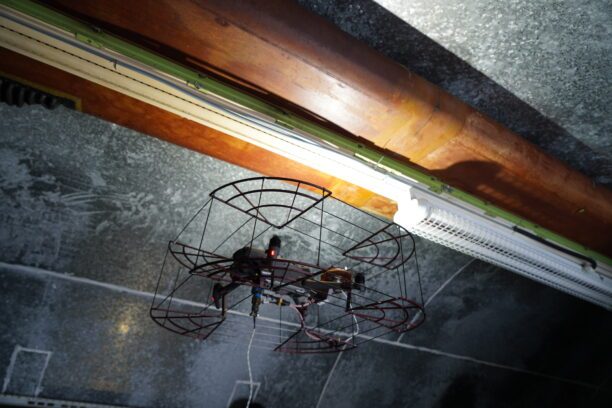
Miniaturization and AI have transformed autonomy itself: from simple navigation to situational judgment. In practical terms, compact drones are now used even in controlled environments like warehouses, where they navigate aisles and scan goods to maintain real-time inventory accuracy.
From building airframes to building systems: where true innovation happens
Assembling a drone and creating a reliable system are two entirely different challenges. Anyone can build a frame with motors and a flight controller, but making that system work consistently across environments and hundreds of flight hours – that’s a different level.
The visible parts, airframe, propulsion, aerodynamics, are only the surface. The real complexity lies in what CAD models don’t show: sensor timing drift, electrical noise, vibration, interference, or calibration errors that appear only after long field use. The real technological value lies not in hardware, but in system architecture, algorithmic stability, and calibration precision.
While technology has advanced rapidly, regulation still limits growth. Authorities like EASA and the FAA prioritize safety, and rightly so. Several years ago, an experimental agricultural drone went off course and flew several dozen kilometers before finally losing connection. “It was pure luck it didn’t pass over a settlement – that’s exactly why certification rules exist,” one engineer recalls.
Even research faces restrictions. “In some European countries, high-frequency experiments come with heavy regulatory requirements,” he says. “Companies need to go through tons of paperwork or even rent testing ranges abroad just to operate legally.” Bureaucracy slows innovation but keeps it controlled.
Despite this, the drone market is moving toward standardization. Strip the payload, and most drones are identical and real performance now depends on payloads and data intelligence.
Manufacturers compete through integration and analytics. For example, Canadian company Gem Systems optimized magnetometer payloads for geological surveys. They didn’t just build the sensors, they built the system around them. Mounting a magnetometer on a drone is a “complex” application: the drone has to be selected and configured carefully, because motors and electronics can interfere with the readings, so the sensors are often carried on a 5-20 m tether. Similar setups are being explored in humanitarian demining operations, where drones could help detect buried explosives. That’s real innovation.
Differentiation no longer comes from flight time or materials, but from how intelligently a drone can sense, process, and interpret the world. Hardware parity is already here, the real competition is in software, algorithms, and data integration.
Specialization drives modern drone performance
Developing advanced analytical systems requires skills beyond aerodynamics and hardware integration. Most drone manufacturers collaborate with specialized partners to design AI models, sensor calibration, and real-time data fusion, integrating solutions early to deliver practical results.
Industry trends favor specialization over universality. In agriculture, precision algorithms optimize fertilization and irrigation. In geological exploration, ultra-sensitive magnetometers detect subtle anomalies. In infrastructure monitoring, sensors identify microfractures with millimeter precision.
For customers, universality has little value. What matters is solving specific problems efficiently. As one expert put it, “You may be solving world hunger, that’s great, but I’m paying you to solve my problem.” The modern drone economy is driven not by spectacle, but by measurable value, operational efficiency, and direct applicability.
 Vladimir Spinko is founder of the deep-tech startup Aery Bizkaia, where he leads the development of AI-powered radar and sensor systems for drone-based surveying and humanitarian mine-action. A graduate of Moscow Institute of Physics and Technology (MIPT) and former COO of Aeroxo, Vladimir brings over a decade of experience in robotics, cleantech, space/aviation and venture capital to the intersection of unmanned systems and high-value payload innovation.
Read more:
- Gremsy Adds New NDAA Payloads with FLIR Thermal Technology
- Seven-Hour Flights and 100-Pound Payloads: Draganfly’s Drones Join the Border Fight [DRONELIFE Exlusive Interview]
- Windracers Introduces ULTRA MK2 Cargo UAV: More Power, Payload, and Efficiency

Miriam McNabb is the Editor-in-Chief of DRONELIFE and CEO of JobForDrones, a professional drone services marketplace, and a fascinated observer of the emerging drone industry and the regulatory environment for drones. Miriam has penned over 3,000 articles focused on the commercial drone space and is an international speaker and recognized figure in the industry. Miriam has a degree from the University of Chicago and over 20 years of experience in high tech sales and marketing for new technologies.
For drone industry consulting or writing, Email Miriam.
TWITTER:@spaldingbarker
Subscribe to DroneLife here.

Leave a Reply