
Guest post by Drone Industry Insights —
To push the boundaries of drone flight performance, batteries must become smaller and lighter. It appears that we reached a certain limit when it comes to power density. Lithium-Polymer (Li-Po) and Lithium-Ion (Li-ion) batteries have become very small and affordable, mainly driven by the mobile phone industry. This led to a wide adoption and today it is fair to say that the great majority of commercial unmanned aerial vehicles uses batteries as a power source (~96%).
Simply adding more batteries to the system will not create the flight times and payload capacities you are looking for. Now what? Given the current status of specific energies, there are some things to consider in order to achieve higher payloads and longer flight times:
The mass-specific energy (how much power [Wh] per unit mass [kg]) and the volumetric specific energy (how much power [Wh] per unit volume [l]).
Reducing this to the energy source alone would be wrong since the whole system (energy source + propulsion system) has an influence on flight performance. A source with an extremely high energy density (e.g. Kerosene or H2) will not help if the propulsion system (e.g. turbine or fuel cell) is extremely heavy and outweighs the savings.
The efficiency factors of the propulsion systems are very different too: While a battery powered system transforms 73% of the provided energy into movement, a fuel-cell provides 44% and a combustion engine only 39%.
Another factor influencing the decision for an energy source is the intended mission. Is the drone supposed to fly very long distances or carry high payloads? Is the drone going to fly in a limited radius or far away and above the clouds? These questions have a strong influence on the energy-source decision since they allow very different scenarios of operation.
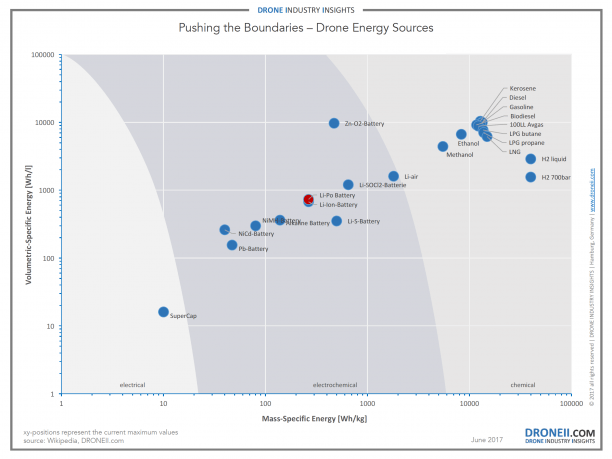
Taking the propulsion system, the mission and the need to increase the energy density into account brings us back to the sources. The graph below shows the specific energy densities per source on a double logarithmic scale:
Batteries
Yes, batteries again. The good thing about batteries is the infrastructure – they can be charged anywhere, in most cases can be transported without limitations, nothing can be spilled or inflamed, and ‘re-fueling’ is done easily by exchanging the battery blocks.
Li-Po and Li-Ion are the most common sources for drones but it does not mean that the journey ends here. Lithium-Thionyl-chloride batteries (Li-SOCl2) promise a 2 times higher energy density per kg compared to Li-Po batteries, Lithium-Air-batteries (Li-air) promise to be almost 7 times higher. However, they are not widely available and they come with a certain price tag. Lithium-Sulfur-batteries (Li-S) may succeed Li-ion cells because of their higher energy density (factor 1,8) and reduced costs from the use of sulfur.
Hydrogen fuel-cells
Fuel-cells are fascinating: No direct pollution, no sound and they are powered by an extremely powerful source: H2. Comparing liquid H2 with the energy density [Wh/kg] of a Li-Po-battery, there lies a factor 150 between them! This alone is reason enough to bring hydrogen-fuels UAV to the market.
One company looking to take advantage of these opportunities is Protonex, a subsidiary of Burnaby-based fuel cell developer Ballard Power Systems. They recently delivered their proton exchange membrane (PEM) fuel cells to Insitu, a subsidiary of U.S. aerospace giant Boeing that produces military- and industrial-grade, long-endurance, fixed-wing drones, i.e. the “Phantom Eye” or “ScanEagle”.
H3 dynamics and HES Energy Systems which is a cooperation between ST Aerospace, DSO, HES Energy Systems and FSTD Singapore has resulted in a breakthrough in solid-hydrogen on demand powered systems. H3 Dynamics, a developer of robotics technologies, has therefore announced the release of “Hywings”, a hand-launchable fixed-wing UAV capable of 10-hour flight durations and distances of up to 500km.
Hycopter by Horizon Unmanned System reaches four hours of flight without a payload and 2.5 hours of flight time with a 2-pound payload. This drone makes use of its “hollow” structure to store energy in the form of hydrogen instead of air, eliminating energy storage weight.
MicroMulticopter Aero Technology, Co. Ltd. (MMC) is commercializing Hydrogen fuel-cells for drones, called the “H-1 Fuel Cell”. In addition, the “HyDrone 1550” is the world’s first hydrogen-powered drone designed and manufactured by MMC.
Korean Hylium Industries, Inc. is developing drones with a 4 hours flight time; Montreal-based EnergyOr “H2Quad-1000” reaches 2 hours flight endurance with 1 kg payload.
Intelligent Energy is also selling fuel-cell powered drones and claims: “Intelligent Energy’s air-cooled fuel cell systems run on hydrogen and ambient air to produce clean DC power in a simple, cost-effective, robust and lightweight package. They have a higher energy to mass ratio than battery-based systems and can be refueled in a few minutes.”
Metro skyways Ltd, a subsidiary of Urban Aeronautics announced in April 2017 that the company is developing a four passengers hydrogen-powered VTOL flying car, the “CityHawk”.
Petrol, Kerosene, Methanol, Ethanol, LPG Propane
There are many well established petrol-powered solutions available – some of them with a remarkable flight performance. UAV Factory’s “Penguin C” fixed-wing can fly more than 20 hours with one full tank of gasoline, Siebel’s “CAMCOPTER S-100”, 6 hours.
The beauty of this energy source lies within the combination of high mass-specific energy [Wh/kg] and high volumetric-specific energy [Wh/l]. Compared to Li-Po batteries, gasoline multiplies 48x in mass-density and 13x in volumetric density. Combustion engines, in addition, are robust, small, light-weight and have a good specific fuel consumption.
Another advantage when it comes to endurance is, that gasoline-powered UAVs lose weight over time making the platform lighter and therewith increase the range.
Gas-Electric Hybrids
Great examples are hybrid gas-electric engines from Pegasus Aeronautics based in Waterloo, Ontario or YEAIR from Berlin, Germany. Both combine the quick reactions of an electric motor with the advantages of gasoline powered flight.
Solar Power
Solar cells have increased their efficiency over the last years from 10% to almost 46% and reach a power ratio of around 175W/m2. To power a drone exclusively with solar a large surface – like the upper side of a wing – is required. They can, however, work very well as range-extenders for multirotor drones as well.
Silicon Valley tech companies are exploring the potential of solar-powered drones: Facebook is making progress with its “Aquila” HALE-UAV (High Altitude, Long Endurance) to bring Wifi to rural areas, and Google X gave solar a shot with its now-defunct Titan.
“Zephyr” by Airbus is a High Altitude Pseudo-Satellite (HAPS) that fills a capability gap between satellites and UAVs. It runs exclusively on solar power and flies above the weather and commercial air traffic, as it reaches a cruising level of up to 70,000 feet. Boeing’s “Solar Eagle” was canceled in 2012.
OpenRobotix Labs is developing a Mars aerial rover – they also built the “XSOL-E1”, a solar powered quadcopter. A company spokesperson outlined that flight time “depends on a lot of factors, but generally, we can extend a 15 min flight up to 40 to 45 minutes using the solar assist technology.”
Solar Hybrids
Solar Hybrids (solar + battery) reach astonishing endurances. Alta Devices and PowerOasis have announced they are “partnering to develop the world’s first reference design for integrated solar and Li-ion battery power systems for small UAVs”. The reference architecture will target 2-4 meter (6.5-13 feet) span UAVs, using 5s-7s Li-ion batteries. The release date for the design is late 2017.
Tethered
Tethered systems allow ‘unlimited’ flight time in a small radius – perfect for surveillance and reconnaissance. The “T1” tether system by MMC can support most drones, such as MMC “TDrone 1200”, DJI “Matrice 600”, DJI “S1000”, Yuneec “Typhoon H”, Intel “Falcon 8+”, Microdrones “md4-1000”, and many more. There are similar projects from Bluevigil, Elistair, Drone Aviation Corp and SPH Engineering.
Super/Ultra-Capacitors
Will graphene bring SuperCaps to new heights? In February 2015 General Electrics was sponsoring research work on supercapacitors. Primary energy sources such as internal combustion engines, fuel-cells and batteries work well as a continuous source of low power, but cannot efficiently handle peak power demands or recapture energy because they discharge and recharge slowly. Supercapacitors deliver quick bursts of energy during peak power demands and then quickly store energy and capture excess power that would otherwise be lost.
It seems that the capacitors are far behind the batteries in energy density but they appear to be a great vehicle to enhance agile gas-electric hybrid configurations.
Laser
Laser Motive has developed the UAV power-link technology, which power-beams drones equipped with a laser receiver. In 2012 “Lockheed Martin, with the assistance of Laser Motive, demonstrated its “Stalker” drone flying for a continuous 48 hours using a laser-based charging system.” Tom Koonce, Stalker program manager, said: “A ground-to-air recharging system like this allows us to provide practically unlimited flight endurance to extend and expand the mission profiles that the Stalker vehicle can fulfill.”
Germany-based Ascending Technologies together with Laser Motive proofed the efficiency this technology back in 2010 on a small quadcopter drone with a 12 hours’ flight.
Bottom line
All drone energy sources have their individual advantages making the usefulness mission specific. Hybrid solutions (source and propulsion system) are in line with the transition towards cleaner energies. Today it seems to be a wise choice to take the best of two worlds since hybrids allow to equalize drawbacks from a single technology. Furthermore, it might be a smart move to see where other industries are heading (e.g. automotive), since these are good multipliers when it comes to future cost reduction due to mass production and availability of infrastructure.

Frank Schroth is editor in chief of DroneLife, the authoritative source for news and analysis on the drone industry: it’s people, products, trends, and events.
Email Frank
TWITTER:@fschroth


Leave a Reply