
 This article published in collaboration with JUIDA, the Japan UAS Industrial Development Association.
Shinshu University and Chiba University researchers kept a silkworm moth antenna sensor above 92% of its initial signal after seven hours. They also showed a small drone moving forward when the antenna detected an odor.
A research group from Shinshu University and Chiba University has developed a water-retaining hydrogel electrode that keeps insect antennae working longer as odor sensors. The team was led by associate professor Daigo Terutsuki of Shinshu University and associate professor Toshiyuki Nakata of Chiba University. The work addresses a key weakness of biohybrid odor sensors: once cut from the insect, an antenna dries out over time, and its electrical contact becomes unstable. The results appeared in the journal Sensors and Actuators B: Chemical on July 2, 2026, and Chiba University issued its release on July 16.
Insect antennae respond to odor molecules with high sensitivity and speed. However, when mounted on a mobile robot such as a drone, the antenna ends and conductive gel dry out, which degrades the signal.
How the hydrogel electrode works
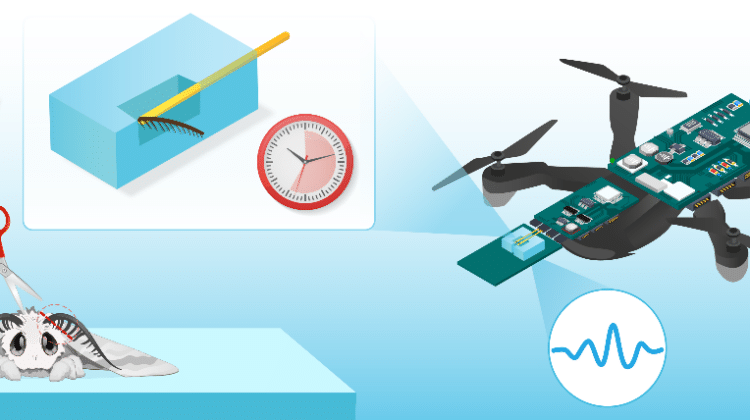
The new electrode combines four parts: a water-retaining hydrogel made from a food gelling agent, a conductive gel, gold-plated electrodes and a 3D-printed frame. The conductive gel and gold-plated electrodes carry the electrical connection. Meanwhile, the hydrogel supports the junction between the antenna ends and the conductive gel and keeps it moist. As a result, the design limits signal loss from drying and contact shifts.
The team tested the electrode in an electroantennogram (EAG) sensor using a silkworm moth antenna, which produces a voltage change when it detects an odor. Under indoor, room-temperature conditions, the sensor held more than 92% of its initial response seven hours after the antenna was excised. By comparison, a conventional metal electrode fell below 50% of its initial value after four hours. Electrochemical impedance measurements also showed that the hydrogel keeps the initial electrical coupling between electrode and conductive gel intact and limits impedance changes over time.
Odor-tracking drone demonstration
The researchers then mounted the EAG sensor on a small drone. During hover, the sensor still picked up odor signals, and the team used those signals to trigger the drone to move forward in a simple closed-loop test.
The group has previously worked to improve the search performance of odor-tracking drones that use insect antennae as sensors. While that earlier research improved how well the drones search, this work extends how long the antenna sensor stays usable. In the future, the team expects applications in search for disaster victims, gas leak detection and environmental monitoring.
Graduate student Rena Omori of the Shinshu University Graduate School of Science and Technology led the study with fellow Shinshu student researchers. They worked with associate professor Yosuke Kageshima of the Shinshu University Faculty of Engineering.
More information is available at Chiba University.
Read More
-
Sumitomo Forestry and Mazex Expand Forestry Cargo Drones With Lower-Cost Karusuke Series
-
Robot Dogs and Drones? Asylon Robotics Guards Critical Infrastructure
-
Proposed “Ban Flock Act” Targets License Plate Readers, Including Drone-Based Systems

Ian McNabb is a journalist focusing on drone technology and lifestyle content at Dronelife. He is based between Boston and NH and, when not writing, enjoys hiking and Boston area sports.


Leave a Reply