
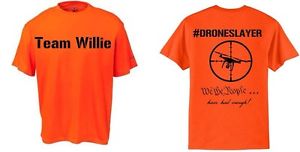
 The story of the self-proclaimed “drone slayer” is one of those North American embarrassments over which the rest of the world shakes their collective head. William Merideth, the Kentucky man who shot down a drone flying over his property, says he’d “do it again, with a smile.” This is Merideth’s 15 minutes of fame, and he’s making the most of it: selling drone slayer t-shirts, bragging about threatening the drone operators with his Glock, and reveling in his vindication by a local judge, who ruled that “he had a right to shoot this drone.”
Other states have tended to frown on using guns to shoot down hobby drones: in similar situations in California and New Jersey, the shooters were arrested. Not in Kentucky. When the case came to court, the judge refused to take any punitive action against Mr. Merideth, indicating that his privacy had been violated and his property threatened by the drone. While drone owners across the country were shocked at the ruling, nobody was more surprised than the drone’s operator, John David Boggs. Mr. Boggs has filed a subsequent lawsuit to try again to clarify the issue.
While “Willie” Meredith’s story sounds like that of a low-budget reality TV series, the implications of the drone slayer case are complex – and important for everyone in the drone business, both consumers and commercial operators.
There are a number of issues at stake, and drone slayer supporters tend to harp on the privacy issues surrounding the use of aerial photography. But more important for the drone industry are these 3 questions, all of which we’ve heard before:
- Are unmanned aircraft aircraft?
- Who regulates the air?
- Who owns the air?
Mr. Boggs hopes that the suit he has filed will provide a definitive answer to these questions. The case documents state:
The tension between private property rights and right to traverse safely the national airspace was resolved during the formative days of manned aviation. The issue is now arising in the context of unmanned aircraft, also known as “drones.” Plaintiff seeks a declaratory judgment from this Court to resolve that tension and define clearly the rights of aircraft operators and property owners.
… the Plaintiff seeks the following declaratory judgment:
(A) An unmanned aircraft is an “aircraft” according to Federal law.
(B) An unmanned aircraft operating in Class G airspace in the manner alleged above is operating in “navigable airspace” within the exclusive jurisdiction of the United States.
(C) That Plaintiff was operating his unmanned aircraft in the navigable airspace within the exclusive jurisdiction of the United States and not within Defendant’s property…
Are Unmanned Aircraft Aircraft?
On this question, the experts remain divided. The FAA has clearly stated that they are, but is currently being challenged on the issue by the American Model Aircraft Association (AMA) and other industry groups. The FAA is firm on the point; in fact, they have based their response to critics of the drone registration on it, stating that drone registration is not a new law, merely an adjustment of an old law which requires all aircraft to be registered, stating: “As previously addressed, Public Law 112-95 identifies model aircraft as aircraft and as such, the existing statutory aircraft registration requirements implemented by part 47 apply.”
If the judge in Mr. Boggs suit rules that model aircraft are aircraft (and that drones are model aircraft) that will be good news for Mr. Boggs’ team; as this is a central argument for their case:
Further, Congress has indicated its unambiguous intent to ensure the safety of aircraft. Pursuant to 18 U.S.C.A. § 32, whoever “sets fire to, damages, destroys, disables, or wrecks any aircraft in the special aircraft jurisdiction of the United States or any civil aircraft used, operated, or employed in interstate, overseas, or foreign air commerce” commits a felony. Although this statute may not create a private right of action, the interpretation of the statute is critical to the determination of the claims asserted herein. Should the court determine that this statute applies to unmanned aircraft, as it should, that would leave no room for Defendant’s assertion of the right to self-help or the Kentucky District Court Judge’s ruling that Defendant was “within his rights” to shoot the aircraft.
Should the judge refuse a declaratory judgement that model aircraft are aircraft, all bets are off – not only for the drone slayer case, but for the FAA’s jurisdiction over hobby drones at all. And that could have implications that go far beyond a mere $5 drone registration fee.
Who Regulates the Air?
The question of who regulates the air is another FAA hotpoint. While the FAA delayed in setting clear regulations concerning the integration of drones into the National Airspace, state and local governments rushed to regulate a topic that their constituents cared about. 45 states considered bills – 168 of them – to regulate drones in 2015. 26 states actually passed new laws.
Faced with the potential consequences of a patchwork quilt of regulations across state lines, the FAA was forced to shut down local efforts. On December 17, 2015, the FAA issued a Fact Sheet designed to establish their ultimate authority over the regulation of airspace. Defending the move, considered an overreach of federal authority by some, the FAA stated:
Substantial air safety issues are raised when state or local governments attempt to regulate the operation or flight of aircraft… A navigable airspace free from inconsistent state and local restrictions is essential to the maintenance of a safe and sound air transportation system.
While citing the pertinent Congressional acts to back up their claim, the FAA’s message was clear: they rule the skies. “To ensure the maintenance of a safe and sound air transportation system and of navigable airspace free from inconsistent restrictions, FAA has regulatory authority over matters pertaining to aviation safety,” says the Fact Sheet.
Scientific American reports that “the FAA says it controls airspace down to the soil.” Here again, if the judge in the drone slayer case rules in favor of the plaintiff and declares that the navigable airspace is the exclusive jurisdiction of the federal government – or its representative, the FAA – then both Mr. Boggs and the FAA win. If the judge does not rule that to be the case, the FAA may find themselves facing challenges from all sides, as opponents of their right to regulate low-flying hobby and consumer drones find a chink in their armor to exploit. Similarly, companies hoping to exploit commercial drone applications such as construction or drone delivery may find themselves in a quandary, trying to figure out what laws they must comply with; while the FAA has been slow on regulation, it is at least a single devil to know. If the FAA is not the ultimate authority, US drone businesses could find themselves in a chaos of regulations that vary widely based on locality.
Who Owns the Sky?
This last question is almost existential in its depth and breadth. It isn’t an issue that came up much before the age of air travel; previous examples are hard to find. Apparently, the Supreme Court hasn’t dealt with the issue since 1946: when the court decided that a farmer in North Carolina was eligible for compensation for military aircraft that were flying low enough to bother his cows and chickens. At the time, the court ruled that the farmer could assert property rights up to 83 feet in the air. But this issue may actually be the largest of the three.
If the court rules that air in the low altitude space – under 400 feet, or under 200 feet -belongs to the National Airspace and is under the jurisdiction of the FAA, then commercial drone companies like Amazon’s Prime Air and others can move forward with negotiations on air traffic control plans for drones. If the court rules against Mr. Boggs and says that the low altitude space belongs to the property owner, a whole new Pandora’s Box of problems arises for commercial drone applications. Drone delivery is just one example of an application which will be impossible to implement if drones are not allowed to fly over property.
Who’s to Blame?
While the Drone Slayer case has a catchy title, and it’s easy to point fingers at the uninformed judge in Kentucky who made the original ruling or the uninformed cadre of “Team Willie the Drone Slayer,” the blame for this fiasco lies firmly with the FAA themselves. By delaying drone regulation, the FAA has left a vacuum, and state and local governments have rushed to fill it. The resulting lack of clarity means that a lot rides on the outcome of this case: for the FAA and for the entire commercial industry.

Miriam McNabb is the Editor-in-Chief of DRONELIFE and CEO of JobForDrones, a professional drone services marketplace, and a fascinated observer of the emerging drone industry and the regulatory environment for drones. Miriam has penned over 3,000 articles focused on the commercial drone space and is an international speaker and recognized figure in the industry. Miriam has a degree from the University of Chicago and over 20 years of experience in high tech sales and marketing for new technologies.
For drone industry consulting or writing, Email Miriam.
TWITTER:@spaldingbarker
Subscribe to DroneLife here.
Those comments are self serving nonsense. He didn’t shoot at a person. Idiotic name calling, hyperbole and stereotyping your perceived ‘offender’ make me more inclined to side with him than with you.
I have a question …if I was standing around his property holding a cell phone or a tablet would I be fair game for a bullet? I mean I could be using the camera …right I mean that poor man could be having his picture taken or being violated by a cell phone. Perhaps the judge should consider open season on anyone that’s looks like they might have a camera in there n perhaps the judge should consider open season on anyone or any thing. that’s looks like they might have a camera on it or in it. Or maybe the drone killer was doing something he didn’t want anyone to see.
It’s hard to decide which party is guilty of a lack of common sense in this case. No matter how you look at it Mr. Merideth fired a lethal weapon in populated neighborhood. He then brandished a different lethal and said that … “If you cross my sidewalk, there’s gonna be another shooting.’” … You were willing to kill someone over this toy? Or did you think shooting them in the knee caps should do the trick.
Is Mr. Merideth a victim or a perpetrator?
With this decision, is Mr. Merideth now allowed to be judge, jury and executioner of his “rights”?
Wouldn’t you hate to be the Jehovah’s Witness at his door?
The judge, on the other hand, has opened a big can of worms, allowing anyone to fire lethal weapons in populated areas. (At least in Kentucky) All they have to say was that they were “firing at a drone”. I would like to think that since there was a school in the area Mr. Merideth was shooting, that the judge would have at least admonish for a little caution.
Inbred Hillbilly justice mixed with Hillbilly jurisprudence. …………… {{Shutter}}
Mr. Meridth may want to reconsider wearing his T shirt that shows cross-hairs and a drone, after all, there now seems to be an “open season” program on shooting at drones in his neck of the woods. One never can tell what would happen if some inbred, cross-eyed, buck toothed, back wood “sportsman” with his gun makes his way to town.
Further reading…
http://gizmodo.com/is-it-ok-to-shoot-down-your-neighbors-drone-1718055028