
(Source: fortune.com)
 We’re taking the drone out for a spin. It’s a sun-drenched Friday in Indianapolis’s Broad Ripple neighborhood, and though it’s late afternoon the wind hasn’t picked up. Perfect flying conditions. T.J. Johnson, 29, co-founder and chief engineer of a local consumer drone startup called AirDroids, kneels on the untrimmed grass in the middle of a city park. He unzips a small black carrying case no bigger than a regulation football and extracts an almost-final version of his company’s sole product.
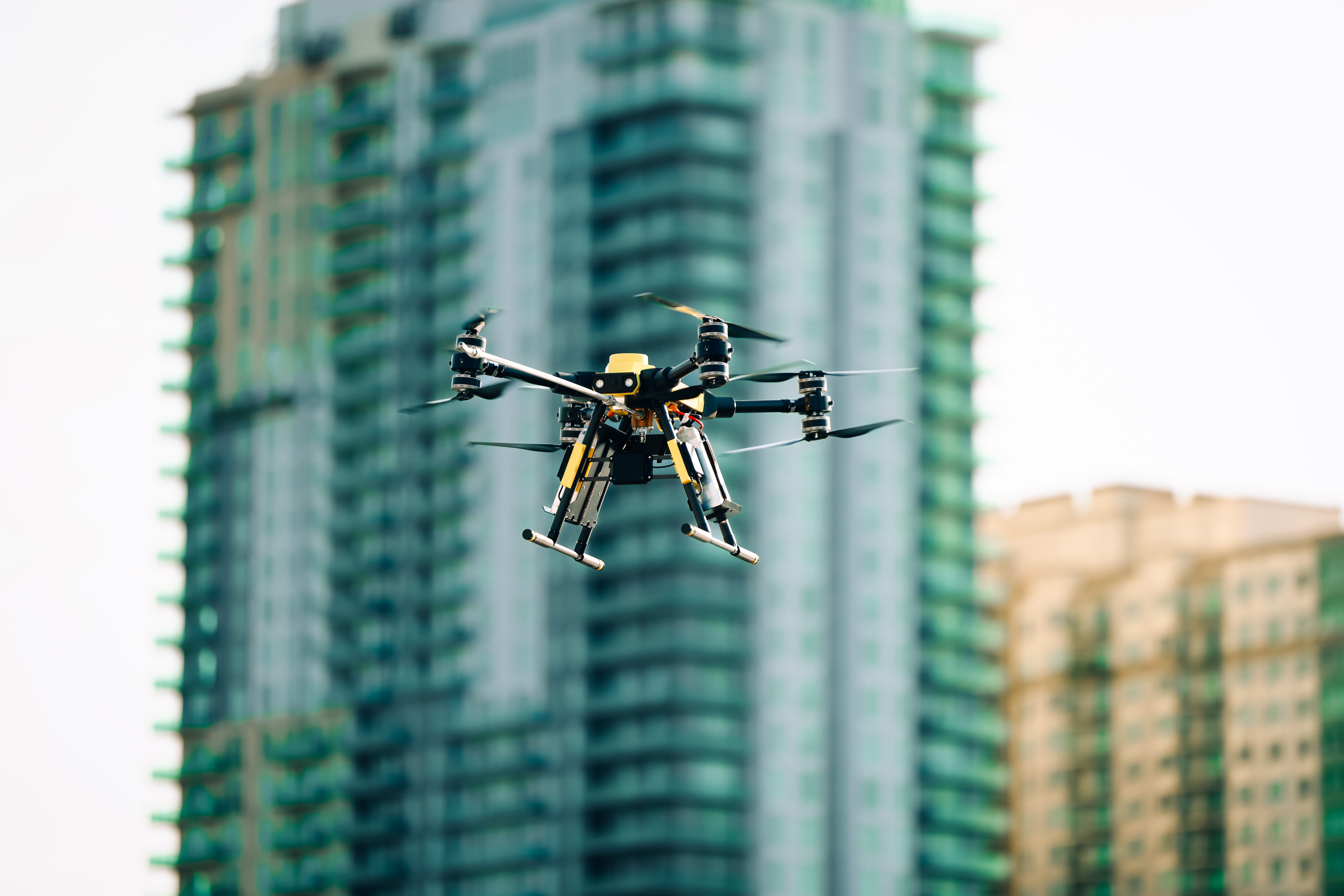
The Pocket Drone—a collapsible, three-rotor aerial vehicle—folds up small enough to fit in a backpack easily, but its three independent propeller motors are powerful enough to carry a GoPro camera. Johnson and his partners think it could be the first in a huge, new category of personal electronics—the small, easily portable flying robot that goes everywhere with you to capture overhead imagery on demand.
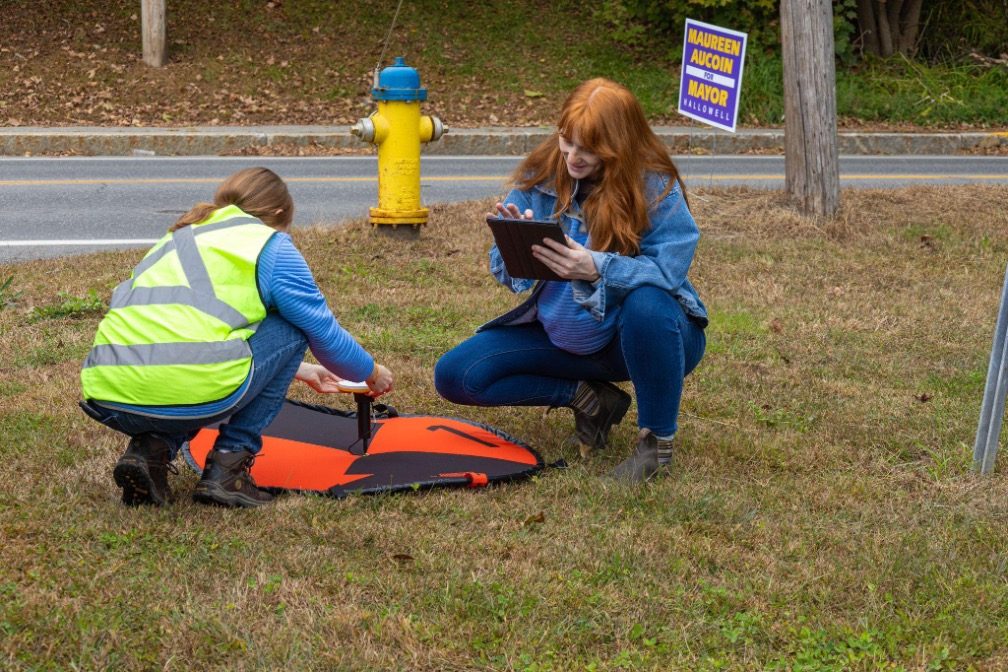
In a few swift motions, Johnson snaps the rotors into place and connects the battery. Stepping back a few paces to give the machine clear passage to the airspace above, he taps in some guidance “waypoints” onto the satellite image of the park displayed on his Android tablet. Then he gives the command to fly. The propellers whir to life, and the drone zips into the air with startling speed, hovering for just a moment directly overhead before streaking off to autonomously execute its flight plan. As we watch it soar, we’re updated on the drone’s progress via a female robotic voice emanating from Johnson’s tablet: “Waypoint one … waypoint two …”
Johnson’s company has achieved liftoff almost as quickly as his invention. Along with co-founders Timothy Reuter, 37, and Chance Roth, 40, Johnson developed a rough prototype of the Pocket Drone and put it on Kickstarter in January. The partners were hoping to raise $35,000. But they ended up getting $929,212 in just 60 days to produce roughly 1,800 drones. Pre-orders on the AirDroids site have pushed sales still higher, to some $1.2 million. “To do a million? We felt like we really had something here, but we were definitely surprised,” says Johnson, an engineering major in college who has a day job as an intellectual-property attorney. “None of us were expecting that kind of demand.”
AirDroids is just the tip of the propeller. Think of this as a Model T moment—when a new industry finds its commercial footing, and thereafter the world is never the same. The idea of unmanned aircraft as consumer devices or commercial tools is a relatively new one in the U.S. Drones, as they are more commonly known, own a place in the American public consciousness right next to the war on terrorism and America’s shadow conflicts in places like Pakistan and Yemen. Predator and Reaper drones—the hulking, matte-gray unmanned aircraft now synonymous with “drone strikes”—have loitered in foreign skies for decades. But five years ago consumer drones didn’t exist. Even two years ago, low-cost and easy-to-use commercial drones were largely the subject of futurism. Today the business world is on the verge of being swarmed by unmanned aircraft.
The global market for nonmilitary drones has already ballooned into a $2.5 billion industry, one that’s growing 15% to 20% annually. And that’s under the current law. One of the biggest potential markets for commercial drones—the U.S.—isn’t even open for business yet.
At least not officially.
While the use of unmanned aerial vehicles (UAVs) for commercial purposes is soaring in countries like Japan, Australia, France, and the U.K., the U.S. Federal Aviation Administration has yet to institute regulations governing the operation of commercial drones, and in the meantime it has issued a blanket ban prohibiting their use in nearly all endeavors. Further complicating things is the gray area in defining the difference between “recreational” drones (which aren’t restricted by the FAA) and commercial drones (which are). In September the FAA issued exceptions to six film companies to use drones, and it has approved their use to monitor oil operations in Alaska. Regulators aren’t expected to issue a full set of guidelines for at least another year.
Continue Reading at fortune.com…

Alan is serial entrepreneur, active angel investor, and a drone enthusiast. He co-founded DRONELIFE.com to address the emerging commercial market for drones and drone technology. Prior to DRONELIFE.com, Alan co-founded Where.com, ThinkingScreen Media, and Nurse.com. Recently, Alan has co-founded Crowditz.com, a leader in Equity Crowdfunding Data, Analytics, and Insights. Alan can be reached at alan(at)dronelife.com
Leave a Reply