• Skip to main content
  • Skip to secondary menu
  • Skip to primary sidebar
  • Skip to secondary sidebar
  • Skip to footer
  • DroneRacingLife
  • DroneFlyers
  • Newsletter
DroneLife

DRONELIFE

Stay up to date on all the latest Drone News

  • News
  • Products
  • Industries
    • Agriculture
    • Construction
    • Delivery
    • Dual Use
    • Inspection
    • Public Safety
    • Surveying
  • Enthusiasts
  • Regulations
  • Business
  • Video
  • Podcasts

Michigan’s Bet on the Low Altitude Economy: How M Air Connects Aerospace Innovation and Detroit Manufacturing

May 14, 2026 by Miriam McNabb Leave a Comment

At XPONENTIAL 2026 this week, leaders from University of Michigan outlined an ambitious vision for the future of drones and advanced air mobility (AAM): one where Michigan becomes a central hub for the emerging low altitude economy by combining aerospace innovation with Detroit’s industrial manufacturing strength.

DRONELIFE had the opportunity for a meaningful discussion with Greg McGuire, Managing Director of M Air, and Venkat Viswanathan, an associate professor at the University of Michigan: one that started with M Air but brought a new perspective on the future of the AAM ecosystem in the US.

M Air is a public-private partnership launched through the University of Michigan. The initiative focuses on autonomous aviation, connected transportation systems, and advanced air mobility technologies. According to McGuire, the program serves several purposes at once: supporting pre-competitive research, providing real-world testing infrastructure, and training the next generation of engineers and entrepreneurs.
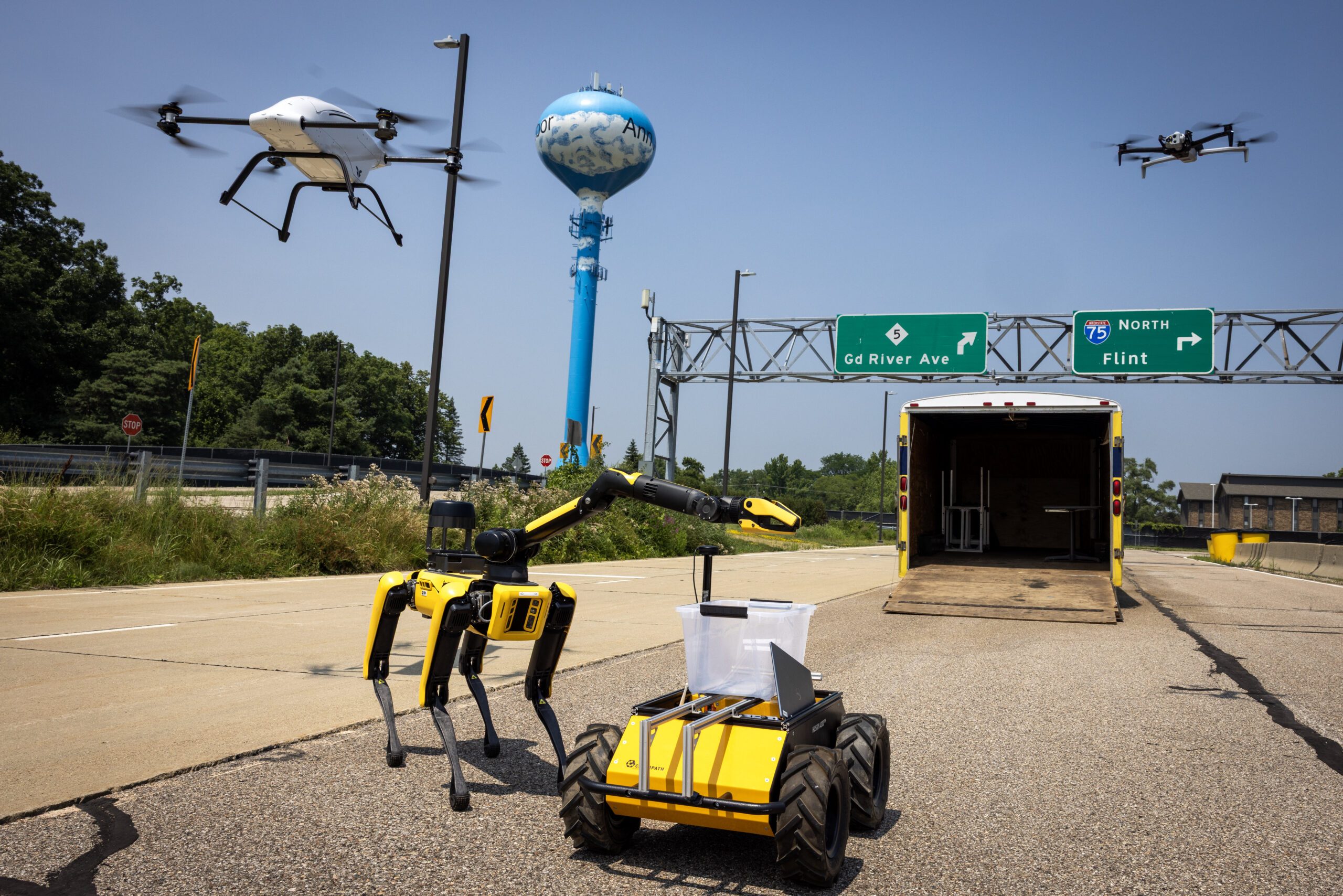
PHOTO: Marcin Szczepanski/Michigan Engineering

The organization also operates a 30-acre test environment located minutes from the university’s aerospace department. The site includes simulated urban infrastructure, highways, school districts, and digital twins designed to accelerate testing and validation for drones and autonomous systems.

Michigan’s State-Level Push Into AAM

M Air is part of a larger statewide strategy backed by Michigan Governor Gretchen Whitmer to position the state as a national center for advanced air mobility and drone manufacturing.

The initiative received early support through Michigan’s Advanced Air Mobility Activation Fund, backed by the state’s Office of Future Mobility and Electrification (OFME), the Michigan Department of Transportation, and the Michigan Aeronautics Commission. That funding helped support projects such as the installation of electric aircraft charging infrastructure by BETA Technologies at airports across Michigan.

In 2025, Governor Whitmer expanded the effort through the Michigan Advanced Air Mobility Initiative, a statewide program designed to accelerate drone deployment, strengthen domestic supply chains, and connect Michigan’s automotive and aerospace sectors.

As part of that initiative, the state awarded funding to the University of Michigan to help expand M Air as an extension of the university’s successful Mcity autonomous vehicle program. The investment supports testbeds for drones and AAM systems, workforce development, startup incubation, and proposed air mobility corridors tied to Michigan Central’s Advanced Aerial Innovation Region.

The strategy reflects a broader belief within Michigan leadership that the future of aviation may depend on many of the same industrial capabilities that built the state’s automotive economy.

That theme surfaced repeatedly throughout the discussion.

Why Michigan Sees Opportunity in Drones and AAM

Viswanathan argued that aerospace is entering what he described as a “second century of aeronautics,” driven by systems that are autonomous, electric, and connected.

Historically, aerospace manufacturing operated at relatively small production volumes. Aircraft were expensive, specialized systems built in limited numbers. Drones and electric vertical takeoff and landing aircraft are changing that equation.

“The scale is vastly different,” Viswanathan explained.

That shift, he said, makes aerospace begin to resemble the automotive industry more than traditional aviation.

The overlap is becoming increasingly visible across the technology stack. Batteries, electric motors, power electronics, and inverters are all foundational technologies for both electric vehicles and advanced aircraft. Michigan already has deep expertise and manufacturing capacity in those areas thanks to decades of automotive investment.

“This has not been the case historically,” Viswanathan said. “But what you are now seeing is a convergence.”

The interview repeatedly returned to the idea that the drone ecosystem may depend less on traditional aerospace manufacturing methods and more on the ability to produce reliable systems at automotive scale.

Viswanathan pointed to the growing demand for large fleets of drones, particularly in defense and industrial applications.

“With drone dominance being 300,000 drones, you cannot inspect, inspect, inspect,” he said, contrasting modern drone production needs with traditional aerospace quality assurance processes. “Who has figured out how to deliver tens of millions of reliable parts per year? Detroit.”

Building the “AAM Stack”

The conversation also highlighted how closely the emerging AAM ecosystem mirrors existing automotive infrastructure and supply chains.

Nearly half the mass of many drones comes from batteries alone, according to Viswanathan. That creates a direct connection to Michigan’s growing electric vehicle investments.

The speakers referenced major state investments in electrification, including funding for battery and EV research facilities. M Air itself includes battery laboratories capable of developing and testing battery cells directly in flight systems.

The implication is significant for the drone industry.

Rather than building an entirely separate aerospace ecosystem from scratch, Michigan believes drones and AAM can leverage existing automotive capabilities across manufacturing, electrification, supply chain management, and large-scale production engineering.

McGuire also emphasized that professional drone systems should not be viewed through the same lens as consumer electronics or hobbyist products.

“When we look at the professional drones, it’s a whole different safety issue,” he said. “Drones are a smaller version of robust autonomous aircraft,” Viswanathan added.

That perspective shapes M Air’s broader mission. The organization aims to validate real-world drone applications ranging from medical delivery and agriculture to communications infrastructure and public safety operations.

McGuire described the initiative as focused on “the serious use of drones that have the potential to change lives.”

For Michigan, the strategy appears to be about more than attracting aerospace startups. It is about positioning the state’s manufacturing ecosystem to play a central role in scaling the next generation of autonomous aviation systems.

Read more:

  • Michigan Pushes Sweeping Drone Legislation Package Through State Legislature
  • Michigan Announces $40 Million in AAM Funding in New Report
  • Michigan Launches First-Ever Uncrewed Triple Challenge

Miriam McNabb

Miriam McNabb is the Editor-in-Chief of DRONELIFE and CEO of JobForDrones, a professional drone services marketplace, and a fascinated observer of the emerging drone industry and the regulatory environment for drones. Miriam has penned over 3,000 articles focused on the commercial drone space and is an international speaker and recognized figure in the industry.  Miriam has a degree from the University of Chicago and over 20 years of experience in high tech sales and marketing for new technologies.
For drone industry consulting or writing, Email Miriam.

TWITTER:@spaldingbarker

Subscribe to DroneLife here.

Filed Under: Advanced Air Mobility, Aerospace, Applications, Autonomous, DL Exclusive, Drone Manufacturing, Drone News, Drone News Feeds, drone parts, drone technology, Dual Use, Featured, News Tagged With: AAM, Advanced Air Mobility, Aerospace Innovation, aerospace manufacturing, Autonomous Aviation, Autonomous Systems, Detroit manufacturing, drone ecosystem, Drone Industry, Drone Manufacturing, drone testing, Electric Aircraft, electric aviation, Gretchen Whitmer, low-altitude economy, M Air, Michigan drones, mobility technology, University of Michigan, XPONENTIAL 2026

Reader Interactions

Leave a Reply Cancel reply

Your email address will not be published. Required fields are marked *

Primary Sidebar

LATEST

Matternet Gains Access to More Than 2,300 North American Hospitals Through Swisslog Healthcare Partnership

New distribution agreement could give Matternet a competitive advantage in hospital drone delivery by leveraging an established healthcare sales network.…

Continue Reading Matternet Gains Access to More Than 2,300 North American Hospitals Through Swisslog Healthcare Partnership

FCC Opens 50 MHz of Cellular Spectrum for Drone Operations

New rules remove a decades-old restriction on airborne use of the 800 MHz Cellular band. The Federal Communications Commission (FCC)…

Continue Reading FCC Opens 50 MHz of Cellular Spectrum for Drone Operations

Zipline Announces Quieter Drone Deliveries as Communities Raise Noise Concerns

New flight software reduces modeled sound exposure by 68%, addressing a growing concern as drone delivery expands into residential areas.…

Continue Reading Zipline Announces Quieter Drone Deliveries as Communities Raise Noise Concerns

FCC Proposes New Rules for Drone Communications and Counter-Drone Radar

November vote would expand low-altitude aviation data links, support drone-detection radar, and update satellite connectivity rules. The Federal Communications Commission…

Continue Reading FCC Proposes New Rules for Drone Communications and Counter-Drone Radar

New State Drone Laws Create Patchwork of Restrictions, Raising Concerns for Operators

New restrictions in California, Arizona, and Alabama highlight differences in state regulations and raise questions about federal airspace authority. By…

Continue Reading New State Drone Laws Create Patchwork of Restrictions, Raising Concerns for Operators

ANRA Advances NATO-Tested Counter-Drone Technology With UTM Airspace Data

SIOP and TACO have advanced from TRL 5 to TRL 7. ANRA is now inviting U.S. sensor makers, integrators and…

Continue Reading ANRA Advances NATO-Tested Counter-Drone Technology With UTM Airspace Data

Basquevolt and Battera Technologies Partner on Lithium Metal Batteries for Aerospace Applications

The Spanish companies plan to combine Basquevolt’s lithium metal cells, which exceed 400 Wh/kg, with Battera’s pack integration, and they…

Continue Reading Basquevolt and Battera Technologies Partner on Lithium Metal Batteries for Aerospace Applications

Quantum Systems Establishes Japanese Subsidiary and Tokyo Office

The German defense company formed Quantum Systems Japan K.K. and plans to expand industrial cooperation with Mitsubishi Chemical and Panasonic…

Continue Reading Quantum Systems Establishes Japanese Subsidiary and Tokyo Office

NATO Nations Gain Faster Access to Combat-Proven Danish Drones Through New Procurement Agreement

Sky-Watch’s RQ-35 Heidrun, deployed in Ukraine and other conflict zones, is now available to participating NATO nations through a streamlined…

Continue Reading NATO Nations Gain Faster Access to Combat-Proven Danish Drones Through New Procurement Agreement

FCC Touts Industry Support for Opening 800 MHz Cellular Spectrum to Drones

Ahead of an October 29 vote, the FCC highlights backing from drone manufacturers, wireless carriers, and industry groups for removing…

Continue Reading FCC Touts Industry Support for Opening 800 MHz Cellular Spectrum to Drones

Secondary Sidebar

Footer

SPONSORED

drone cleaning

Do Cleaning Drones Actually Work? 15 Apellix Before-and-After Jobs Show the Results

What Is the Best Commercial Cleaning Drone in 2026? Specs, Prices, and a Head-to-Head Comparison

Inspired Flight Gremsy IF800 VIO F1 drones geo week

What Will It Take to Strengthen U.S. Drone Manufacturing? A Conversation with Inspired Flight’s CEO

Global Mapper Mobile data collection

Collection Ground Control Points with Global Mapper Mobile

Military Drone Mapping Solutions

How SimActive’s Correlator3D™ is Revolutionizing Military Mapping: An Exclusive Interview with CEO Philippe Simard

Photogrammetry Accuracy Standards

SimActive Photogrammetry Software: Enabling Users to Meet Accuracy Standards for Over 20 Years

About Us | Contact Us | Advertise With Us | Write for Us | Privacy Policy | Terms of Service

The Trusted Source for the Business of Drones.

This website uses cookies and third party services. By clicking OK, you are agreeing to our privacy policy. ACCEPT

Manage consent

Privacy Overview

This website uses cookies to improve your experience while you navigate through the website. Out of these, the cookies that are categorized as necessary are stored on your browser as they are essential for the working of basic functionalities of the website. We also use third-party cookies that help us analyze and understand how you use this website. These cookies will be stored in your browser only with your consent. You also have the option to opt-out of these cookies. But opting out of some of these cookies may affect your browsing experience.
Necessary
Always Enabled
Necessary cookies are absolutely essential for the website to function properly. These cookies ensure basic functionalities and security features of the website, anonymously.
CookieDurationDescription
cookielawinfo-checkbox-analytics11 monthsThis cookie is set by GDPR Cookie Consent plugin. The cookie is used to store the user consent for the cookies in the category "Analytics".
cookielawinfo-checkbox-functional11 monthsThe cookie is set by GDPR cookie consent to record the user consent for the cookies in the category "Functional".
cookielawinfo-checkbox-necessary11 monthsThis cookie is set by GDPR Cookie Consent plugin. The cookies is used to store the user consent for the cookies in the category "Necessary".
cookielawinfo-checkbox-others11 monthsThis cookie is set by GDPR Cookie Consent plugin. The cookie is used to store the user consent for the cookies in the category "Other.
cookielawinfo-checkbox-performance11 monthsThis cookie is set by GDPR Cookie Consent plugin. The cookie is used to store the user consent for the cookies in the category "Performance".
viewed_cookie_policy11 monthsThe cookie is set by the GDPR Cookie Consent plugin and is used to store whether or not user has consented to the use of cookies. It does not store any personal data.
Functional
Functional cookies help to perform certain functionalities like sharing the content of the website on social media platforms, collect feedbacks, and other third-party features.
Performance
Performance cookies are used to understand and analyze the key performance indexes of the website which helps in delivering a better user experience for the visitors.
Analytics
Analytical cookies are used to understand how visitors interact with the website. These cookies help provide information on metrics the number of visitors, bounce rate, traffic source, etc.
Advertisement
Advertisement cookies are used to provide visitors with relevant ads and marketing campaigns. These cookies track visitors across websites and collect information to provide customized ads.
Others
Other uncategorized cookies are those that are being analyzed and have not been classified into a category as yet.
SAVE & ACCEPT