• Skip to main content
  • Skip to secondary menu
  • Skip to primary sidebar
  • Skip to secondary sidebar
  • Skip to footer
  • DroneRacingLife
  • DroneFlyers
  • Newsletter
DroneLife

DRONELIFE

Stay up to date on all the latest Drone News

  • News
  • Products
  • Industries
    • Agriculture
    • Construction
    • Delivery
    • Dual Use
    • Inspection
    • Public Safety
    • Surveying
  • Enthusiasts
  • Regulations
  • Business
  • Video
  • Podcasts

Surveying with Drones: The Key Differences Between Aerial LiDAR and Photogrammetry

August 30, 2018 by staff 8 Comments

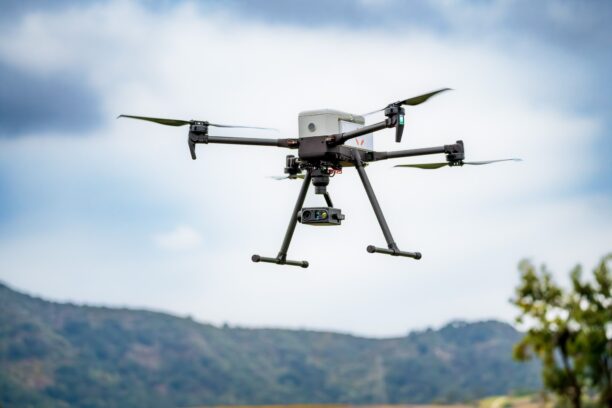
By Cargyrak (Own work) [CC BY-SA 4.0]
The following is a guest post from Dustin Price, licensed land surveyor and operations manager at Landpoint: a surveying, aerial data and technical services provider.

There has been an influx of new and, in some cases, game-changing surveying technologies that have popped up over the past few years. Arguably the biggest of these technologies is unmanned aerial vehicles (UAVs), which has allowed surveyors to collect data in a fraction of the time it would take using traditional methods. The rise of UAV surveying has also created a choice for those that need aerial data: LiDAR or photogrammetry. Here are a few key ways in which these two technologies are different.

Imaging Technology: Light Sensors vs. Photographic Imaging

Aerial LiDAR imagery is produced through light-based sensors, which bounce waves across the surface of the terrain below. Due to the way this type of imaging is completed, it can pass through objects such as brush or bramble, creating an accurate image of terrain that may not be visible. LiDAR is extremely sensitive and accurate and is, therefore, able to take high-resolution surveys of large, overgrown areas. The sensor data is then used to create a 3D map of the terrain, which can be imported into software to create a simulation.

Photogrammetric imaging is based on photographic imagery. This type of imaging takes large numbers of snapshots to render a two dimensional or three-dimensional version of the terrain. There are limitations to this system: it is unable to penetrate below even thin brush, and consequently may have a skewed perception of the actual ground terrain. On the other hand, photogrammetry can preserve the color of the terrain, which can make it easier for people to interpret results.

It should be noted that photogrammetric imaging depends a lot on light and shadows to identify areas of terrain. It may fail in areas that are not lit properly; as an example, photogrammetric imagery has a very difficult time with things such as sand, because the sand will reflect an even surface even if the surface isn’t even at all.

Cost: The Cost of Imaging vs. The Cost of Overhead

LiDAR imagery can be about ten times the cost of photogrammetric imaging. This cost is going down steadily, however. Right now, LiDAR is a newer technology. As more companies adopt its use, it will become more affordable. In terms of up-front cost – photogrammetry is currently a much more affordable option, especially for smaller budgets and projects.

However, there is something to be said about the cost of overhead associated with LiDAR and photogrammetry. If an organization’s overhead could be substantially reduced by having more accurate imagery, LiDAR could ultimately prove to be less expensive. As an example, an organization may be able to reduce the costs of their project through the use of accurate 3D models and simulations. Both solutions can be used to create 3D models, but LiDAR could provide more accurate simulations, while not missing things that photogrammetry might. Depending on the project, LiDAR may actually be the most cost-effective option in the long run.

Software: Developing Data Points and Simulations

LiDAR imagery is produced at a greater level of accuracy and precision than photogrammetric images, which naturally means that it has more data points. This can add to the time and expense necessary to process this data into working simulations, as more processing power is needed. Depending on the processing power that you or your surveyor has on hand, this can take anywhere from hours to days to completely process. That said, you can be pretty confident in the end result.

Photogrammetric images, on the other hand, rely upon software and algorithms to interpret the data that has been collected. Automated algorithms stitch together photographic images in a way that makes sense to them, which means that the software itself has a great deal to do with accuracy.

Air Technology: Manned and Unmanned Aircraft

One thing that LiDAR and photogrammetry both have in common is that they can be produced either via manned or unmanned aircraft. Manned aircraft tend to be expensive and can also be dangerous; both planes and helicopters can encounter emergencies. UAVs tend to be faster and more effective, as they can fly closer to the ground and take higher precision scans.

LiDAR is still an expensive technology, and consequently, it may not be the best choice for every project. Though LiDAR is a more advanced technology, it’s also a specialized tool: its primary benefit is its ability to penetrate to the ground and to produce clean, readable, and accurate 3D files. For many surveying applications, photogrammetry may still be a suitable choice — with the understanding that it isn’t as likely to be precise or accurate as LiDAR. It all depends on the type of surveying that has to be done, as well as the budget.

Dustin Price is a licensed land surveyor and the operations manager at Landpoint. He leads the company in determining the technical approach for delivering professional, tailored surveying services through UAV technology.

Filed Under: Feature 1, Industries, News, Surveying Tagged With: differences between LiDAR and Photogrammetry, drones for surveying, Landpoint, LIDAR, photogrammetry, surveying drones

Reader Interactions

Trackbacks

  1. Professional drone surveying applications | Drone India says:
    August 11, 2019 at 3:31 am

    […] Read More Here… […]

    Reply
  2. Surveying with Drones: The Key Differences Between Aerial LiDAR and Photogrammetry | Drone India says:
    August 11, 2019 at 3:30 am

    […] Read More Here… […]

    Reply
  3. Merry Drone Christmas to All and to All a Good Flight - Drones Crunch says:
    December 25, 2018 at 3:31 am

    […] imagers! LIDAR! 4K high-def […]

    Reply
  4. Boeing wins Navy drone contract, potentially worth billions of dollars | Drone "Ki" says:
    September 30, 2018 at 1:00 am

    […] The following is a guest post from Dustin Price, licensed land surveyor and operations manager at Landpoint: a surveying, aerial data and technical services provider. There has been an influx of new and, in some cases, game-changing surveying technologies that have popped up over the past few years. Arguably the biggest of these technologies is […] The post Surveying with Drones: The Key Differences Between Aerial LiDAR and Photogrammetry appeared first on DRONELIFE. See Original Article […]

    Reply
  5. Surveying with Drones: The Key Differences Between Aerial LiDAR and Photogrammetry – GPAS says:
    August 31, 2018 at 10:49 pm

    […] Read More: Drone Life […]

    Reply
  6. Surveying with Drones: The Key Differences Between Aerial LiDAR and Photogrammetry - Droneoo says:
    August 31, 2018 at 9:23 pm

    […] Source link […]

    Reply
  7. Surveying with Drones: The Key Differences Between Aerial LiDAR and Photogrammetry - Drones Crunch says:
    August 31, 2018 at 1:30 am

    […] DRONELIFE […]

    Reply
  8. Surveying with Drones: The Key Differences Between Aerial LiDAR and Photogrammetry | MUSIC 4 DRONES says:
    August 30, 2018 at 5:59 pm

    […] post Surveying with Drones: The Key Differences Between Aerial LiDAR and Photogrammetry appeared first on […]

    Reply

Leave a Reply Cancel reply

Your email address will not be published. Required fields are marked *

Primary Sidebar

LATEST

Manna Raises $50M to Expand Drone Delivery Network in the U.S.

Funding supports plans for 40 new bases and continued scaling of suburban UAV delivery operations Manna Air Delivery has announced…

Continue Reading Manna Raises $50M to Expand Drone Delivery Network in the U.S.

Terra Drone Invests in Ukraine-Based Interceptor Drone Company, Launches Terra A1

Partnership aims to scale low-cost defense solutions and expand global unmanned systems capabilities Terra Drone Corporation has announced a strategic…

Continue Reading Terra Drone Invests in Ukraine-Based Interceptor Drone Company, Launches Terra A1

FCC Seeks Input to Advance U.S. Drone Industry

Public notice outlines questions about regulatory reforms, spectrum access, and innovation zones The Federal Communications Commission (FCC) has opened a…

Continue Reading FCC Seeks Input to Advance U.S. Drone Industry

Skyports Deploys Automated BVLOS Drone Surveys for Major German Bridge Project

Remote-operated “drone-in-a-box” system delivers weekly 2D and 3D data for construction monitoring Skyports Drone Services has partnered with HOCHTIEF to…

Continue Reading Skyports Deploys Automated BVLOS Drone Surveys for Major German Bridge Project

Can You Get Survey-Grade Accuracy Without Ground Control Points?

New Study Explores When Drone Mapping Can Reduce Ground Setup A new white paper from Swiss drone manufacturer Wingtra takes…

Continue Reading Can You Get Survey-Grade Accuracy Without Ground Control Points?

April 2026 Public Safety Drone Review: Drones in Remote Environments and Operations on Lanai

DRONELIFE and DRONERESPONDERS host live webcast April 7 at 3 PM EST Register here for the next Public Safety Drone…

Continue Reading April 2026 Public Safety Drone Review: Drones in Remote Environments and Operations on Lanai

Commercial Drone Alliance Calls for “Whole-of-Government” Strategy to Build U.S. Drone Industry

New white paper outlines policy roadmap following FCC action on foreign drones and components The Commercial Drone Alliance (CDA) has…

Continue Reading Commercial Drone Alliance Calls for “Whole-of-Government” Strategy to Build U.S. Drone Industry

XTEND and ParaZero Partner to Deliver Autonomous Drone Interception System

New integration combines AI-powered drone platform with net-based capture system for counter-UAS missions JFB Construction Holdings and XTEND have announced…

Continue Reading XTEND and ParaZero Partner to Deliver Autonomous Drone Interception System

EU Fast-Tracks €115M Defense Innovation Fund to Accelerate Drone and AI Deployment

EU to earmark €115 million for AI, drone innovation By DRONELIFE Features Editor Jim Magill The governing body of the…

Continue Reading EU Fast-Tracks €115M Defense Innovation Fund to Accelerate Drone and AI Deployment

DeTect Reorganizes into Three Global Regions to Support Growth

New leadership structure aims to strengthen global operations and customer support DeTect, Inc. has announced a new organizational structure designed…

Continue Reading DeTect Reorganizes into Three Global Regions to Support Growth

Secondary Sidebar

Footer

SPONSORED

Inspired Flight Gremsy IF800 VIO F1 drones geo week

What Will It Take to Strengthen U.S. Drone Manufacturing? A Conversation with Inspired Flight’s CEO

Global Mapper Mobile data collection

Collection Ground Control Points with Global Mapper Mobile

Military Drone Mapping Solutions

How SimActive’s Correlator3D™ is Revolutionizing Military Mapping: An Exclusive Interview with CEO Philippe Simard

Photogrammetry Accuracy Standards

SimActive Photogrammetry Software: Enabling Users to Meet Accuracy Standards for Over 20 Years

NACT Engineering Parrot ANAFI tether indoor shot

Smart Tether for Parrot ANAFI USA from NACT Engineering

Blue Marble, features global mapper, features Blue Marble

Check Out These New Features in Global Mapper v25 from Blue Marble

About Us | Contact Us | Advertise With Us | Write for Us | Privacy Policy | Terms of Service

The Trusted Source for the Business of Drones.

This website uses cookies and third party services. By clicking OK, you are agreeing to our privacy policy. ACCEPT

Manage consent

Privacy Overview

This website uses cookies to improve your experience while you navigate through the website. Out of these, the cookies that are categorized as necessary are stored on your browser as they are essential for the working of basic functionalities of the website. We also use third-party cookies that help us analyze and understand how you use this website. These cookies will be stored in your browser only with your consent. You also have the option to opt-out of these cookies. But opting out of some of these cookies may affect your browsing experience.
Necessary
Always Enabled
Necessary cookies are absolutely essential for the website to function properly. These cookies ensure basic functionalities and security features of the website, anonymously.
CookieDurationDescription
cookielawinfo-checkbox-analytics11 monthsThis cookie is set by GDPR Cookie Consent plugin. The cookie is used to store the user consent for the cookies in the category "Analytics".
cookielawinfo-checkbox-functional11 monthsThe cookie is set by GDPR cookie consent to record the user consent for the cookies in the category "Functional".
cookielawinfo-checkbox-necessary11 monthsThis cookie is set by GDPR Cookie Consent plugin. The cookies is used to store the user consent for the cookies in the category "Necessary".
cookielawinfo-checkbox-others11 monthsThis cookie is set by GDPR Cookie Consent plugin. The cookie is used to store the user consent for the cookies in the category "Other.
cookielawinfo-checkbox-performance11 monthsThis cookie is set by GDPR Cookie Consent plugin. The cookie is used to store the user consent for the cookies in the category "Performance".
viewed_cookie_policy11 monthsThe cookie is set by the GDPR Cookie Consent plugin and is used to store whether or not user has consented to the use of cookies. It does not store any personal data.
Functional
Functional cookies help to perform certain functionalities like sharing the content of the website on social media platforms, collect feedbacks, and other third-party features.
Performance
Performance cookies are used to understand and analyze the key performance indexes of the website which helps in delivering a better user experience for the visitors.
Analytics
Analytical cookies are used to understand how visitors interact with the website. These cookies help provide information on metrics the number of visitors, bounce rate, traffic source, etc.
Advertisement
Advertisement cookies are used to provide visitors with relevant ads and marketing campaigns. These cookies track visitors across websites and collect information to provide customized ads.
Others
Other uncategorized cookies are those that are being analyzed and have not been classified into a category as yet.
SAVE & ACCEPT