• Skip to main content
  • Skip to secondary menu
  • Skip to primary sidebar
  • Skip to secondary sidebar
  • Skip to footer
  • DroneRacingLife
  • DroneFlyers
  • Newsletter
DroneLife

DRONELIFE

Stay up to date on all the latest Drone News

  • News
  • Products
  • Industries
    • Agriculture
    • Construction
    • Delivery
    • Dual Use
    • Inspection
    • Public Safety
    • Surveying
  • Enthusiasts
  • Regulations
  • Business
  • Video
  • Podcasts

Yamaha Demos Agricultural Drone, But Humans Can’t Unleash It Yet

October 16, 2014 by Alan Phillips 1 Comment

from IEEE Spectrum

Agriculture is (arguably) where drones are going to be the most useful in the near future. Drones have already proven their usefulness to hobbyists and the military, and agriculture is the next huge commercial frontier. And although commercial drone operation is still waiting for official approval, at least in the United States, developers of unmanned aerial vehicles are eager to show that the technology is ready.

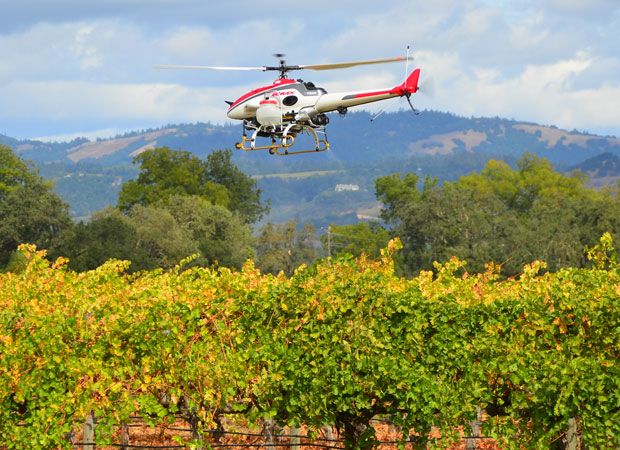
Yesterday, Yamaha and UC Davis put on a demonstration of the RMAX unmanned helicopter in Napa Valley, in the heart of California’s wine country. Yamaha’s RMAX is basically a scaled-up version of a nitro (or electric) hobby sport helicopter, or a scaled-down version of a real helicopter.

It’s beastly enough to carry a 28-kilogram payload, and Yamaha has it set up to spray vineyards. It’s complex and expensive, but the company is making a case that it’s the most efficient and cost effective way to treat high value crops, especially with an eye towards autonomy.

When we say that the RMAX can’t be “unleashed” yet, we’re talking about autonomy, or the lack thereof. Currently, the helicopter communicates via a radio link to a controller operated by a human, and it is unable to fly autonomously. There’s an autonomous component to the flight control software, in that the helicopter can hold its altitude, speed, and heading, or hover in place without a human having to manage it. But that’s it. The rest of the time (all of the time, essentially), a human is working a controller, flying the helicopter back and forth over the vineyard rows entirely by hand.

This is not ideal for a whole bunch of reasons. First, it’s not something that humans are particularly efficient at. We can do it, but since the pilot is flying the drone while standing in one spot, they’ve got just one viewpoint on what’s going on, which makes it difficult to fly a spraying pattern without building in a lot of needless overlap, wasting both time and money and adding more chemicals that necessary.

Second, these drones aren’t messing around: they’re very large, very scary vehicles, and are difficult to control (even with practice) due to both the inherent instability of all helicopters and the fact that while the controls of a helicopter operate from its perspective, a remote pilot has to mentally compensate for any angles of yaw whenever the helicopter isn’t facing directly away from them. So, if something goes wrong (mechanical failure, gust of wind, bird strike), an autonomous system will likely be better suited to getting the drone back down to the ground safely.

rmax2-1413442793748And third, lack of autonomy has a significant impact on the cost effectiveness of the system. To fly it, Yamaha sends out a team of three people. There’s a pilot, a safety observer to help the pilot fly in the right places and not crash into anything, and an assistant who deals with refilling tanks and moving stuff around. With an autonomous system, on the other hand, you could likely reduce that to one person: a safety pilot who could manage the hardware aspects, and then stand by to take over manual control if it ever became necessary.

Yamaha, though, is sticking with the humans in the loop system for the foreseeable future. They have enough trouble getting clearance from the U.S. Federal Aviation Administration for this totally human-controlled version of the drone. The FAA has very good reasons for being as cautious as it is, and we don’t want to suggest that the agency should suddenly lift all bans on drones. Having said that, government regulation is the biggest obstacle to deploying the RMAX in the United States, autonomous or not. It’s been operating successfully in Australia for years, and in Japan since 1991, seeding and spraying rice crops.

Talking to viticulturalists from UC Davis, on the other hand, made things seem a little more optimistic for the near future of autonomous agriculture. UC Davis is partnering with Yamaha to evaluate the RMAX on a research vineyard, so they’ve had plenty of experience (in additional effort and frustration) jumping through all the necessary FAA hoops.

UC Davis is actively working towards autonomy for things like spot spraying, where the drone sprays only in the very specific areas of a vineyard that need it, identified from (say) multispectral aerial maps. Again, this would save time and money while minimizing chemical use. Another cool thing that you could do with an autonomous helicopter is to identify areas in a vineyard susceptible to freezing at night, and then send in the helicopter to use its rotor wash to keep the plants moving and thawed out.

Putting aside the issue of autonomy (for now), do very expensive (low six figures) drones really make sense in an agricultural context? Napa Valley may be a special case because aerial spraying using traditional cropduster aircraft is prohibited, which means that spraying is usually done by tractors driving along each row. The RMAX can cover twelve acres in the time that it takes for a tractor to cover one, and that’s on flat ground. Where Yamaha foresees the real benefits are on hillside applications, where it’s dangerous (and sometimes impossible) for ground vehicles to operate effectively. The RMAX doesn’t care in the least whether it’s hovering over flat ground or a steep slope, and spends the same amount of time covering hillside crops.

Continue Reading at Spectrum.IEEE.org…

Alan Phillips
Alan Phillips

Alan is serial entrepreneur, active angel investor, and a drone enthusiast. He co-founded DRONELIFE.com to address the emerging commercial market for drones and drone technology. Prior to DRONELIFE.com, Alan co-founded Where.com, ThinkingScreen Media, and Nurse.com. Recently, Alan has co-founded Crowditz.com,  a leader in Equity Crowdfunding Data, Analytics, and Insights.  Alan can be reached at alan(at)dronelife.com
Filed Under: Agriculture, News Tagged With: FAA, Napa Valley, RMAX, UC Davis, Yamaha

Reader Interactions

Comments

  1. Nicholas Carlough says

    October 18, 2014 at 11:12 pm

    Removal of humans from direct agricultural involvement, is arguably the greatest downfall of civilization in general. Pesticide dispensing drones will likely be it’s doom.

    Reply

Leave a Reply Cancel reply

Your email address will not be published. Required fields are marked *

Primary Sidebar

LATEST

UK Government Backs Drone Expansion with £50 Million Investment

Windracers among companies recognized as UK moves to scale routine drone operations and advanced air mobility The UK government has…

Continue Reading UK Government Backs Drone Expansion with £50 Million Investment

U.S. Navy Awards Packet Digital $9.8 Million to Scale Drone Battery Production in North Dakota

North Dakota facility will manufacture NDAA-compliant battery cells for drones and defense systems Packet Digital and its subsidiary Badland Batteries…

Continue Reading U.S. Navy Awards Packet Digital $9.8 Million to Scale Drone Battery Production in North Dakota

Danish Startup Launches 10K Drone Sensor for Wide-Area Search, Surveillance, and Mine Detection

Danish start-up promotes innovative sensor system By DRONELIFE Features Editor Jim Magill Marine rescue teams using drones to search for…

Continue Reading Danish Startup Launches 10K Drone Sensor for Wide-Area Search, Surveillance, and Mine Detection

FAA Publishes Proposed Rule for Drone Restrictions Around Critical Infrastructure

New Section 2209 NPRM would create a formal process for restricting drone flights near sensitive facilities The Federal Aviation Administration…

Continue Reading FAA Publishes Proposed Rule for Drone Restrictions Around Critical Infrastructure

Public Comment Window Closing: FCC Weighs DJI Challenge to Covered List Ruling

Public input period highlights ongoing divide over foreign drone policy and market access The deadline to submit comments on the…

Continue Reading Public Comment Window Closing: FCC Weighs DJI Challenge to Covered List Ruling

FAA Advances Long-Delayed Rule to Restrict Drones Over Sensitive Sites

Long-awaited proposal aims to balance security and access in low-altitude airspace The Federal Aviation Administration (FAA) has announced a long-anticipated…

Continue Reading FAA Advances Long-Delayed Rule to Restrict Drones Over Sensitive Sites

WaiV Robotics Debuts Maritime VTOL Landing Pad with $7.5M Seed Round

The London-based maritime startup unveils a gyro-stabilized landing pad that recovers VTOL drones on vessels as small as 10 meters…

Continue Reading WaiV Robotics Debuts Maritime VTOL Landing Pad with $7.5M Seed Round

Perceptual Robotics Raises Funding to Automate Wind Turbine Inspection Drones

Loggerhead Ventures leads the round with follow-on from One Planet Capital, fueling AI-powered drones for wind farm maintenance. Perceptual Robotics…

Continue Reading Perceptual Robotics Raises Funding to Automate Wind Turbine Inspection Drones

Teledyne FLIR OEM Launches Prism Software to Detect Small Drones at Longer Range

New AI-enabled software aims to identify small drone threats earlier and support faster response Teledyne FLIR OEM, part of Teledyne…

Continue Reading Teledyne FLIR OEM Launches Prism Software to Detect Small Drones at Longer Range

When Commercial Drone Technology Meets Defense: A Closer Look at Civil–Military Integration

New analysis highlights how shared innovation pipelines are shaping both commercial drone markets and military capabilities A recent report from…

Continue Reading When Commercial Drone Technology Meets Defense: A Closer Look at Civil–Military Integration

Secondary Sidebar

Footer

SPONSORED

Inspired Flight Gremsy IF800 VIO F1 drones geo week

What Will It Take to Strengthen U.S. Drone Manufacturing? A Conversation with Inspired Flight’s CEO

Global Mapper Mobile data collection

Collection Ground Control Points with Global Mapper Mobile

Military Drone Mapping Solutions

How SimActive’s Correlator3D™ is Revolutionizing Military Mapping: An Exclusive Interview with CEO Philippe Simard

Photogrammetry Accuracy Standards

SimActive Photogrammetry Software: Enabling Users to Meet Accuracy Standards for Over 20 Years

NACT Engineering Parrot ANAFI tether indoor shot

Smart Tether for Parrot ANAFI USA from NACT Engineering

Blue Marble, features global mapper, features Blue Marble

Check Out These New Features in Global Mapper v25 from Blue Marble

About Us | Contact Us | Advertise With Us | Write for Us | Privacy Policy | Terms of Service

The Trusted Source for the Business of Drones.

This website uses cookies and third party services. By clicking OK, you are agreeing to our privacy policy. ACCEPT

Manage consent

Privacy Overview

This website uses cookies to improve your experience while you navigate through the website. Out of these, the cookies that are categorized as necessary are stored on your browser as they are essential for the working of basic functionalities of the website. We also use third-party cookies that help us analyze and understand how you use this website. These cookies will be stored in your browser only with your consent. You also have the option to opt-out of these cookies. But opting out of some of these cookies may affect your browsing experience.
Necessary
Always Enabled
Necessary cookies are absolutely essential for the website to function properly. These cookies ensure basic functionalities and security features of the website, anonymously.
CookieDurationDescription
cookielawinfo-checkbox-analytics11 monthsThis cookie is set by GDPR Cookie Consent plugin. The cookie is used to store the user consent for the cookies in the category "Analytics".
cookielawinfo-checkbox-functional11 monthsThe cookie is set by GDPR cookie consent to record the user consent for the cookies in the category "Functional".
cookielawinfo-checkbox-necessary11 monthsThis cookie is set by GDPR Cookie Consent plugin. The cookies is used to store the user consent for the cookies in the category "Necessary".
cookielawinfo-checkbox-others11 monthsThis cookie is set by GDPR Cookie Consent plugin. The cookie is used to store the user consent for the cookies in the category "Other.
cookielawinfo-checkbox-performance11 monthsThis cookie is set by GDPR Cookie Consent plugin. The cookie is used to store the user consent for the cookies in the category "Performance".
viewed_cookie_policy11 monthsThe cookie is set by the GDPR Cookie Consent plugin and is used to store whether or not user has consented to the use of cookies. It does not store any personal data.
Functional
Functional cookies help to perform certain functionalities like sharing the content of the website on social media platforms, collect feedbacks, and other third-party features.
Performance
Performance cookies are used to understand and analyze the key performance indexes of the website which helps in delivering a better user experience for the visitors.
Analytics
Analytical cookies are used to understand how visitors interact with the website. These cookies help provide information on metrics the number of visitors, bounce rate, traffic source, etc.
Advertisement
Advertisement cookies are used to provide visitors with relevant ads and marketing campaigns. These cookies track visitors across websites and collect information to provide customized ads.
Others
Other uncategorized cookies are those that are being analyzed and have not been classified into a category as yet.
SAVE & ACCEPT