
Company to use tethered drones to generate power
By DRONELIFE Features Editor Jim Magill
When thinking about wind-generated electrical power, most people envision an array of massive wind turbines, each as tall as a 20-story building, with blades averaging about 210 feet in length.
However, a Durham, North Carolina start-up company is developing a system that employs a tethered-drone with a 12-foot wing span, capable of generating enough electricity to power an average size house by flying in a series of continuous figure 8 loops.
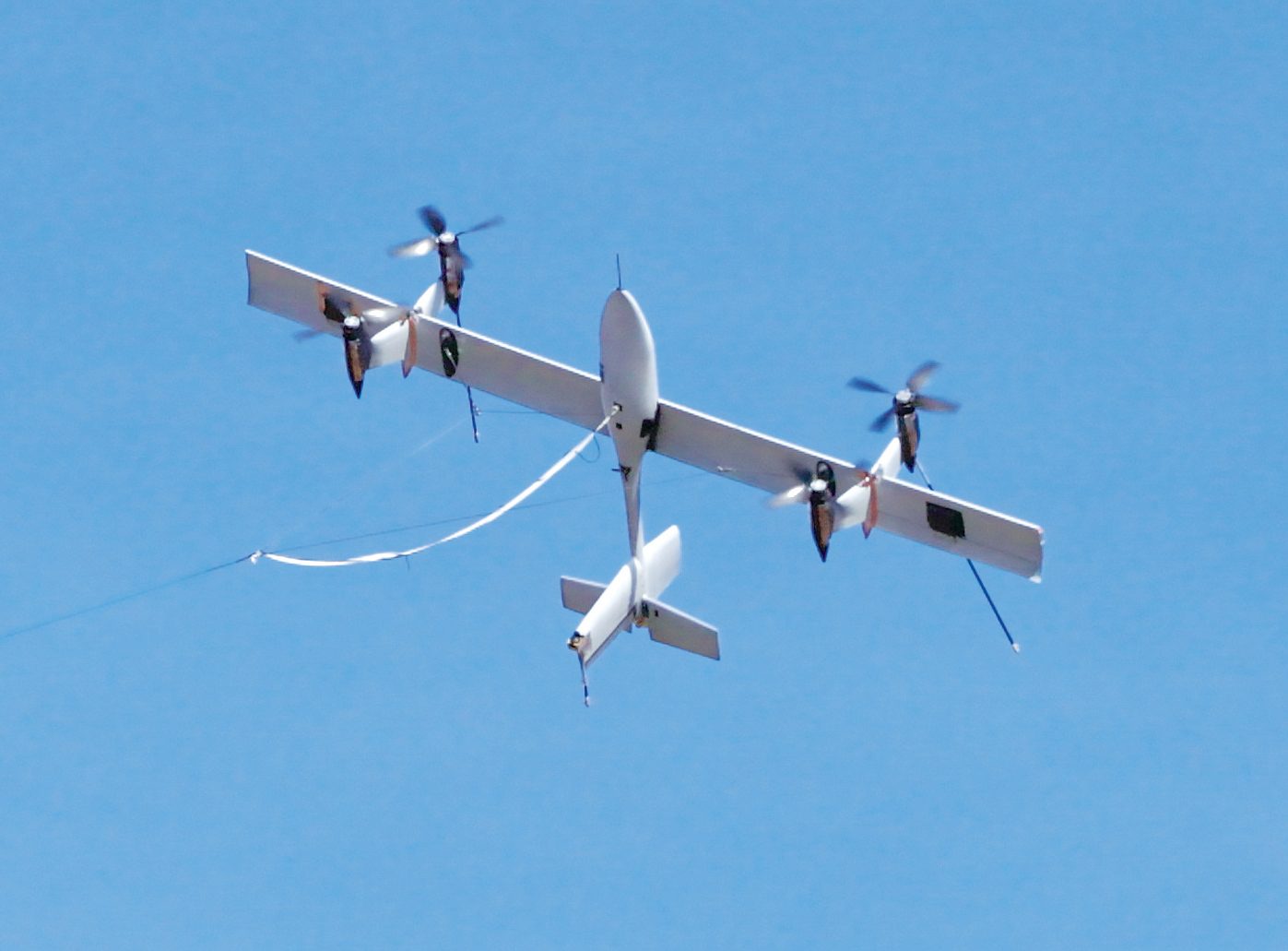
Under a $30 million contract with the U.S. Department of Defense, Windlift is conducting test flights at two airfields in North Carolina. Once the technology is proved out, company officials hope to begin securing contracts to enable the launch of commercial applications, using much larger drones, Sean Meyer, Windlift’s chief operating officer, said in an interview.
“What we have is a tethered autonomous drone that flies in patterns extracting energy from the wind. We fly crosswind and the rotors alternate between thrust and drag depending on their needs within the pattern,” Meyer said.
Although the company’s current focus is on perfecting the development of energy-producing light-weight tethered drones, Windlift founder and CEO Rob Creighton had a different vision for taming the wind when he launched the company in 2006.
“He had started with kites and trying to use wind power to do a variety of tasks,” Meyer said. “When he put something together at first, it was just essentially a kite steered by a hockey stick attached to a swing set that was lifting sandbags. It was meant to pump water in areas where electricity wasn’t necessarily feasible.”
Creighton eventually developed the tethered drone concept in 2019 and secured an indefinite delivery/indefinite quantity government contract with the Defense Department, which gave the start-up the capital it needed to begin a pilot testing program for its power-generating drones.
Although Windlift officials envision ultimately installing a fleet of electricity-generating drones tethered to platforms in the ocean, where winds blow more consistently than on land, the company initially is proving out the technology onshore, before moving into a maritime environment.
Windlift has selected two airfields for its test flights, one at North Carolina State University’s (NCSU) Butner Beef Cattle Field Laboratory, located about 15 miles north of Durham, and the second at Kinston Regional Jetport, a public airport located about 50 miles southeast of Durham.
The NCSU facility includes an old crop-dusting airstrip, which Windlift employs for its flights. “Sometimes the cows are wandering around, which is kind of fun to watch their reaction. At first, they’re very curious, and then they just go back to eating grass,” Meyer said.
Although the NCSU site is a little closer to the company’s home base, the Kinston airfield “has better wind,” he said. “We tend to test things at Butner in low-wind environments, things like changes to controls, changes to structure, just to make sure that everything’s operating correctly. Then we’ll bring it up to Kinston to test against power generation.”
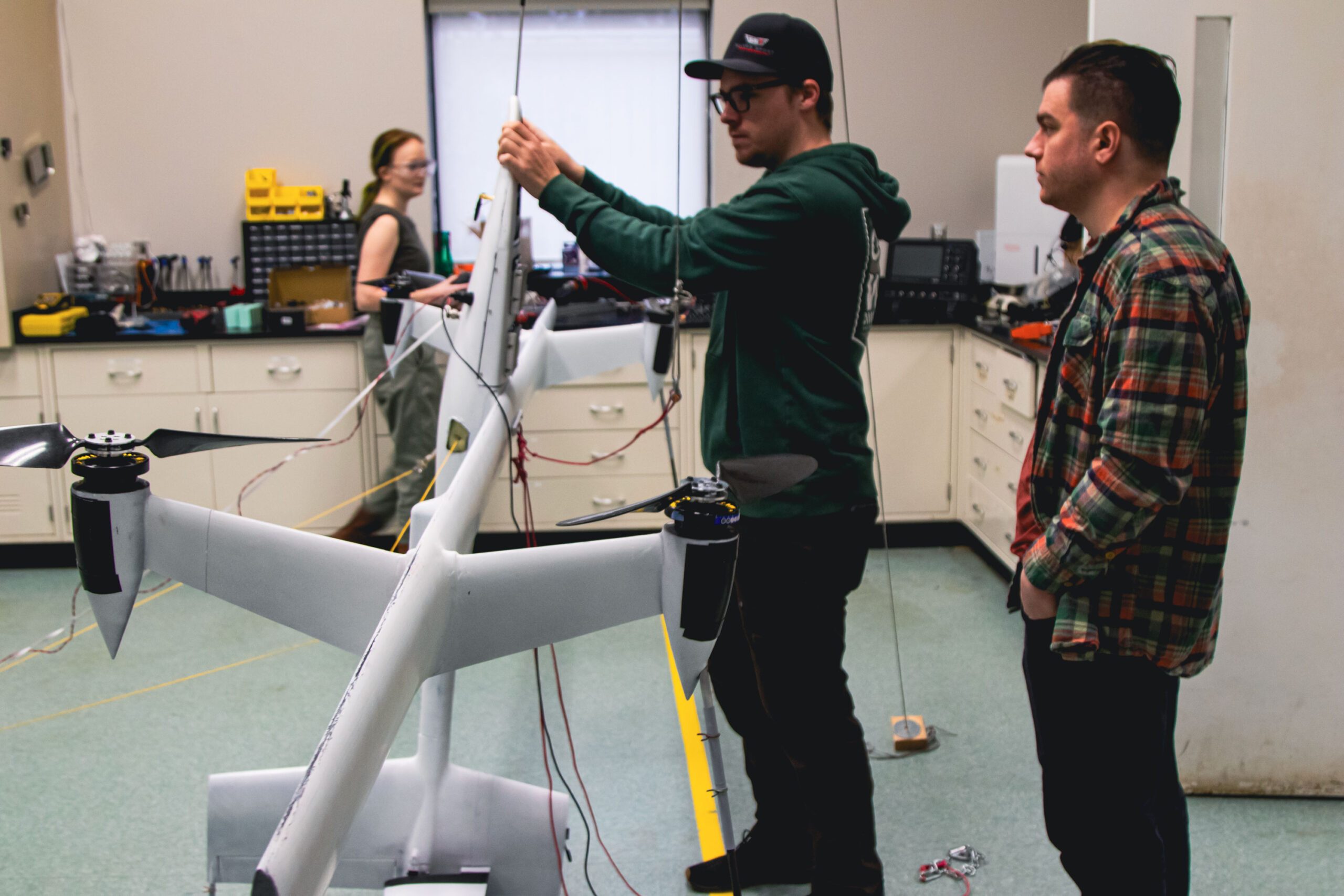
The drones the company employs are made of lightweight but strong carbon-fiber materials. With motors installed, they weigh about 25 to 30 pounds. The UAVs are connected by a bi-directional electrical tether to a ground station that has electricity-receiving equipment, a winch and a battery.
In Windlift’s system, the autonomous drone is programmed to fly in a pattern that resembles a figure 8 or an infinity symbol. “You’re flying crosswind. What’s happening is essentially like tacking a sailboat, you’re positioning the wing to operate a bit like a sail tacking into the wind, which then pushes the aircraft through the pattern,” Meyer said.
In one segment of the pattern, the rotors have to work to provide thrust, pushing the aircraft forward. Then, depending on the size of the aircraft’s wing, there’s a point at which in the wind itself can begin to move the aircraft through its entire pattern.
“You’ve got the tether, and at some point, you reach the edge of the tether, that plus inertia pulls you into a dive. You’re now diving, and the wind is pushing you forward, and the rotor is switched from thrust into drag, where you’re slowing the aircraft down, like regenerative braking on a Tesla,” Meyer said.
These maneuvers result in a net gain of energy, which is sent down the tether as electricity. The drone is fully autonomous, with a system that includes a self-learning, repeating controller. The controller is constantly evaluating where the drone is in the sky and what the wind is doing around it, and determines the best trajectory to follow for maximum power production.
Company looks to production of larger drones for commercial market
Under the DOD contract, a single 12-foot-wingspan drone is designed to be part of a 3-kilowatt rated system to be used as a portable source of power generation for forward operating positions. Looking beyond the system designed for the DOD, Windlift is designing a 75-kilowatt system that will employ drones with a 40-foot wingspan and which will be useful in commercial power-generating applications.
“We use a pretty advanced, proprietary full-physics simulation environment to scale things up. We’re pretty confident that the 40-foot wing will behave the way that we expect it to,” Meyer said. He said the company is seeking private funding, which would allow it to build a larger project than it would be able to accomplish with just the DOD contract.
One of the reasons the company chose to concentrate on drones with a 40-foot wingspan, and not ones of greater length, is the square-cube law of physics, which states that as an object scales up in size, its volume increases proportionally to the cube of its length, while its surface area only increases proportionally to the square of its length. This means that, because of their greater weight in proportion to their size, drones with wingspans of longer than 40 feet would be less efficient for power generation.
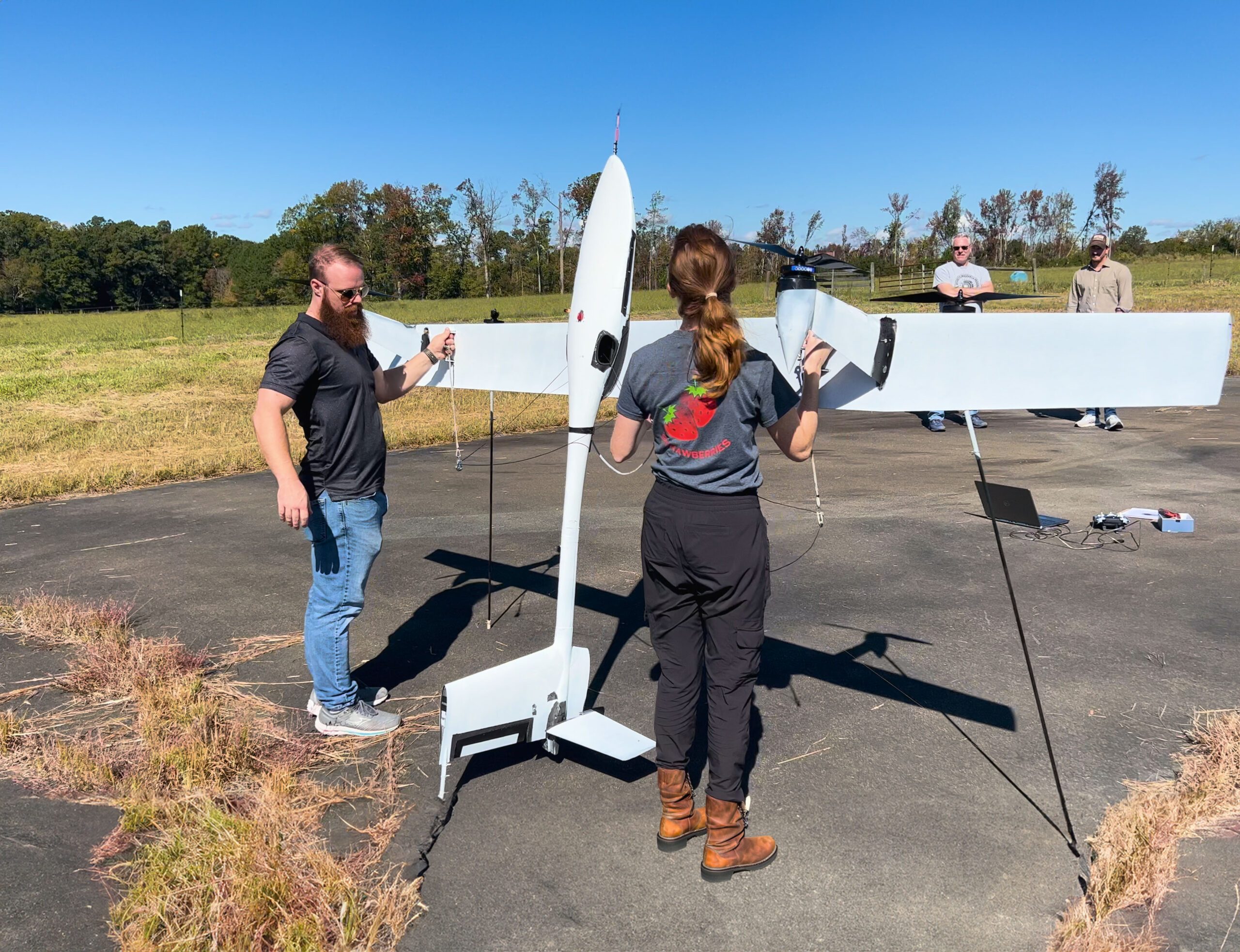
Another reason for choosing the 40-foot length is portability, Meyer said. “You get to fit one of these in a 40-foot shipping container. So, essentially, it still becomes very mobile,” he said. “The smaller footprint of the 40-foot shipping container and the mobile nature of the system makes it easy and cheap to deploy.”
The company has been looking at the feasibility of partnering with microgrid companies to use the larger drones to supplement solar arrays to supply power for agricultural applications.
“We believe that that’s going to present the biggest commercial opportunity,” Meyer said. “And that same system would be the one that we could scale for use offshore or in freshwater.”
Currently, the drones used in its pilot program are relatively pricey, but Windlift expects the per-unit price to drop once the company begins commercial production of its products.
“Right now, of course, they’re more expensive because we build them like super cars, right? It’s like a Bugatti. We’re hand-laying carbon fiber and shaping these things one by one,” he said. “But if you think about manufacturing anything, the price of all things approaches the price of the raw materials at the end of a manufacturing curve.”
He added that on a per-kilowatt basis, he expects Windlift’s technology will be able to produce electricity at a rate that’s much cheaper than a wind turbine, because its construction would involve about 90% less material.
Want DRONELIFE news delivered to your inbox every weekday? Sign up here.
Read more:
- FlyFreely in Australia: Drone Safety App Startup Gets CASA Authorization
- Danish-Ukrainian Startup Leverages Robotics and Drones to Accelerate Demining in Ukraine
- Lithuanian Startup Granta Autonomy Strengthens Military Support for Ukraine with New €1M Drone Order
 Jim Magill is a Houston-based writer with almost a quarter-century of experience covering technical and economic developments in the oil and gas industry. After retiring in December 2019 as a senior editor with S&P Global Platts, Jim began writing about emerging technologies, such as artificial intelligence, robots and drones, and the ways in which they’re contributing to our society. In addition to DroneLife, Jim is a contributor to Forbes.com and his work has appeared in the Houston Chronicle, U.S. News & World Report, and Unmanned Systems, a publication of the Association for Unmanned Vehicle Systems International.

Miriam McNabb is the Editor-in-Chief of DRONELIFE and CEO of JobForDrones, a professional drone services marketplace, and a fascinated observer of the emerging drone industry and the regulatory environment for drones. Miriam has penned over 3,000 articles focused on the commercial drone space and is an international speaker and recognized figure in the industry. Miriam has a degree from the University of Chicago and over 20 years of experience in high tech sales and marketing for new technologies.
For drone industry consulting or writing, Email Miriam.
TWITTER:@spaldingbarker
Subscribe to DroneLife here.

Leave a Reply