• Skip to main content
  • Skip to secondary menu
  • Skip to primary sidebar
  • Skip to secondary sidebar
  • Skip to footer
  • DroneRacingLife
  • DroneFlyers
  • Newsletter
DroneLife

DRONELIFE

Stay up to date on all the latest Drone News

  • News
  • Products
  • Industries
    • Agriculture
    • Construction
    • Delivery
    • Dual Use
    • Inspection
    • Public Safety
    • Surveying
  • Enthusiasts
  • Regulations
  • Business
  • Video
  • Podcasts

The Primer on Surveillance vs. Declaration vs. Operational Volume, for Advanced Drone Operations

November 28, 2023 by Miriam McNabb 4 Comments

As advanced drone operations scale, stakeholders need greater understanding of ground-based surveillance systems (GBSS) and airspace awareness tools that enable autonomous, BVLOS operations: and the terms that describe their coverage relative to drone operations.  Here, an expert from MatrixSpace explains Surveillance vs. Declaration vs. Operational volume. MatrixSpace is re-imagining radar, addressing the next generation of AI-enabled sensing so that objects can be identified and data collected in real-time.

The following is a guest post by Akaki Kunchulia of MatrixSpace.  DRONELIFE neither accepts nor makes payment for guest posts. 

A Primer: Surveillance vs. Declaration vs. Operational volume for UAS

By Akaki Kunchulia, Airspace Regulations, MatrixSpace

There’s a common misconception in the UAS industry when talking about surveillance and operational volumes for UAS operations. The RTCA DO-381A Ground-based Surveillance System (GBSS) Standard provides definitions for these terms:

  • Surveillance Volume is the 3D volume defined by the area where at least one Ground-based Sensor (GBS) has coverage.
  • Declaration Volume is the 3D volume inside the Surveillance Volume where at least one sensor meets the track accuracy requirements and can declare the track for air traffic.
  • Operational Volume is the 3D volume where the UA relaying on GBSS track data can safely operate within its performance specifications.
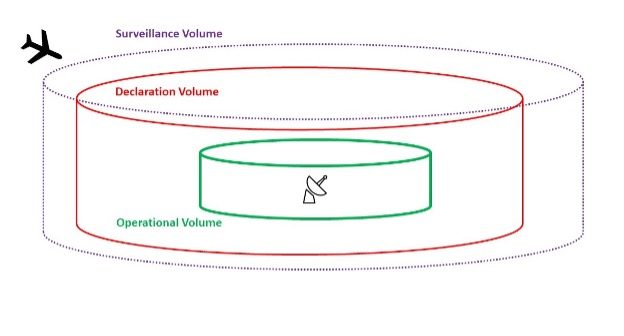
surveillance volume vs. operational volume UASWhile these terms sound a little confusing, let’s try to make them more comprehensible.

Imagine that an air traffic intruder (big/small plane, helicopter) flies towards the GBSS location. The first area it will hit is Surveillance Volume (SV). SV is an area where a ground-based system can detect “something,” but is still not clear if this “something” is a real intruder or some kind of other object. The system is still trying to find out if this object is a real intruder or not. Once the GBSS system passes the criteria for track determination, it declares the object as a track of an air traffic intruder – and the intruder is transitioned from the surveillance volume to the Declaration Volume (DV) (it should be noted that different technologies (e.g., RADAR, Electro-Optical, or Acoustic) have different approaches to determining whether the intruder is an object of interest or not. Each technology uses its own algorithms and techniques to define the criteria for track establishment).

From this point on, the intruder is in the Declaration Volume. The GBSS has established the track and can transmit it to the other functions in the DAA framework, such as Alert or Avoid functions.

The Alert function should now determine if this intruder is a threat to the UAV or not. If the intruder is determined to be on the course to breach a UAV Well Clear (WC) Volume (2000ft horizontal ± 100ft vertical), then an avoidance maneuver is initiated (commonly a vertical descent to a safe altitude). While the UAV is executing this, the intruder is still flying towards the UAV. Once the UAV reaches a safe altitude, a minimum 2000ft (610m) horizontal buffer should be between the UAV and the intruder to ensure that WC volume is not breached.
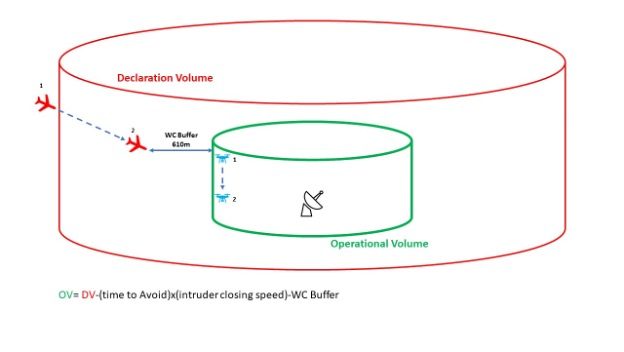
declaration volume vs operational volume UAS

To determine the Operational Volume (OV) around the GBSS, the UAV operator should take into consideration multiple variables such as the Declaration range, average intruder speed, total avoidance maneuver time, and others. Below is a simple example of how to determine operational volume boundaries based on all of the above:

Let’s assume:

  • GBSS Declaration Range – 2000 meters
  • Average intruder speed – 57m/s (110 kts)
  • UAV operational altitude – 100ft AGL
  • UAV safe altitude – 50ft
  • Time to complete the avoidance maneuver – 4s (50ft descend at 4m/s descend rate)
  • Pilot response time – 5s (Per ASTM DAA performance standard, pilot-directed maneuver)
  • Total system latencies – 1s
  • WC buffer – 2000ft (610m)

To determine the operational volume radius, we must calculate the worst-case scenario, meaning that the UAV is at the edge of the operational volume, and the intruder is flying toward it.

  1. GBSS detects the intruder at the 2000-meter range.
  2. The detected track is communicated to the Remote Pilot In Command (RPIC)
  3. Pilot executes predetermined avoidance maneuver procedure (5s)
  4. UAV completes avoidance maneuver and reaches the safe altitude(4s)
  5. Add total system latency (1s)
  6. Subtract WC buffer 610m.

If we do “Outside In” calculations >>> 2000m – 5sx57m/s – 4sx57m/s – 1sx57m/s – 610m= 820m. This means that based on the above assumptions, at an 820m radius from the GBSS, the UAV can operate everywhere and have enough time budget to reach the safe altitude when encountering the intruder in a worst-case scenario. If the UAV is operating inside the 820m radius volume, then it will have more time to reach the safe altitude, therefore making the whole operation safer.

The above calculations represent the simplified version of the operational area determination. Actual calculations might take into account other variables.

Conclusion

UAS Operational Volume is not a fixed value. While the GBSS Surveillance and Declaration ranges are fixed, UAV Operational Volume is mostly dependent on the UAS operations conops and the characteristics of the UAS systems. Making adjustments to the operational and safe altitude, UAV speeds and other factors can drastically change the operational area. It’s therefore upon the system integrators to determine the exact dimensions of the operational area based on certain locations and circumstances.

Learn more about MatrixSpace’s drone detection solution at https://matrixspace.com/dronedetection/

Akaki Kunchulia, Airspace Regulations Lead, MatrixSpace has over 18 years of experience in the aviation field, starting his career in the Republic of Georgia as an Air Traffic Controller at Georgian Air Navigation. He has supported the FAA and NASA on multiple programs such as UAS Traffic Management, FAA NextGen, SESAR JU harmonization, and NASA mostly in UAS and Advanced Air Mobility fields.


Read more:

  • MatrixSpace Scores $10 Million in Funding
  • MatrixSpace Radar: Cell-Phone Sized, High Performance, AI Sensor
  • 3 Businesses that Rely Upon Complex UAS Operations Explain Why BVLOS Drone Flight is Critical for the Industry to Succeed

 

Miriam McNabb

Miriam McNabb is the Editor-in-Chief of DRONELIFE and CEO of JobForDrones, a professional drone services marketplace, and a fascinated observer of the emerging drone industry and the regulatory environment for drones. Miriam has penned over 3,000 articles focused on the commercial drone space and is an international speaker and recognized figure in the industry.  Miriam has a degree from the University of Chicago and over 20 years of experience in high tech sales and marketing for new technologies.
For drone industry consulting or writing, Email Miriam.

TWITTER:@spaldingbarker

Subscribe to DroneLife here.

Filed Under: DL Exclusive, Drone News, Drone News Feeds, Drones in the News, Featured, News, Products, Sensors Tagged With: advanced drone operations, declaration volume GBSS, GBSS, ground based surveillance systems, MatrixSpace, operational volume UAS, surveillance volume

Reader Interactions

Trackbacks

  1. Surveillance SDSP – A New Standard for Low Altitude Air Traffic Detections - MatrixSpace says:
    January 11, 2024 at 10:51 am

    […] Surveillance and declaration volume sizes (read more information here). […]

    Reply
  2. Surveillance vs. Declaration vs. Operational Quantity UAS - Hello says:
    December 3, 2023 at 12:05 am

    […] Miriam McNabb is the Editor-in-Chief of DRONELIFE and CEO of JobForDrones, an expert drone companies market, and a fascinated observer of the rising drone trade and the regulatory setting for drones. Miriam has penned over 3,000 articles targeted on the business drone area and is a world speaker and acknowledged determine within the trade.  Miriam has a level from the College of Chicago and over 20 years of expertise in excessive tech gross sales and advertising for brand new applied sciences.For drone trade consulting or writing, E-mail Miriam. […]

    Reply
  3. Surveillance vs. Declaration vs. Operational Quantity UAS - Enjbs says:
    November 29, 2023 at 5:03 am

    […] Miriam McNabb is the Editor-in-Chief of DRONELIFE and CEO of JobForDrones, knowledgeable drone providers market, and a fascinated observer of the rising drone business and the regulatory setting for drones. Miriam has penned over 3,000 articles targeted on the industrial drone house and is a global speaker and acknowledged determine within the business.  Miriam has a level from the College of Chicago and over 20 years of expertise in excessive tech gross sales and advertising for brand new applied sciences.For drone business consulting or writing, E mail Miriam. […]

    Reply
  4. The Primer on Surveillance vs. Declaration vs. Operational Volume says:
    November 28, 2023 at 4:08 pm

    […] Published in DroneLife […]

    Reply

Leave a Reply Cancel reply

Your email address will not be published. Required fields are marked *

Primary Sidebar

LATEST

Vantis BVLOS System Adds New Partner, FAA Waiver Across 5,000 Square Miles

A new FAA aircraft-agnostic waiver lets Frontier Precision fly any NDAA-compliant drone under 55 pounds across more than 5,000 square…

Continue Reading Vantis BVLOS System Adds New Partner, FAA Waiver Across 5,000 Square Miles

MatrixSpace Validated in U.S. Army’s Operation Jailbreak Integration Sprint

The portable radar maker’s integration with Anduril Lattice and IBCS-M passed Army validation at Fort Carson, joining 55 companies in…

Continue Reading MatrixSpace Validated in U.S. Army’s Operation Jailbreak Integration Sprint

Army Medical Brigade Expands Drone Use for Battlefield Resupply

New training program helps medical personnel deliver critical supplies faster while reducing risk to soldiers The U.S. Army’s 44th Medical…

Continue Reading Army Medical Brigade Expands Drone Use for Battlefield Resupply

Counter-Drone Partnership Sends Ouster Shares Higher as Investors Focus on Airspace Security

Lidar company’s agreement with German counter-UAS firm highlights growing market for drone detection and interception technologies Shares of lidar manufacturer…

Continue Reading Counter-Drone Partnership Sends Ouster Shares Higher as Investors Focus on Airspace Security

Airport Drone Closures Raise a Bigger Question: What Do Authorities Actually Know?

Recent airport disruptions highlight a growing challenge: detecting an object in protected airspace is often easier than identifying it, locating…

Continue Reading Airport Drone Closures Raise a Bigger Question: What Do Authorities Actually Know?

Finding the Person Behind the Drone: Sky Spy Demonstrates Airborne Detection System with French Military

Drone-mounted system helps military users detect and locate drone operators, control stations, jammers, and other RF emitters in contested environments.…

Continue Reading Finding the Person Behind the Drone: Sky Spy Demonstrates Airborne Detection System with French Military

Congress Pushes for Expanded ADS-B Requirements Following Deadly D.C. Midair Collision

Bipartisan lawmakers urge aviation bill negotiators to adopt stronger aircraft visibility measures and preserve broader safety reforms The leaders of…

Continue Reading Congress Pushes for Expanded ADS-B Requirements Following Deadly D.C. Midair Collision

Motorola Solutions Makes $1.5 Billion Bet on Counter-Drone Technology

Acquisition Highlights Growing Demand for Airspace Security as Governments Expand Counter-UAS Authorities Motorola Solutions announced plans to acquire counter-drone company…

Continue Reading Motorola Solutions Makes $1.5 Billion Bet on Counter-Drone Technology

Government Signals Drive Rally in US Drone Stocks

Red Cat, Ondas, and Unusual Machines Gain as Investors Respond to Growing Federal Support for U.S. Drone Industry Several publicly…

Continue Reading Government Signals Drive Rally in US Drone Stocks

FAA Creates World Cup No-Drone Zones Across U.S. Host Cities

Temporary flight restrictions will cover stadiums, fan events, team hotels, training sites, and base camps during FIFA World Cup 2026…

Continue Reading FAA Creates World Cup No-Drone Zones Across U.S. Host Cities

Secondary Sidebar

Footer

SPONSORED

Inspired Flight Gremsy IF800 VIO F1 drones geo week

What Will It Take to Strengthen U.S. Drone Manufacturing? A Conversation with Inspired Flight’s CEO

Global Mapper Mobile data collection

Collection Ground Control Points with Global Mapper Mobile

Military Drone Mapping Solutions

How SimActive’s Correlator3D™ is Revolutionizing Military Mapping: An Exclusive Interview with CEO Philippe Simard

Photogrammetry Accuracy Standards

SimActive Photogrammetry Software: Enabling Users to Meet Accuracy Standards for Over 20 Years

NACT Engineering Parrot ANAFI tether indoor shot

Smart Tether for Parrot ANAFI USA from NACT Engineering

Blue Marble, features global mapper, features Blue Marble

Check Out These New Features in Global Mapper v25 from Blue Marble

About Us | Contact Us | Advertise With Us | Write for Us | Privacy Policy | Terms of Service

The Trusted Source for the Business of Drones.

This website uses cookies and third party services. By clicking OK, you are agreeing to our privacy policy. ACCEPT

Manage consent

Privacy Overview

This website uses cookies to improve your experience while you navigate through the website. Out of these, the cookies that are categorized as necessary are stored on your browser as they are essential for the working of basic functionalities of the website. We also use third-party cookies that help us analyze and understand how you use this website. These cookies will be stored in your browser only with your consent. You also have the option to opt-out of these cookies. But opting out of some of these cookies may affect your browsing experience.
Necessary
Always Enabled
Necessary cookies are absolutely essential for the website to function properly. These cookies ensure basic functionalities and security features of the website, anonymously.
CookieDurationDescription
cookielawinfo-checkbox-analytics11 monthsThis cookie is set by GDPR Cookie Consent plugin. The cookie is used to store the user consent for the cookies in the category "Analytics".
cookielawinfo-checkbox-functional11 monthsThe cookie is set by GDPR cookie consent to record the user consent for the cookies in the category "Functional".
cookielawinfo-checkbox-necessary11 monthsThis cookie is set by GDPR Cookie Consent plugin. The cookies is used to store the user consent for the cookies in the category "Necessary".
cookielawinfo-checkbox-others11 monthsThis cookie is set by GDPR Cookie Consent plugin. The cookie is used to store the user consent for the cookies in the category "Other.
cookielawinfo-checkbox-performance11 monthsThis cookie is set by GDPR Cookie Consent plugin. The cookie is used to store the user consent for the cookies in the category "Performance".
viewed_cookie_policy11 monthsThe cookie is set by the GDPR Cookie Consent plugin and is used to store whether or not user has consented to the use of cookies. It does not store any personal data.
Functional
Functional cookies help to perform certain functionalities like sharing the content of the website on social media platforms, collect feedbacks, and other third-party features.
Performance
Performance cookies are used to understand and analyze the key performance indexes of the website which helps in delivering a better user experience for the visitors.
Analytics
Analytical cookies are used to understand how visitors interact with the website. These cookies help provide information on metrics the number of visitors, bounce rate, traffic source, etc.
Advertisement
Advertisement cookies are used to provide visitors with relevant ads and marketing campaigns. These cookies track visitors across websites and collect information to provide customized ads.
Others
Other uncategorized cookies are those that are being analyzed and have not been classified into a category as yet.
SAVE & ACCEPT