
Recently published European drone regulations provide operations- and risk-based rules for drone operations. Here, former EASA Pincipal Advisor explains the European regulatory system: and gives an update on the new developments on the horizon.
Drone Life – Drones are Flying High in Europe!
 By: Dawn M.K. Zoldi, Guest Contributor
European drones are flying high, as regulators continue to forge a viable path for integration. Yves Morier, former European Union Aviation Safety Agency (EASA) Principal Advisor for new technologies to the Flight Standard Director, provides an explanation of the European regulatory system and an update on the way ahead European drone regulations. After having served in the French military, Morier’s illustrious civilian career includes long stints at the French Civil Aviation Authority, the Joint Aviation Authorities in the Netherlands and at EASA, from which he retired in 2019.
According to Morier, EASA, created in 2002 by a regulation of the European Parliament and the Council (Member States), provides a high uniform level of civil Aviation Safety in the European Union (EU). State aircraft and operations, similar to the U.S. “public aircraft,” are excluded from EASA’s regulation as are certain small low risk manned aircraft operations. All civil drones, regardless of size, weight or use are covered by EASA regulations.
The EASA Basic Regulation (EU) 2018/ 1139 defines the roles and responsibilities of the EASA, European Commission (EC), the 27 EU Member States (plus Iceland, Norway, Switzerland and Liechtenstein) and the Agency as follows:
- EASA – focuses on aircraft design (e.g. type certificates) and product approvals (e.g. design organization approvals) including for third-party countries. It also approves organizations located in third countries.The Agency issues Certification Specifications, Airworthiness Directives, and Safety Directives and Acceptable Means of Compliance/ Guidance Material (AMC/GM), which are broadly equivalent to the Federal Aviation Administration’s (FAA) Advisory Circulars. EASA also issues Regulations (Opinions), which when adopted by the Commission after open consultation (Notice of Proposed Amendment or NPA) with the European Parliament and/or the Member States, become binding on Member States. The Agency also monitors Member States’ implementation of drone regulations through regular team visits and evaluations.
- Member States – provide all other approvals for the people or organizations under their jurisdiction including licences, air operator certificates, maintenance approvals, production approvals, air traffic control, aerodrome (airport) certificates, UAS pilot qualifications, authorizations for operations in the specific category (more below on that) and registration of drone operators. Registries are national but interconnected through an EASA-defined and brokered system. Member State approvals are valid in all EU and associated States except in the case of specific operations authorisations where some elements related to geography and weather may need to be checked when moving to another country. Finally, Member States also participate on the EASA Management Board, which gives them a voice in internal EASA management.
The Basic Regulation has been implemented through two regulations, below.
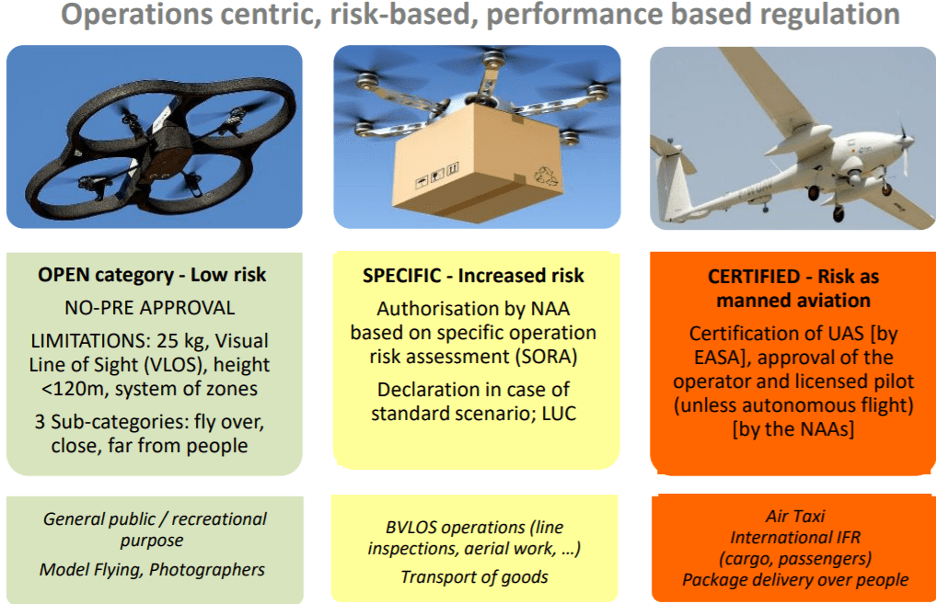
Regulation 2019/947 provides operations-centric and risk-based rules and procedures for drone operations. It defines three categories of UAS operations (open, specific and certified) developed in parallel to the JARUS categories A, B and C, also covered previously in DroneLife here.
Open Category
In the open category, there is no operational approval but rather a set of limitations such as visual line of sight (VLOS), maximum height 400 ft, and maximum take-off mass below 55 lbs. The regulation included operations over people (OOP) and at night at its inception. The open category is subdivided in 3 sub-categories relevant to OOP noted below:
- A1 – allows overflight over isolated people, with drones having a max mass of 900g (1.98 lbs) in classes C0 and C1 (more on classes below). Online training is required.
- A2 – allows flying close to people, for drones with a max mass: of 4kg (8.8 lbs), in class C2. Online training plus self-declared practical training is required.
- A3-allows flights only far from people and from airports, for drones having a max mass of 55 lbs, class C3 and C4. Online training is also required.
Specific Category
The specific category covers all operations that are not in the open and certified categories. It requires risk-based operational authorization issued by the relevant Member State Authority. Examples include beyond visual line of sight and some drone delivery operations. The specific category is akin to obtaining Part 107 waivers in the U.S.
The accepted method of compliance used by Member States is the Specific Operation Risk Assessment (SORA) developed by the Joint Authorities for Rulemaking of Unmanned Systems (JARUS). It addresses ground and air risk and combines the two to create a Specific Assurance and Integrity Level (SAIL) between I and VI. A risk level of VII or above moves the operation into the higher certified category. The SORA also defines appropriate mitigation measures.
Morier, who was the Chairman of the JARUS from 2017 to 2019, elaborates, “To avoid systematic application of SORA, standard scenarios (low risk operations) have been defined, which allow for provision of a Declaration of Compliance instead of a formal authorization. Pre-Determined Risk Assessments (PDRA) have also been defined. If an operation meets these, an authorization is still necessary but should be obtained more easily. Authorizations in the specific category are valid in all EU Countries, but mitigation measures related to the geography and the weather may need to be checked.”
BVLOS is allowed in specific and certified categories, depending on the risk assessment.
Certified category
In the certified category, the drones are certified, the operators receive a certificate and the pilot has a license. This is most akin to manned aviation flights and how the U.S. applies Part 135 to on demand commercial deliveries. Certified operations have been classified in 3 types:
- Type #1 operations – Instrument flight rules (IFR) operations for drones that carry cargo in airspace classes A–C (ICAO airspace classification) and take off from and/or landing at airports falling under the Basic Regulation.
- Type #2 operation – drones that take off and/or land in congested environments using predefined routes in the U-space airspace. These include operations of unmanned VTOL aircraft carrying passengers (e.g. air taxis) or cargo (e.g. goods delivery services).
- Type #3 operations – same as for type #2 operations with VTOL aircraft with a pilot on board, including operations out of the U-Space airspace
Regulation 2019/ 945 is the second implementing regulation for the Basic Regulation and describes how to obtain a class marking for the drone similar to how all other products in the EU are marked using the “CE Marking.” For drones, six classes, C0 to C, apply. C0 to C4 levels of compliance apply to the open category; C5 and C6 to the specific category inclusive of SORA standard scenarios 01 and 02. Morier explains, “This is not an airworthiness approval but there are some similarities such as technical requirements, applicable standards, and verification of conformity by an independent body.”
Drones in classes C1 and 2, C3 (unless tethered) and C5 and 6 must be equipped with remote identification (RID). The Reg defines RID as, “a system that ensures the local broadcast of information about an unmanned aircraft in operation, including the marking of the unmanned aircraft, so that this information can be obtained without physical access to the unmanned aircraft.” Regulation 2019/945 defines the requirement for the RID system and the requirement for the identification number (Standard ANSI/CTA-2063-A-2019).
This Regulation also includes the requirements when drones should be certified, as well as requirements for third countries operators of UAS. Americans visiting Europe with their drones basically have to comply with all these regulations except when the Commission recognizes third-party certificates for pilots and operators which provide the same level of safety as EU regulations. These third-party operators are overseen by the first Member State in which they plan to operate.
Stay tuned the following upcoming events anticipated in Europe:
- Certified Category Regs – two upcoming Notices of Proposed Amendment, like the FAA’s Notice of Public Rulemaking, will be published in the certified category: one for type 3 operations that will be issued in 2022 and the other for type 1 and 2 operations that will be issued in 2023.
- Regulation 2019/945 technical requirements standards – including direct RID, light drones and for geo-awareness remain under following a rolling development plan maintained by the European Unmanned Aircraft Standard Coordination Group (EUSCG) , hosted by EUROCAE.
- U-Space (UTM) – the SESAR Joint Undertaking has fifteen active and twenty-two closed research projects, including scale demonstrations. The applicable Regulation 2021/ 664, complemented by other two regulations, Regulations 2021/ 665 and 666 will apply in January 2023 in geographical areas established as U-space airspace defined by the Member States to UAS operators, U-space service providers and providers of common information services. Expect Fall 2021 trials (Dronelife coverage here)
- Acceptable Means of Compliance/ Guidance Material (AMC/GM) and Standards – the NPA for AMC/GM for the U-Sspace regulation is scheduled for this year.
For more information on European regulations and guidance, see:
- SESAR U-Space: https://www.sesarju.eu/U-space
- EC R&D: https://www.aw-drones.eu/
- EUROCONTROL Standards and methodologies: https://www.eurocontrol.int/unmanned-aircraft-systems
- EUSCG Standards Development Plan: https://www.euscg.eu/
- EASA: https://www.easa.europa.eu/domains/civil-drones-rpas
 Dawn M.K. Zoldi (Colonel, USAF, Retired) is a licensed attorney with 28 years of combined active duty military and federal civil service to the Department of the Air Force. She is an intIernationally recognized expert on unmanned aircraft system law and policy, a columnist for several magazines,recipient of the Woman to Watch in UAS (Leadership) Award 2019, President and CEO of UAS Colorado and the CEO of P3 Tech Consulting LLC. For more information, visit her website at: https://www.p3techconsulting.com.


[…] and ground risk-based model, would work well as a pan-African and national-level regulatory model. Europe, Canada and Australia already use […]