• Skip to main content
  • Skip to secondary menu
  • Skip to primary sidebar
  • Skip to secondary sidebar
  • Skip to footer
  • DroneRacingLife
  • DroneFlyers
  • Newsletter
DroneLife

DRONELIFE

Stay up to date on all the latest Drone News

  • News
  • Products
  • Industries
    • Agriculture
    • Construction
    • Delivery
    • Dual Use
    • Inspection
    • Public Safety
    • Surveying
  • Enthusiasts
  • Regulations
  • Business
  • Video
  • Podcasts

DRONEII: The 6 Key Elements of a Good Drone Law

May 6, 2019 by Miriam McNabb 7 Comments


Drone industry analysts DRONEII use their recent drone industry analysis to point out the key elements of good drone laws – and determine whether or not a country is ready for the commercial drone industry.

Guest Post: This article published with permission from our partners at DroneII, Drone Industry Insights. 

Regulating new technologies has always been a cumbersome task for authorities. This is because regulations must encompass technological leaps at the same time as they occur, and innovation is much faster than bureaucracy. Striking the balance between responsible and facilitating regulations is difficult, and various countries have taken very different approaches to drones.

In order to make comparisons between national regulations easier there is now a quantitative metric of a country’s preparedness for the current and future development of commercial drones – the Drone Readiness Index.

What goes into such an index? How do we determine whether a country is ‘ready’ for the current and continued development of commercial drones? There are six key factors that are crucial to a good drone law: applicability, human resources, administrative infrastructure, operational limitations, airspace integration, and social acceptance
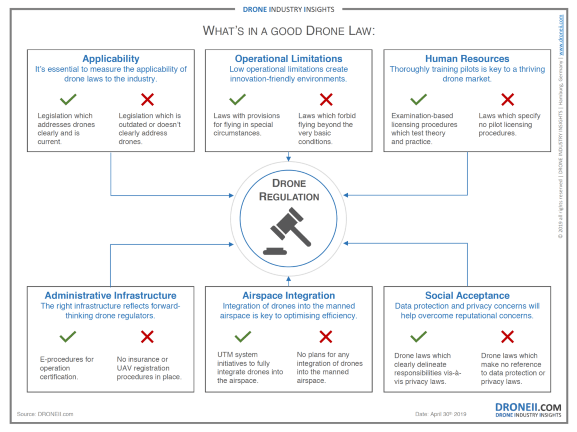
image courtesy DRONEII

Applicability

Not all countries in the world have drone regulations. Some have laws specifically dedicated to drones, some have adapted their general aviation regulations to include drones, and other make no reference to unmanned aircraft at all. A reference to drones in aviation legislation is the bare minimum a government must do to qualify as ‘ready’ for the current and future development of drones.

When examining laws it is also important to look for context. Legislation made four years ago but untouched since is likely to be outdated. Given the dynamic pace at which the industry is growing, it’s crucial to examine whether the drone regulations have been regularly updated.  Continuous revisions reflect the government and bureaucratic apparatus’ willingness and drive to grow the drone market by continuing to address the emerging regulatory challenges in the commercial drone space.

Human Resources

Despite the drive towards fully autonomous drones, the drone industry still requires significant human resources to move forward. It is crucial to measure the efficacy of regulations to streamline the process of recruitment and training of humans for work in the commercial drone industry i.e. the consideration for pilots.

The HR parameter of the Drone Readiness Index measures what sort of infrastructure is in place for training and certifying pilots, assuming that the more comprehensive the drone regulation, the more consideration it has for those flying drones. The parameter also measures the results of the regulations by comparing the numbers of approved drone operators per capita in different countries.

Administrative Infrastructure

A sound and functioning administrative infrastructure is the key support a government can provide to new tech. In a new and often legally undefined space, governments often scramble to develop administrative infrastructure for new businesses to rely on.

This parameter measures the administrative infrastructure in place to facilitate the responsible use of commercial drones which includes insurance requirements, drone registers, and standard procedures for acquiring flight permissions. Administrative infrastructure is graded on not only how comprehensive it is, but also how clear and streamlined it is (considering e-infrastructure, for example).

Operational Limits

The most common regulation question is “where can you actually fly a drone?” Countries vary greatly in the sort of limitations they have in place for the operation of a drone. To balance out strict administrative requirements, it is critical to provide a range of operational limits which allow the drone industry to keep developing state of the art solutions, as long as they adhere to the legislation in place.

This parameter measures whether, where and how drones are able to operate. It compares countries by whether their regulations allow fo BVLOS (Beyond the Visual Line of Sight) flights or not, at night or not, near people or not. As such the Drone Readiness Index is also able to measure the headway countries are making towards urban aerial mobility.

Airspace Integration

If urban aerial mobility is the goal then successful airspace integration is essential to success. In order to be able to fly drones in urban environments and in ‘special conditions’, it is crucial for unmanned aircraft to be able to operate smoothly in zones which are currently restricted. This parameter measures whether and to what extent there have been regulatory efforts to integrate manned and unmanned airspace.

Social Acceptance

Social acceptance of a new technology is crucial to its success. The major concerns that people usually have with drones is their ability to fly in their proximity and enter their personal space without authorisation. Many debates over drones and urban aerial mobility have centred on the issues of privacy and personal data protection. The most forward-looking responsible drone law anticipates this issue and provides a clear outline of drone operator responsibilities when flying in order to protect people’s privacy.

This parameter measures the consideration of social acceptance hurdles of drone regulations as the best drone laws will be helpful in mitigating reputational risks. It is used to analyse whether a drone law has considered data protection and/or privacy concerns.

Miriam McNabb

Miriam McNabb is the Editor-in-Chief of DRONELIFE and CEO of JobForDrones, a professional drone services marketplace, and a fascinated observer of the emerging drone industry and the regulatory environment for drones. Miriam has penned over 3,000 articles focused on the commercial drone space and is an international speaker and recognized figure in the industry.  Miriam has a degree from the University of Chicago and over 20 years of experience in high tech sales and marketing for new technologies.
For drone industry consulting or writing, Email Miriam.

TWITTER:@spaldingbarker

Subscribe to DroneLife here.
Filed Under: Business and Finance, Droneii, Feature 1, News, Uncategorized Tagged With: Drone Industry, drone laws, droneii

Reader Interactions

Trackbacks

  1. DRONEII: The 6 Key Elements of a Good Drone Law | MyDroneWorld says:
    May 7, 2019 at 10:57 am

    […] Source link […]

    Reply
  2. DRONEII: The 6 Key Elements of a Good Drone Law - Air Drone Camera says:
    May 7, 2019 at 4:30 am

    […] More Info […]

    Reply
  3. DRONEII: The 6 Key Elements of a Good Drone Law says:
    May 6, 2019 at 6:34 pm

    […] post DRONEII: The 6 Key Elements of a Good Drone Law appeared first on […]

    Reply
  4. DRONEII: The 6 Key Elements of a Good Drone Law ⋆ www.Droni4k.com says:
    May 6, 2019 at 4:33 pm

    […] Link sorgente originale […]

    Reply
  5. DRONEII: The 6 Key Elements of a Good Drone Law - Drones Crunch says:
    May 6, 2019 at 4:29 pm

    […] DRONELIFE […]

    Reply
  6. DRONEII: The 6 Key Elements of a Good Drone Law | Drone Magazine says:
    May 6, 2019 at 4:01 pm

    […] Source […]

    Reply
  7. DRONEII: The 6 Key Elements of a Good Drone Law - Angle News says:
    May 6, 2019 at 2:53 pm

    […] Source link […]

    Reply

Leave a Reply Cancel reply

Your email address will not be published. Required fields are marked *

Primary Sidebar

LATEST

UK Government Backs Drone Expansion with £50 Million Investment

Windracers among companies recognized as UK moves to scale routine drone operations and advanced air mobility The UK government has…

Continue Reading UK Government Backs Drone Expansion with £50 Million Investment

U.S. Navy Awards Packet Digital $9.8 Million to Scale Drone Battery Production in North Dakota

North Dakota facility will manufacture NDAA-compliant battery cells for drones and defense systems Packet Digital and its subsidiary Badland Batteries…

Continue Reading U.S. Navy Awards Packet Digital $9.8 Million to Scale Drone Battery Production in North Dakota

Danish Startup Launches 10K Drone Sensor for Wide-Area Search, Surveillance, and Mine Detection

Danish start-up promotes innovative sensor system By DRONELIFE Features Editor Jim Magill Marine rescue teams using drones to search for…

Continue Reading Danish Startup Launches 10K Drone Sensor for Wide-Area Search, Surveillance, and Mine Detection

FAA Publishes Proposed Rule for Drone Restrictions Around Critical Infrastructure

New Section 2209 NPRM would create a formal process for restricting drone flights near sensitive facilities The Federal Aviation Administration…

Continue Reading FAA Publishes Proposed Rule for Drone Restrictions Around Critical Infrastructure

Public Comment Window Closing: FCC Weighs DJI Challenge to Covered List Ruling

Public input period highlights ongoing divide over foreign drone policy and market access The deadline to submit comments on the…

Continue Reading Public Comment Window Closing: FCC Weighs DJI Challenge to Covered List Ruling

FAA Advances Long-Delayed Rule to Restrict Drones Over Sensitive Sites

Long-awaited proposal aims to balance security and access in low-altitude airspace The Federal Aviation Administration (FAA) has announced a long-anticipated…

Continue Reading FAA Advances Long-Delayed Rule to Restrict Drones Over Sensitive Sites

WaiV Robotics Debuts Maritime VTOL Landing Pad with $7.5M Seed Round

The London-based maritime startup unveils a gyro-stabilized landing pad that recovers VTOL drones on vessels as small as 10 meters…

Continue Reading WaiV Robotics Debuts Maritime VTOL Landing Pad with $7.5M Seed Round

Perceptual Robotics Raises Funding to Automate Wind Turbine Inspection Drones

Loggerhead Ventures leads the round with follow-on from One Planet Capital, fueling AI-powered drones for wind farm maintenance. Perceptual Robotics…

Continue Reading Perceptual Robotics Raises Funding to Automate Wind Turbine Inspection Drones

Teledyne FLIR OEM Launches Prism Software to Detect Small Drones at Longer Range

New AI-enabled software aims to identify small drone threats earlier and support faster response Teledyne FLIR OEM, part of Teledyne…

Continue Reading Teledyne FLIR OEM Launches Prism Software to Detect Small Drones at Longer Range

When Commercial Drone Technology Meets Defense: A Closer Look at Civil–Military Integration

New analysis highlights how shared innovation pipelines are shaping both commercial drone markets and military capabilities A recent report from…

Continue Reading When Commercial Drone Technology Meets Defense: A Closer Look at Civil–Military Integration

Secondary Sidebar

Footer

SPONSORED

Inspired Flight Gremsy IF800 VIO F1 drones geo week

What Will It Take to Strengthen U.S. Drone Manufacturing? A Conversation with Inspired Flight’s CEO

Global Mapper Mobile data collection

Collection Ground Control Points with Global Mapper Mobile

Military Drone Mapping Solutions

How SimActive’s Correlator3D™ is Revolutionizing Military Mapping: An Exclusive Interview with CEO Philippe Simard

Photogrammetry Accuracy Standards

SimActive Photogrammetry Software: Enabling Users to Meet Accuracy Standards for Over 20 Years

NACT Engineering Parrot ANAFI tether indoor shot

Smart Tether for Parrot ANAFI USA from NACT Engineering

Blue Marble, features global mapper, features Blue Marble

Check Out These New Features in Global Mapper v25 from Blue Marble

About Us | Contact Us | Advertise With Us | Write for Us | Privacy Policy | Terms of Service

The Trusted Source for the Business of Drones.

This website uses cookies and third party services. By clicking OK, you are agreeing to our privacy policy. ACCEPT

Manage consent

Privacy Overview

This website uses cookies to improve your experience while you navigate through the website. Out of these, the cookies that are categorized as necessary are stored on your browser as they are essential for the working of basic functionalities of the website. We also use third-party cookies that help us analyze and understand how you use this website. These cookies will be stored in your browser only with your consent. You also have the option to opt-out of these cookies. But opting out of some of these cookies may affect your browsing experience.
Necessary
Always Enabled
Necessary cookies are absolutely essential for the website to function properly. These cookies ensure basic functionalities and security features of the website, anonymously.
CookieDurationDescription
cookielawinfo-checkbox-analytics11 monthsThis cookie is set by GDPR Cookie Consent plugin. The cookie is used to store the user consent for the cookies in the category "Analytics".
cookielawinfo-checkbox-functional11 monthsThe cookie is set by GDPR cookie consent to record the user consent for the cookies in the category "Functional".
cookielawinfo-checkbox-necessary11 monthsThis cookie is set by GDPR Cookie Consent plugin. The cookies is used to store the user consent for the cookies in the category "Necessary".
cookielawinfo-checkbox-others11 monthsThis cookie is set by GDPR Cookie Consent plugin. The cookie is used to store the user consent for the cookies in the category "Other.
cookielawinfo-checkbox-performance11 monthsThis cookie is set by GDPR Cookie Consent plugin. The cookie is used to store the user consent for the cookies in the category "Performance".
viewed_cookie_policy11 monthsThe cookie is set by the GDPR Cookie Consent plugin and is used to store whether or not user has consented to the use of cookies. It does not store any personal data.
Functional
Functional cookies help to perform certain functionalities like sharing the content of the website on social media platforms, collect feedbacks, and other third-party features.
Performance
Performance cookies are used to understand and analyze the key performance indexes of the website which helps in delivering a better user experience for the visitors.
Analytics
Analytical cookies are used to understand how visitors interact with the website. These cookies help provide information on metrics the number of visitors, bounce rate, traffic source, etc.
Advertisement
Advertisement cookies are used to provide visitors with relevant ads and marketing campaigns. These cookies track visitors across websites and collect information to provide customized ads.
Others
Other uncategorized cookies are those that are being analyzed and have not been classified into a category as yet.
SAVE & ACCEPT