
• Skip to main content
  • Skip to secondary menu
  • Skip to primary sidebar
  • Skip to secondary sidebar
  • Skip to footer
  • DroneRacingLife
  • DroneFlyers
  • Newsletter
DroneLife

DRONELIFE

Stay up to date on all the latest Drone News

  • News
  • Products
  • Industries
    • Agriculture
    • Construction
    • Delivery
    • Dual Use
    • Inspection
    • Public Safety
    • Surveying
  • Enthusiasts
  • Regulations
  • Business
  • Video
  • Podcasts

DRONEII: Tech Talk – Unraveling 5 Levels of Drone Autonomy

March 11, 2019 by Miriam McNabb 10 Comments

Guest Post: This article published with permission from our partners at DroneII, Drone Industry Insights. Article authored by Millie Radovic.

One of the most common phrases in our industry is “we manufacture autonomous drones”. But can companies with very different products claim they have autonomous drones, and both be right?

The simplest answer is, yes. These vast differences in the types of solutions that are described as autonomous are largely down to the fact that as there is no single authority determining those definitions, they are often free-flowing. Not only are definitions free-flowing but phrases like autonomy and automation are mistakenly presumed to be interchangeable in both the drone and car industries. (It doesn’t help that when we discuss levels of autonomy, we look at degrees of automation).

The best way to understand the autonomy of drones is as a spectrum. If autonomy is a measure of independence from external influence and the level of self-governing, then different platforms can be autonomous but on a different point in the autonomy spectrum. The key is to understand these different levels and what they look like in practice in the drone industry.
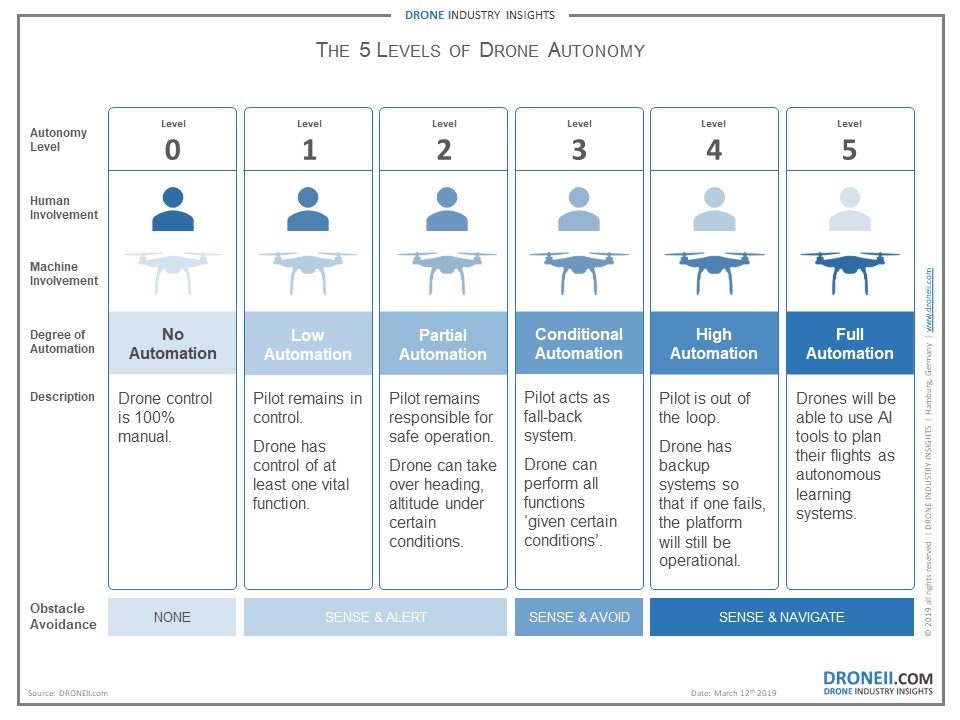
Level 0: No Automation

The pilot is in full control of every movement. Platforms are controlled 100% manually at all times.

What this looks like in practice:Drones for racing and model aircrafts.

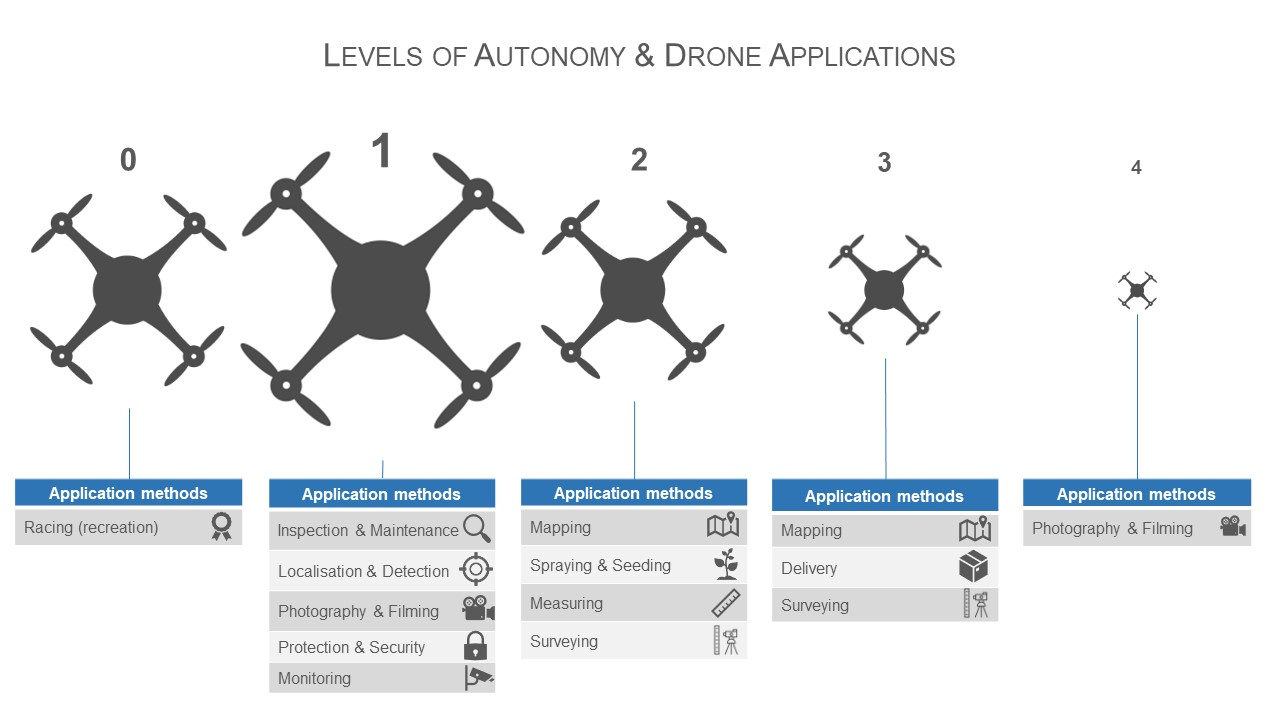
Current Application Method:Racing (recreation).

Level 1 – Pilot Assistance

The pilot remains in control of the overall operation and safety of the vehicle. However, the drone can take over at least one vital function for a finite period of time. It has no sustained vehicle control and is never in control of both speed and direction of flight at the same time, but it can provide support for navigation and/or keep altitude and position.

What this looks like in practice:A hobby or prosumer drone which is GNSS-supported to stabilize flight, while all inputs in terms of heading, altitude and speed is done via manual input. This ranges from simple recreational photo or video footage to high-end asset inspections in the industry. At this level sense & avoid features are available to alert the pilot of the drones close proximity to obstacles – the avoid part, however, is up to the manual input of the pilot.

Current Application Methods:inspection & maintenance, localization & detection, photography & filming, protection & security, and monitoring.

Level 2 – Partial Automation

The pilot is still responsible for the safe operation of the vehicle and must be ready to take control of the drone should something happen. However, under certain conditions the drone is able to take over control in terms of heading, altitude and speed. The pilot is still fully in charge, including monitoring the air space, flight conditions and reacting in case of an emergency. Most manufacturers currently build drones at this level, where the platform can assist with navigation functions and allow the pilot to disengage from some of their tasks.

What this looks like in practice:A pre-programmed flight path is uploaded to the autopilot and the drone will start executing the task to fly along these transects after take-off. Today this is a common practice for mapping and surveying missions. Some drones with this level of autonomy have a built-in automated take-off and landing feature – this makes the drone handling easier but does not make it more autonomous.

Current Application Methods:mapping, surveying, spaying & seeding, and measuring.
Level 3 – Conditional Automation

Like at Level 2, the drone can fly itself, but the human pilot must still pay attention and be prepared to take over at any time. The drone notifies the pilot if intervention is needed, so s/he is the fall-back system. This level means that the drone can perform all functions “given certain conditions”.

What this looks like in practice:A drone flies along a pre-programmed flight path when on-board sensors detect an obstacle. After the detection (e.g. of a treetop in the flight path) the drone will stop and send an alarm of an object in close proximity to the pilot. The pilot then manually corrects the heading/altitude before the drone continues to fly along its pre-programmed path.

Current Application Methods:mapping, surveying and delivery.

Level 3+ – Automized Drone Deployment

Another way to measure the autonomy of a drone is to take into account its working environment. Some manufacturers have made advancements in the automation of drone deployment by building “fully automated drone boxes”. This means there is no human needed in the loop to supervise the flight.

What this looks like in practice:The idea is to have a drone on-site to frequently perform the same task (e.g. surveying of an open-pit mine twice a week). The pre-programmed flight path stays the same, the drone is equipped with automated take-off and landing capabilities, the drone box gives shelter and the chance to recharge the batteries and automatically deploy the drone according to the given schedule.

Current Application Methods:mapping, surveying, and protection & security.

Level 4 – High Automation

The drone can be controlled by a person, but it doesn’t always need to be. It can fly itself full-time under the right circumstances. The drone is expected to have backup systems so that if one system fails, it will still be operational. Its behaviour depends upon a fixed built-in functionality or upon a fixed set of rules that dictate system behaviour. Here sense & avoid matures into sense & navigate.

What this looks like in practice:A drone equipped with a certain stack of sensors follows a person or an object. While doing this, it senses obstacles in the flightpath and actively avoids contact by changing heading and/or altitude. It literally finds a way to follow the task while automatically altering the way to do it.

Current Application Method:photography and filming.

Level 5 – Full Automation

The drone controls itself under all circumstances with no expectation of human intervention. This includes full-time automation of all flying tasks under any conditions.

There are no examples of such drones yet and they are not currently in production.

However, what they are expected to be able to do is use AI tools to plan their flights, in other words – autonomous learning systems with the ability to modify routine defining behaviours. Imagine if one day a Level 5 drone is built and tasked with monitoring sharks on a coastline. Each day the drone monitors the coastline, but most often there are problems in a certain area of its flight path. This drone will in its next flight be able to use the acquired knowledge to plan a flight to monitor that area first. Also important to bear in mind is that the 5th level of autonomy is the ticket to achieving two key goals in the drone industry: urban aerial mobility and large cargo delivery drones.

What’s next?

Don’t expect such smart drones in the air in the next year. Not only is there no regulatory base yet whatsoever to facilitate the 5th level of autonomy, but more importantly the legwork needed to achieve this level is significant – simply because of the frequency and volume of data, and the sophistication of the on-board computers crunching it that it will take. However, once this is done drones will be effectively sentient and able to save mounds of time in every single application category.

Download the PDF Infographic here. Got questions? Get in touch with the DRONEII team here.

Miriam McNabb

Miriam McNabb is the Editor-in-Chief of DRONELIFE and CEO of JobForDrones, a professional drone services marketplace, and a fascinated observer of the emerging drone industry and the regulatory environment for drones. Miriam has penned over 3,000 articles focused on the commercial drone space and is an international speaker and recognized figure in the industry.  Miriam has a degree from the University of Chicago and over 20 years of experience in high tech sales and marketing for new technologies.
For drone industry consulting or writing, Email Miriam.

TWITTER:@spaldingbarker

Subscribe to DroneLife here.
Filed Under: News Tagged With: automated drones, drone autonomy, Drone Tech, droneii

Reader Interactions

Trackbacks

  1. Road to self-driving development - Data Debug Spot says:
    August 20, 2025 at 2:41 pm

    […] DroneLife: DRONEII: Tech Talk – Unraveling 5 Levels of Drone Autonomy […]

    Reply
  2. Making Drones Smarter: The Rise Of AI. | By Wicar Akhtar | September 2023 says:
    September 4, 2023 at 2:14 am

    […] https://dronelife.com/2019/03/11/droneii-tech-talk-unraveling-5-levels-of-drone-autonomy/ […]

    Reply
  3. ドローンによる小包配送が日本で自律レベル 4 に到達 - kansaiben.jp says:
    April 7, 2023 at 6:03 pm

    […] 4 便の運航許可を取得しました。 パイロットが関与しないドローン飛行. 代わりに、ドローンにはシステム障害を補うためのバックアップ […]

    Reply
  4. aam aircraft: levels of autonomous flying – giovani izidorio cesconetto says:
    June 8, 2022 at 11:32 am

    […] as there is no single authority determining those definitions, they are often free-flowing,” Millie Radovic defines. The interesting part is seeing that even though “there is no single authority […]

    Reply
  5. AAM aircraft: Levels of autonomous flying | CAAM says:
    June 8, 2022 at 10:33 am

    […] that as there is no single authority determining those definitions, they are often free-flowing,” Millie Radovic defines. The interesting part is seeing that even though “there is no single authority […]

    Reply
  6. DRONEII: Tech Talk – Unraveling 5 Levels of Drone Autonomy | News and Reviews about Drones, Quadcopter, Camera says:
    March 12, 2019 at 6:49 am

    […] Source link […]

    Reply
  7. DRONEII: Tech Talk – Unraveling 5 Levels of Drone Autonomy – Top Drones & reviews says:
    March 11, 2019 at 11:12 pm

    […] post DRONEII: Tech Talk – Unraveling 5 Levels of Drone Autonomy appeared first on […]

    Reply
  8. DRONEII: Tech Talk – Unraveling 5 Levels of Drone Autonomy says:
    March 11, 2019 at 10:35 pm

    […] post DRONEII: Tech Talk – Unraveling 5 Levels of Drone Autonomy appeared first on […]

    Reply
  9. DRONEII: Tech Speak - Unraveling 5 Ranges of Drone Autonomy - Drone Stuff Pro says:
    March 11, 2019 at 1:29 pm

    […] Supply hyperlink cgcsn wordpress autoblog amazon autoblog affiliate autoblog wordpress web site web site improvement […]

    Reply
  10. DRONEII: Tech Talk – Unraveling 5 Levels of Drone Autonomy | Drone Magazine says:
    March 11, 2019 at 1:11 pm

    […] Source […]

    Reply

Leave a Reply Cancel reply

Your email address will not be published. Required fields are marked *

Primary Sidebar

LATEST

Aeronext Unveils ActiveWing Logistics Drone Prototype for Long-Range Delivery

This article published in collaboration with JUIDA, the Japan UAS Industrial Development Association.     The Tokyo company’s new multicopter pairs…

Continue Reading Aeronext Unveils ActiveWing Logistics Drone Prototype for Long-Range Delivery

FBI, Atlanta PD Stress Need for ‘No-Drone Zone’ Compliance

By Dronelife Features Editor Jim Magill (Editor’s note: This story is part of a series of reports on efforts to…

Continue Reading FBI, Atlanta PD Stress Need for ‘No-Drone Zone’ Compliance

Building a Resilient Supply Chain: Regional Security Leaders Focus on Industrial Readiness

Northeast National Security Conference examines how the U.S. can strengthen its defense industrial base Supply chain security has become a…

Continue Reading Building a Resilient Supply Chain: Regional Security Leaders Focus on Industrial Readiness

Defense Leaders Call for Faster Paths from Innovation to the Field

Remarks at the Northeast National Security Conference highlight growing demand for rapid, commercially informed defense solutions The 2026 Northeast National…

Continue Reading Defense Leaders Call for Faster Paths from Innovation to the Field

Collective Defence Acquires Asterion in $1 Billion Deal Combining Cybersecurity and Counter-Drone Technology

Transaction creates Luxembourg’s first defense unicorn and brings together cyber defense and combat-tested counter-UAS capabilitie Collective Defence has announced its…

Continue Reading Collective Defence Acquires Asterion in $1 Billion Deal Combining Cybersecurity and Counter-Drone Technology

Vantis BVLOS System Adds New Partner, FAA Waiver Across 5,000 Square Miles

A new FAA aircraft-agnostic waiver lets Frontier Precision fly any NDAA-compliant drone under 55 pounds across more than 5,000 square…

Continue Reading Vantis BVLOS System Adds New Partner, FAA Waiver Across 5,000 Square Miles

MatrixSpace Validated in U.S. Army’s Operation Jailbreak Integration Sprint

The portable radar maker’s integration with Anduril Lattice and IBCS-M passed Army validation at Fort Carson, joining 55 companies in…

Continue Reading MatrixSpace Validated in U.S. Army’s Operation Jailbreak Integration Sprint

Army Medical Brigade Expands Drone Use for Battlefield Resupply

New training program helps medical personnel deliver critical supplies faster while reducing risk to soldiers The U.S. Army’s 44th Medical…

Continue Reading Army Medical Brigade Expands Drone Use for Battlefield Resupply

Counter-Drone Partnership Sends Ouster Shares Higher as Investors Focus on Airspace Security

Lidar company’s agreement with German counter-UAS firm highlights growing market for drone detection and interception technologies Shares of lidar manufacturer…

Continue Reading Counter-Drone Partnership Sends Ouster Shares Higher as Investors Focus on Airspace Security

Airport Drone Closures Raise a Bigger Question: What Do Authorities Actually Know?

Recent airport disruptions highlight a growing challenge: detecting an object in protected airspace is often easier than identifying it, locating…

Continue Reading Airport Drone Closures Raise a Bigger Question: What Do Authorities Actually Know?

Secondary Sidebar

Footer

SPONSORED

Inspired Flight Gremsy IF800 VIO F1 drones geo week

What Will It Take to Strengthen U.S. Drone Manufacturing? A Conversation with Inspired Flight’s CEO

Global Mapper Mobile data collection

Collection Ground Control Points with Global Mapper Mobile

Military Drone Mapping Solutions

How SimActive’s Correlator3D™ is Revolutionizing Military Mapping: An Exclusive Interview with CEO Philippe Simard

Photogrammetry Accuracy Standards

SimActive Photogrammetry Software: Enabling Users to Meet Accuracy Standards for Over 20 Years

NACT Engineering Parrot ANAFI tether indoor shot

Smart Tether for Parrot ANAFI USA from NACT Engineering

Blue Marble, features global mapper, features Blue Marble

Check Out These New Features in Global Mapper v25 from Blue Marble

About Us | Contact Us | Advertise With Us | Write for Us | Privacy Policy | Terms of Service

The Trusted Source for the Business of Drones.

This website uses cookies and third party services. By clicking OK, you are agreeing to our privacy policy. ACCEPT

Manage consent

Privacy Overview

This website uses cookies to improve your experience while you navigate through the website. Out of these, the cookies that are categorized as necessary are stored on your browser as they are essential for the working of basic functionalities of the website. We also use third-party cookies that help us analyze and understand how you use this website. These cookies will be stored in your browser only with your consent. You also have the option to opt-out of these cookies. But opting out of some of these cookies may affect your browsing experience.
Necessary
Always Enabled
Necessary cookies are absolutely essential for the website to function properly. These cookies ensure basic functionalities and security features of the website, anonymously.
CookieDurationDescription
cookielawinfo-checkbox-analytics11 monthsThis cookie is set by GDPR Cookie Consent plugin. The cookie is used to store the user consent for the cookies in the category "Analytics".
cookielawinfo-checkbox-functional11 monthsThe cookie is set by GDPR cookie consent to record the user consent for the cookies in the category "Functional".
cookielawinfo-checkbox-necessary11 monthsThis cookie is set by GDPR Cookie Consent plugin. The cookies is used to store the user consent for the cookies in the category "Necessary".
cookielawinfo-checkbox-others11 monthsThis cookie is set by GDPR Cookie Consent plugin. The cookie is used to store the user consent for the cookies in the category "Other.
cookielawinfo-checkbox-performance11 monthsThis cookie is set by GDPR Cookie Consent plugin. The cookie is used to store the user consent for the cookies in the category "Performance".
viewed_cookie_policy11 monthsThe cookie is set by the GDPR Cookie Consent plugin and is used to store whether or not user has consented to the use of cookies. It does not store any personal data.
Functional
Functional cookies help to perform certain functionalities like sharing the content of the website on social media platforms, collect feedbacks, and other third-party features.
Performance
Performance cookies are used to understand and analyze the key performance indexes of the website which helps in delivering a better user experience for the visitors.
Analytics
Analytical cookies are used to understand how visitors interact with the website. These cookies help provide information on metrics the number of visitors, bounce rate, traffic source, etc.
Advertisement
Advertisement cookies are used to provide visitors with relevant ads and marketing campaigns. These cookies track visitors across websites and collect information to provide customized ads.
Others
Other uncategorized cookies are those that are being analyzed and have not been classified into a category as yet.
SAVE & ACCEPT