• Skip to main content
  • Skip to secondary menu
  • Skip to primary sidebar
  • Skip to secondary sidebar
  • Skip to footer
  • DroneRacingLife
  • DroneFlyers
  • Newsletter
DroneLife

DRONELIFE

Stay up to date on all the latest Drone News

  • News
  • Products
  • Industries
    • Agriculture
    • Construction
    • Delivery
    • Dual Use
    • Inspection
    • Public Safety
    • Surveying
  • Enthusiasts
  • Regulations
  • Business
  • Video
  • Podcasts

MIT New Technology Seeks to Make Drones Quieter using “Star Trek” Technology

November 23, 2018 by staff 5 Comments

Drone technology has developed along traditional lines: there is a disruptive element and then other technologies are built around it to make it better for a larger number of uses.

MIT has just published a piece about a base level technology – one where a plane or drone can fly with no moving parts,  no fossil fuel consumption, and be completely silent, being propelled by something called an “ionic wind”.  While not ready for implementation just yet,  it is one of a number of technologies that may be used to build the drones of the future.

This was originally published on the MIT News website  and in the journal Nature.

“Since the first airplane took flight over 100 years ago, virtually every aircraft in the sky has flown with the help of moving parts such as propellers, turbine blades, and fans, which are powered by the combustion of fossil fuels or by battery packs that produce a persistent, whining buzz.

Now MIT engineers have built and flown the first-ever plane with no moving parts. Instead of propellers or turbines, the light aircraft is powered by an “ionic wind” — a silent but mighty flow of ions that is produced aboard the plane, and that generates enough thrust to propel the plane over a sustained, steady flight.

Unlike turbine-powered planes, the aircraft does not depend on fossil fuels to fly. And unlike propeller-driven drones, the new design is completely silent.

“This is the first-ever sustained flight of a plane with no moving parts in the propulsion system,” says Steven Barrett, associate professor of aeronautics and astronautics at MIT. “This has potentially opened new and unexplored possibilities for aircraft which are quieter, mechanically simpler, and do not emit combustion emissions.”

He expects that in the near-term, such ion wind propulsion systems could be used to fly less noisy drones. Further out, he envisions ion propulsion paired with more conventional combustion systems to create more fuel-efficient, hybrid passenger planes and other large aircraft.

Barrett and his team at MIT have published their results today in the journal Nature.

Hobby crafts

Barrett says the inspiration for the team’s ion plane comes partly from the movie and television series, “Star Trek,” which he watched avidly as a kid. He was particularly drawn to the futuristic shuttlecrafts that effortlessly skimmed through the air, with seemingly no moving parts and hardly any noise or exhaust.

“This made me think, in the long-term future, planes shouldn’t have propellers and turbines,” Barrett says. “They should be more like the shuttles in ‘Star Trek,’ that have just a blue glow and silently glide.”

About nine years ago, Barrett started looking for ways to design a propulsion system for planes with no moving parts. He eventually came upon “ionic wind,” also known as electroaerodynamic thrust — a physical principle that was first identified in the 1920s and describes a wind, or thrust, that can be produced when a current is passed between a thin and a thick electrode. If enough voltage is applied, the air in between the electrodes can produce enough thrust to propel a small aircraft.

For years, electroaerodynamic thrust has mostly been a hobbyist’s project, and designs have for the most part been limited to small, desktop “lifters” tethered to large voltage supplies that create just enough wind for a small craft to hover briefly in the air. It was largely assumed that it would be impossible to produce enough ionic wind to propel a larger aircraft over a sustained flight.

“It was a sleepless night in a hotel when I was jet-lagged, and I was thinking about this and started searching for ways it could be done,” he recalls. “I did some back-of-the-envelope calculations and found that, yes, it might become a viable propulsion system,” Barrett says. “And it turned out it needed many years of work to get from that to a first test flight.”

Ions take flight

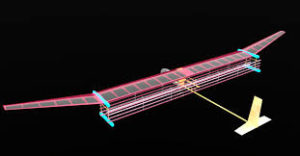
The team’s final design resembles a large, lightweight glider. The aircraft, which weighs about 5 pounds and has a 5-meter wingspan, carries an array of thin wires, which are strung like horizontal fencing along and beneath the front end of the plane’s wing. The wires act as positively charged electrodes, while similarly arranged thicker wires, running along the back end of the plane’s wing, serve as negative electrodes.

The fuselage of the plane holds a stack of lithium-polymer batteries. Barrett’s ion plane team included members of Professor David Perreault’s Power Electronics Research Group in the Research Laboratory of Electronics, who designed a power supply that would convert the batteries’ output to a sufficiently high voltage to propel the plane. In this way, the batteries supply electricity at 40,000 volts to positively charge the wires via a lightweight power converter.

Once the wires are energized, they act to attract and strip away negatively charged electrons from the surrounding air molecules, like a giant magnet attracting iron filings. The air molecules that are left behind are newly ionized, and are in turn attracted to the negatively charged electrodes at the back of the plane.

As the newly formed cloud of ions flows toward the negatively charged wires, each ion collides millions of times with other air molecules, creating a thrust that propels the aircraft forward.

Undistorted camera footage from unpowered glide 2, with position and energy from camera tracking annotated. Credit: Steven Barrett


The team, which also included Lincoln Laboratory staff Thomas Sebastian and Mark Woolston, flew the plane in multiple test flights across the gymnasium in MIT’s duPont Athletic Center — the largest indoor space they could find to perform their experiments. The team flew the plane a distance of 60 meters (the maximum distance within the gym) and found the plane produced enough ionic thrust to sustain flight the entire time. They repeated the flight 10 times, with similar performance.

Undistorted camera footage from flight 9, with position and energy from camera tracking annotated. Sped up 2x. Credit: Steven Barrett


“This was the simplest possible plane we could design that could prove the concept that an ion plane could fly,” Barrett says. “It’s still some way away from an aircraft that could perform a useful mission. It needs to be more efficient, fly for longer, and fly outside.”

The new design is a “big step” toward demonstrating the feasibility of ion wind propulsion, according to Franck Plouraboue, senior researcher at the Institute of Fluid Mechanics in Toulouse, France, who notes that researchers previously weren’t able to fly anything heavier than a few grams.

“The strength of the results are a direct proof that steady flight of a drone with ionic wind is sustainable,” says Plouraboue, who was not involved in the research. “[Outside of drone applications], it is difficult to infer how much it could influence aircraft  propulsion  in the future. Nevertheless, this is not really a weakness but rather an opening for future progress, in a field which is now going to burst.”

Barrett’s team is working on increasing the efficiency of their design, to produce more ionic wind with less voltage. The researchers are also hoping to increase the design’s thrust density — the amount of thrust generated per unit area. Currently, flying the team’s lightweight plane requires a large area of electrodes, which essentially makes up the plane’s propulsion system. Ideally, Barrett would like to design an aircraft with no visible propulsion system or separate controls surfaces such as rudders and elevators.

“It took a long time to get here,” Barrett says. “Going from the basic principle to something that actually flies was a long journey of characterizing the physics, then coming up with the design and making it work. Now the possibilities for this kind of propulsion system are viable.”

This research was supported, in part, by MIT Lincoln Laboratory Autonomous Systems Line, the Professor Amar G. Bose Research Grant, and the Singapore-MIT Alliance for Research and Technology (SMART). The work was also funded through the Charles Stark Draper and Leonardo career development chairs at MIT.”

Filed Under: Aerospace, Business and Finance, Drone News, News, Products Tagged With: Ionic wind drone technology, MIT Drone

Reader Interactions

Trackbacks

  1. Most Read articles – Raspberry Pi, LoRa comms, drones | Drone "Ki" says:
    December 24, 2018 at 12:04 am

    […] Drone technology has developed along traditional lines: there is a disruptive element and then other technologies are built around it to make it better for a larger number of uses. MIT has just published a piece about a base level technology – one where a plane or drone can fly with no moving parts,  no […] The post MIT New Technology Seeks to Make Drones Quieter using “Star Trek” Technology appeared first on DRONELIFE. See Original Article […]

    Reply
  2. MIT New Technology Seeks to Make Drones Quieter using "Star Trek" Technology - Droneoo says:
    November 23, 2018 at 5:39 pm

    […] Source link […]

    Reply
  3. MIT New Technology Seeks to Make Drones Quieter using “Star Trek” Technology - Drones Crunch says:
    November 23, 2018 at 3:28 pm

    […] DRONELIFE […]

    Reply
  4. MIT New Technology Seeks to Make Drones Quieter using “Star Trek” Technology | News and Reviews about Drones, Quadcopter, Camera says:
    November 23, 2018 at 12:05 pm

    […] Source link […]

    Reply
  5. MIT New Technology Seeks to Make Drones Quieter using “Star Trek” Technology | Drone Veracruz - Video y fotografía aérea says:
    November 23, 2018 at 9:00 am

    […] post MIT New Technology Seeks to Make Drones Quieter using “Star Trek” Technology appeared first on […]

    Reply

Leave a Reply Cancel reply

Your email address will not be published. Required fields are marked *

Primary Sidebar

LATEST

The Real FCC Drone Debate: Who Controls the Airwaves?

A closer look at how spectrum policy and licensing could determine the future of U.S. drone operations The FCC is…

Continue Reading The Real FCC Drone Debate: Who Controls the Airwaves?

Why Japan’s AAM Roadmap May Be the Most Realistic in the World

A phased, system-wide approach focuses on operations, infrastructure, and public acceptance Japan’s leading AAM provider, SkyDrive, has translated the country’s…

Continue Reading Why Japan’s AAM Roadmap May Be the Most Realistic in the World

DroneShield Opens European Headquarters in Amsterdam Amid Growing Counter-Drone Demand

DroneShield has officially opened its new European headquarters in Amsterdam, The Netherlands. The move strengthens the counter-drone company’s operational presence…

Continue Reading DroneShield Opens European Headquarters in Amsterdam Amid Growing Counter-Drone Demand

Mid-America Transplant Opens 160-Mile Drone Corridor for Organ Donation

Mid-America Transplant has become the first organ procurement organization (OPO) in the United States to use drones for donor blood…

Continue Reading Mid-America Transplant Opens 160-Mile Drone Corridor for Organ Donation

Manna Raises $50M to Expand Drone Delivery Network in the U.S.

Funding supports plans for 40 new bases and continued scaling of suburban UAV delivery operations Manna Air Delivery has announced…

Continue Reading Manna Raises $50M to Expand Drone Delivery Network in the U.S.

Terra Drone Invests in Ukraine-Based Interceptor Drone Company, Launches Terra A1

Partnership aims to scale low-cost defense solutions and expand global unmanned systems capabilities Terra Drone Corporation has announced a strategic…

Continue Reading Terra Drone Invests in Ukraine-Based Interceptor Drone Company, Launches Terra A1

FCC Seeks Input to Advance U.S. Drone Industry

Public notice outlines questions about regulatory reforms, spectrum access, and innovation zones The Federal Communications Commission (FCC) has opened a…

Continue Reading FCC Seeks Input to Advance U.S. Drone Industry

Skyports Deploys Automated BVLOS Drone Surveys for Major German Bridge Project

Remote-operated “drone-in-a-box” system delivers weekly 2D and 3D data for construction monitoring Skyports Drone Services has partnered with HOCHTIEF to…

Continue Reading Skyports Deploys Automated BVLOS Drone Surveys for Major German Bridge Project

Can You Get Survey-Grade Accuracy Without Ground Control Points?

New Study Explores When Drone Mapping Can Reduce Ground Setup A new white paper from Swiss drone manufacturer Wingtra takes…

Continue Reading Can You Get Survey-Grade Accuracy Without Ground Control Points?

April 2026 Public Safety Drone Review: Drones in Remote Environments and Operations on Lanai

DRONELIFE and DRONERESPONDERS host live webcast April 7 at 3 PM EST Register here for the next Public Safety Drone…

Continue Reading April 2026 Public Safety Drone Review: Drones in Remote Environments and Operations on Lanai

Secondary Sidebar

Footer

SPONSORED

Inspired Flight Gremsy IF800 VIO F1 drones geo week

What Will It Take to Strengthen U.S. Drone Manufacturing? A Conversation with Inspired Flight’s CEO

Global Mapper Mobile data collection

Collection Ground Control Points with Global Mapper Mobile

Military Drone Mapping Solutions

How SimActive’s Correlator3D™ is Revolutionizing Military Mapping: An Exclusive Interview with CEO Philippe Simard

Photogrammetry Accuracy Standards

SimActive Photogrammetry Software: Enabling Users to Meet Accuracy Standards for Over 20 Years

NACT Engineering Parrot ANAFI tether indoor shot

Smart Tether for Parrot ANAFI USA from NACT Engineering

Blue Marble, features global mapper, features Blue Marble

Check Out These New Features in Global Mapper v25 from Blue Marble

About Us | Contact Us | Advertise With Us | Write for Us | Privacy Policy | Terms of Service

The Trusted Source for the Business of Drones.

This website uses cookies and third party services. By clicking OK, you are agreeing to our privacy policy. ACCEPT

Manage consent

Privacy Overview

This website uses cookies to improve your experience while you navigate through the website. Out of these, the cookies that are categorized as necessary are stored on your browser as they are essential for the working of basic functionalities of the website. We also use third-party cookies that help us analyze and understand how you use this website. These cookies will be stored in your browser only with your consent. You also have the option to opt-out of these cookies. But opting out of some of these cookies may affect your browsing experience.
Necessary
Always Enabled
Necessary cookies are absolutely essential for the website to function properly. These cookies ensure basic functionalities and security features of the website, anonymously.
CookieDurationDescription
cookielawinfo-checkbox-analytics11 monthsThis cookie is set by GDPR Cookie Consent plugin. The cookie is used to store the user consent for the cookies in the category "Analytics".
cookielawinfo-checkbox-functional11 monthsThe cookie is set by GDPR cookie consent to record the user consent for the cookies in the category "Functional".
cookielawinfo-checkbox-necessary11 monthsThis cookie is set by GDPR Cookie Consent plugin. The cookies is used to store the user consent for the cookies in the category "Necessary".
cookielawinfo-checkbox-others11 monthsThis cookie is set by GDPR Cookie Consent plugin. The cookie is used to store the user consent for the cookies in the category "Other.
cookielawinfo-checkbox-performance11 monthsThis cookie is set by GDPR Cookie Consent plugin. The cookie is used to store the user consent for the cookies in the category "Performance".
viewed_cookie_policy11 monthsThe cookie is set by the GDPR Cookie Consent plugin and is used to store whether or not user has consented to the use of cookies. It does not store any personal data.
Functional
Functional cookies help to perform certain functionalities like sharing the content of the website on social media platforms, collect feedbacks, and other third-party features.
Performance
Performance cookies are used to understand and analyze the key performance indexes of the website which helps in delivering a better user experience for the visitors.
Analytics
Analytical cookies are used to understand how visitors interact with the website. These cookies help provide information on metrics the number of visitors, bounce rate, traffic source, etc.
Advertisement
Advertisement cookies are used to provide visitors with relevant ads and marketing campaigns. These cookies track visitors across websites and collect information to provide customized ads.
Others
Other uncategorized cookies are those that are being analyzed and have not been classified into a category as yet.
SAVE & ACCEPT