
Bridger Photonics expands methane detection to the offshore
By DRONELIFE Features Editor Jim Magill
A company that has pioneered the use of LiDAR-based sensors mounted on fixed-wing aircraft to detect methane emissions emanating from oil and gas facilities on the ground has turned to the use of drones to achieve the same mission for offshore rigs and other remote locations.

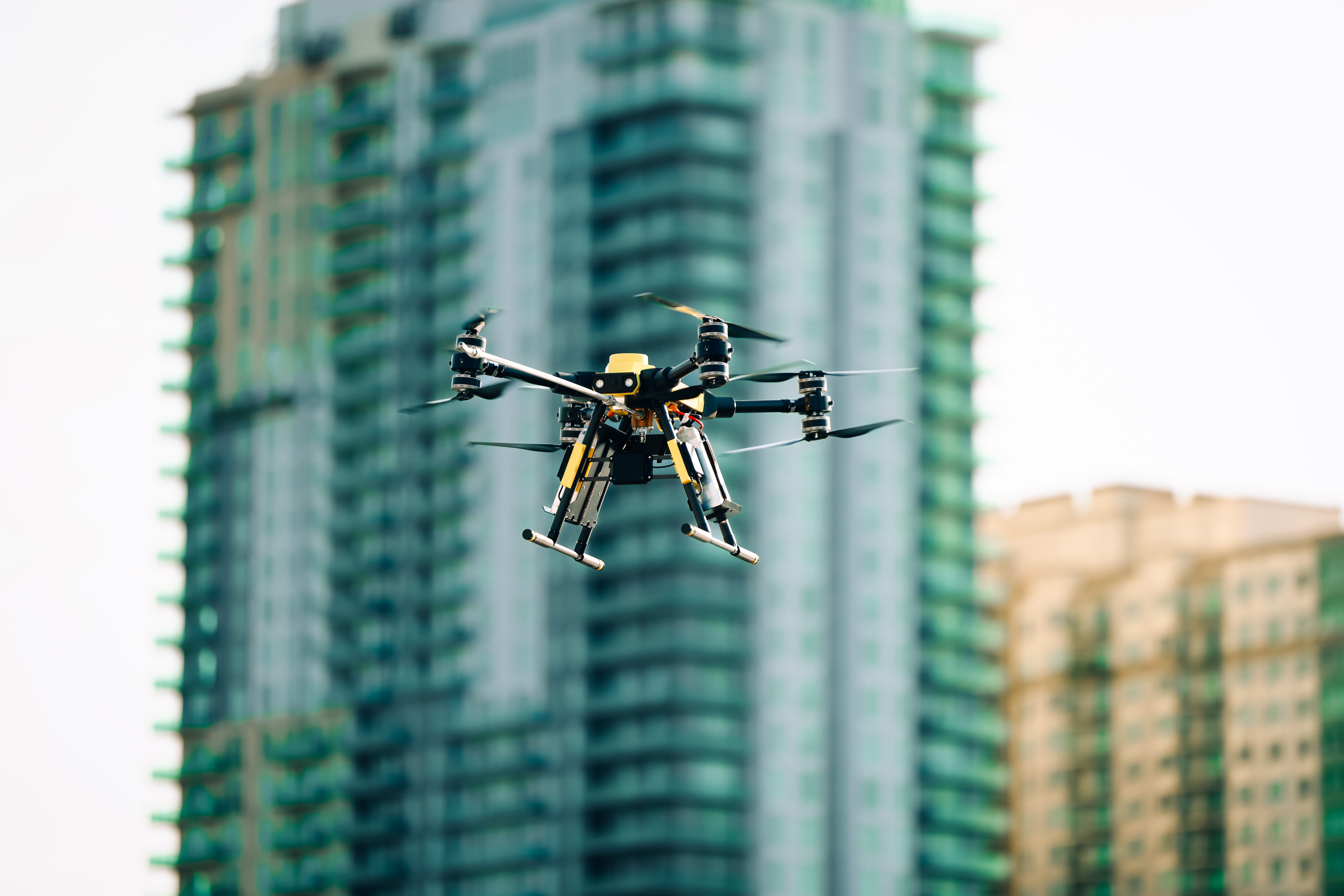
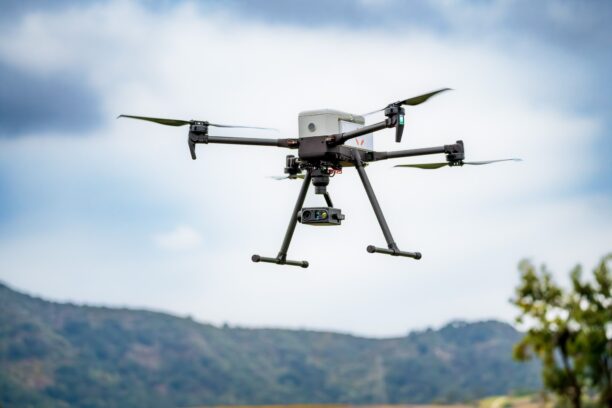
Bozeman, Montana-based Bridger Photonics recently announced the expansion of its Gas Mapping LiDAR (GML) system to provide methane-tracking services to the offshore arena and to complex industrial facilities. Using a smaller version of its proprietary LiDAR sensor equipment mounted on a heavy-lift UAV, the company is able to get to remote locations and get readings from hard-to-reach corners of those sites.
“A fixed-wing (aircraft) is very restricted in the types of flight and the proximity of approach to structures that it can do,” Mike Thorpe, Bridger’s chief scientist, said in an interview. “A helicopter is a little better with very good maneuverability, but still it’s a very large aircraft … that can’t do close approach to structures.”
For Bridger, the use of drones to detect methane is something of a return to the company’s earlier days. About 10 years ago, the company, which has offered LiDAR technology solutions to industry for almost 20 years, started developing an airborne sensor system that could detect and map methane emissions, while simultaneously doing topographic mapping of a site.
“When we were developing gas-mapping LiDAR, we had a prototype that went on a drone and we started doing the math of trying to cover oil and gas production and transmission infrastructure,” Thorpe said.
“We quickly realized that to cover all of that ground, we needed a better vehicle. And so, we pivoted at that point to create manned aircraft versions of the sensor that could fly higher and fly faster.”
Bridger spread the use of methane-detection technology across the oil patch, first in the United States and later internationally. “We work with most of the major oil and gas producers around the globe, and what we have found now is that there are gaps in the monitoring coverage,” Thorpe said.
The company learned that it was difficult to get manned aircraft out to some of the more remote oil- and gas-producing regions across the globe. In addition, Bridger found that many of the complex facilities requesting methane detection surveys required that the surveying aircraft not only be able to take measurements from a downward-looking view, but also be capable of performing side-view and close-proximity scans.
“That was the impetus for us to shrink down the sensor packages and put these on drones so we could fill those gaps in the manned aircraft monitoring,” Thorpe said. In addition, Bridger upgraded its drone-borne sensor package offered to companies, adding a second modality, called Flux Curtain, which doesn’t scan the infrastructure to find the sources of methane leaks. Instead, it looks downwind of the facility to perform an emission measurement of the entire site.
Bringing methane detection to the offshore environment
In the offshore environment, where oil rigs are often situated many miles from the nearest airport, a UAV provides the ideal tool for conducting a methane emissions survey, Thorpe said.
Before the drone pilot and crew set foot on the rig, they meet at the company’s offices to map out the flight plan for the UAV, using models of the facility. Because of flight restrictions that limit the transport of batteries, the drone and sensor kit are typically transported to the rig aboard a boat.
Once aboard the rig, the crew deploys the single drone to scan around the rig, and identify the emission points. “Then we send out the second modality, which is the Flux Curtain, to go downwind and make that whole facility emission measurement,” Thorpe said.
One reason the company deploys the two modalities is in order to comply with OGMP 2.0, a United Nations framework aimed at reducing methane emissions on a global level, he said. Employing the two modalities also allows the companies to distinguish between source-level and site-level emissions.
Deploying the two modalities simultaneously involves an intricate ballet of two drones operating in coordinated flight with one another.
“We have a gimbling system on the drone with the sensor payload to keep our beam locked onto the other drone, which carries a retro reflector,” Thorpe said. “The advantage that this provides for us is the two drones define the boundaries of a surface downwind that we’re going to interrogate for the methane gas.”
Because the operators are continuously measuring that whole path in between the drones, they can order the drones to do a very rapid coordinated vertical flight and sweep out the entire downwind surface of the facility being monitored in a matter of tens of seconds. “And then we can repeat the measurement over and over again to quickly converge on the right answer by averaging over the atmospheric fluctuations that are happening in transporting that gas pollutant from the sources to this downwind surface,” he said.
At the same time, onboard anemometers allow the operators to calculate the wind speed at every point in the flight.
“If you combine these concentration measurements of the methane with how fast the gas is flowing through the plane, you can easily calculate an emission rate. We think this is a pretty dramatic step-up or advancement from previous technologies that have point sensors,” Thorpe said.
To understand how much gas is coming off of an offshore rig by use of previous standard methane detection methods could take operators up to an hour to do one downwind measurement. “Within a couple of minutes, we can have many measurements, and so this is a step-change in capability,” he said.
In addition, because the smaller drone-mounted payload allows for close-up scans of an LNG terminal or offshore rig, the result is higher resolution data for the customer. Thorpe said the company has recently deployed the new system on an offshore rig, for an undisclosed oil company, as well as performed some runup testing on complex onshore production facilities.
Bridger anticipates that there will be a robust market for its drone-based sensor systems, because of the growing demand among oil producing nations to better detect and track methane emissions.
“Right now, the global market for methane monitoring is huge. And so, our first focus is to address that,” Thorpe said.
Read more:
- Detecting Methane Gas at Water Treatment Plants: iRed Inks Deal for Continuous Monthly Inspections
- Teledyne FLIR OEM Thermal by FLIR Collaborator AerialOGI Launches First Dual-use OGI Camera Module
- Methane Gas is Odorless, Colorless, and Deadly. FLIR’s New MUVE C360 Can Help Public Safety Officials Find it Fast.
 Jim Magill is a Houston-based writer with almost a quarter-century of experience covering technical and economic developments in the oil and gas industry. After retiring in December 2019 as a senior editor with S&P Global Platts, Jim began writing about emerging technologies, such as artificial intelligence, robots and drones, and the ways in which they’re contributing to our society. In addition to DroneLife, Jim is a contributor to Forbes.com and his work has appeared in the Houston Chronicle, U.S. News & World Report, and Unmanned Systems, a publication of the Association for Unmanned Vehicle Systems International.

Miriam McNabb is the Editor-in-Chief of DRONELIFE and CEO of JobForDrones, a professional drone services marketplace, and a fascinated observer of the emerging drone industry and the regulatory environment for drones. Miriam has penned over 3,000 articles focused on the commercial drone space and is an international speaker and recognized figure in the industry. Miriam has a degree from the University of Chicago and over 20 years of experience in high tech sales and marketing for new technologies.
For drone industry consulting or writing, Email Miriam.
TWITTER:@spaldingbarker
Subscribe to DroneLife here.
Leave a Reply