
Battery endurance is a bottleneck for drone technology. Could hydrogen offer a solution? DRONELIFE is honored to publish this guest post from Dr, Neel Sirosh, CTO at H2MOF: a provider of safe and efficient hydrogen storage solutions. DRONELIFE neither accepts nor makes payment for guest posts.
Overcoming the UAV Industry’s Energy Storage Bottleneck
Written by Dr. Neel Sirosh, CTO at H2MOF
Picture a drone soaring high above a vast, remote landscape — its sensors capturing critical data for environmental/infrastructure monitoring or surveying a disaster zone. The mission is critical, and every second of data transmission counts. Yet, as the drone nears a critical phase of the mission, the countdown to landing begins, with only minutes left before it must return to base for a lengthy recharge. This scenario plays out every day in industries reliant on UAVs, where energy storage is the unsung hero — and yet, the weakest link in the industry pursuit of “long range, heavy lift.”
The UAV industry is experiencing rapid growth, yet its progress is increasingly constrained by the limitations of current energy storage technologies. The vast majority of drones today rely on lithium-ion or lithium-polymer batteries, which impose limitations on flight endurance, payload capacity, and operational efficiency. Most battery-powered UAVs are restricted to flight times of less than 60 minutes, with many achieving as little as 10 minutes when carrying heavier payloads. While fixed-wing VTOL UAVs can extend their endurance, the improvements remain modest unless internal combustion engines are deployed — an approach commonly seen in the military sector but less practical for commercial and industrial applications.
Battery recharge times, which typically range from 60 to 90 minutes, further disrupt UAV operations. While battery swapping mitigates some of this downtime, it necessitates carrying an inventory of additional batteries and maintaining a power source for remote recharging — often requiring diesel generators in the field, adding logistical complexity and increasing operational costs. Additionally, lithium-based batteries degrade over time, limiting their useful life to a finite number of charge cycles before requiring replacement. This adds recurring costs and maintenance burdens to UAV fleets, further restricting scalability. Moreover, battery weight directly competes with payload capacity, forcing operators to make trade-offs between endurance and the ability to carry mission-critical equipment or cargo.
Hydrogen fuel cells have emerged as a promising alternative, offering vastly superior energy density, rapid refueling, and lower environmental impact compared to traditional battery systems. However, existing hydrogen storage methods — whether high-pressure or cryogenic vessels — introduce complexities in system architecture, flight operations and fuel supply logistics that affect their viability for UAVs. The industry has long sought a hydrogen storage solution that is safe, lightweight, efficient, and scalable for UAV applications.
The Need for Transformational Hydrogen Storage Technology
Despite the superior advantages of hydrogen fuel cells, their widespread adoption in UAVs has been hindered by the fundamental challenges of hydrogen storage. Existing hydrogen storage methods — compressed hydrogen, liquid hydrogen, and chemical or metal hydrides — all present significant trade-offs in efficiency, cost, and practicality for UAV applications.
- Compressed Hydrogen: While a mature technology, compressed hydrogen suffers from relatively poor volumetric efficiency even at high pressures (700 bar). The need for multi-stage compression and complex infrastructure increases both capital expenditure (CAPEX) and operational expenditure (OPEX), with the compression process consuming approximately 15% of the stored energy. High pressure hydrogen systems continue to face regulatory and jurisdictional challenges as well.
- Liquid Hydrogen: Although it offers high volumetric efficiency, liquid hydrogen storage requires energy-intensive liquefaction processes, consuming nearly 40% of the stored energy. The infrastructure needed for liquefaction plants is expensive and only justifiable at large scales. Significant losses due to boil-off and during fuel transfer continue to be major drawbacks.
- Chemical & Metal Hydrides: These storage solutions provide high volumetric efficiency, but slow hydrogen release rates introduce operational limitations. Additionally, substantial amounts of heat (up to 300°C) are required to release stored hydrogen, further increasing energy consumption and reducing overall efficiency. Moreover, their excessive weight makes them impractical for UAV applications, where payload capacity is most critical.
To fully unlock hydrogen’s potential in the UAV industry, a transformational hydrogen storage technology is needed — one that delivers higher energy density, lower weight, rapid refueling, and operational safety without the drawbacks of current solutions.
Solid-State Hydrogen Storage Based on Reticular Materials
A breakthrough in hydrogen storage using nano-engineered reticular materials is revolutionizing how UAVs store and utilize hydrogen. This innovative approach enables safe, compact, and efficient solid-state hydrogen storage at low pressures and near-ambient temperatures, eliminating the need for expensive multi-stage compression and cryogenic liquefaction.
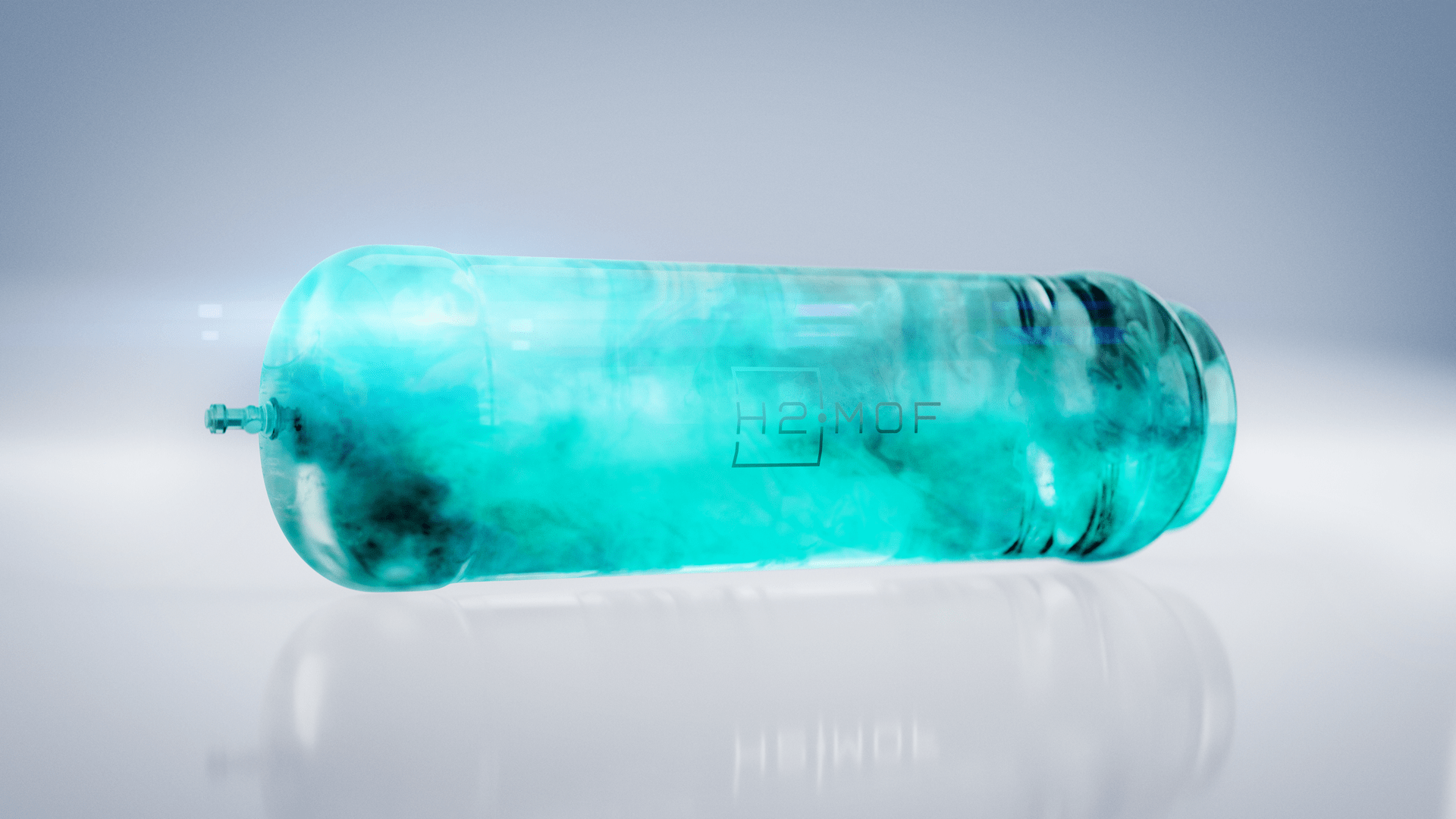
Unlike traditional hydrogen storage solutions, which rely on heavy containment structures or energy-intensive processes, reticular-material-based storage systems offer superior gravimetric and volumetric efficiency. These innovative materials have the potential to exceed the U.S. Department of Energy (DOE) system targets, achieving gravimetric efficiencies well above 5.5 wt.% and volumetric efficiencies exceeding 40 g/L. This translates to nearly a 30% improvement in gravimetric efficiency and up to double the volumetric efficiency of conventional 700-bar hydrogen tanks. The result for UAV applications is significantly extended flight times and increased payload capacity, addressing key limitations of current UAV energy storage methods.
The ability to configure these storage systems for fast hydrogen adsorption and release ensures that UAVs receive on-demand hydrogen fuel to meet diverse operational needs. Low-pressure solid-state storage also enables non-traditional, conformable shapes, improving packaging efficiency and aerodynamics. This flexibility allows UAV manufacturers to optimize aircraft design for both endurance and payload, to satisfy the customer demands of “long range, heavy lift”. Higher gravimetric efficiency directly translates into greater payload capacity, enabling drones to carry heavier reconnaissance and data transmission equipment or cargo without compromising flight duration.
Beyond performance improvements, solid-state hydrogen storage based on reticular materials also offers significant cost and scalability advantages. By lowering hydrogen delivery costs by 50% compared to conventional 200-500 bar storage systems and nearly 80% versus cryogenic liquefaction and transportation, this technology makes hydrogen-powered UAV operations more economically viable. Additionally, the elimination of high-pressure compression or cryogenic storage simplifies infrastructure requirements, reducing the cost and complexity of hydrogen deployment. Operating at low pressures and near-ambient temperatures also simplifies regulatory and compliance hurdles, making integration into UAV systems easier and more practical.
With scalable configurations ranging from 100 grams to 40 kg of hydrogen capacity, solid-state hydrogen storage based on reticular materials can be tailored to various UAV mission requirements. Whether through portable gas cartridges or integrated storage subsystems, this advanced storage method will help break the UAV energy storage bottleneck, extend flight durations, and enhance operational efficiencies across commercial, industrial, and defense applications.
Redefining the Future of UAV Energy Systems
The introduction of hydrogen-powered UAVs represents a fundamental transformation in the industry, providing the next generation of aerial systems with unprecedented endurance, agility, and payload capacity. As solid-state hydrogen storage technology based on reticular materials continues to mature, UAV manufacturers and operators will be able to capitalize on its advantages to push the boundaries of what is possible in drone applications.
Unlocking the full potential of UAVs requires breaking free from the constraints of traditional battery technology. By harnessing the power of nano-engineered reticular materials, the limitations of hydrogen storage are being addressed, paving the way for a future where UAVs can operate longer, carry more, and function with greater safety and reliability than ever before.
For UAV system architects, manufacturers and operators looking to integrate next-generation energy solutions, the time to explore solid-state hydrogen storage is now. Whether in commercial logistics, defense operations, or environmental/infrastructure monitoring, this breakthrough technology will be instrumental in shaping the future of UAV performance.
 Dr. Neel Sirosh, CTO of H2MOF, is a hydrogen systems expert with over 25 years of experience in clean energy R&D, product development, and commercialization. He has led groundbreaking work in hydrogen storage technologies for organizations including Daimler, Toyota, NASA, and Universal Hydrogen, and previously served as CTO at Quantum Technologies and Hydria/CATEC Gases. He holds numerous patents, has published extensively on hydrogen storage, and has helped shape international hydrogen standards. Dr. Sirosh earned a PhD in Engineering from the University of Calgary and an Executive MBA from UC Irvine.

Miriam McNabb is the Editor-in-Chief of DRONELIFE and CEO of JobForDrones, a professional drone services marketplace, and a fascinated observer of the emerging drone industry and the regulatory environment for drones. Miriam has penned over 3,000 articles focused on the commercial drone space and is an international speaker and recognized figure in the industry. Miriam has a degree from the University of Chicago and over 20 years of experience in high tech sales and marketing for new technologies.
For drone industry consulting or writing, Email Miriam.
TWITTER:@spaldingbarker
Subscribe to DroneLife here.


This article is a must-read for anyone interested in the subject.