
Experts: More tools needed to protect airports from drones
By DRONELIFE Features Editor Jim Magill
(This is the fifth in a series of articles, examining the problems posed to critical infrastructure sites and other significant potential targets of drone incursions by hostile actors. Previous installments examined current federal laws pertaining to the use of counter-drone technology; the threats from UAVs faced by jails and prisons, conventional and nuclear power plants, and sports stadiums.
This article will look at what steps can be taken to limit potential dangers from drones flying within the restricted airspace of airports.)
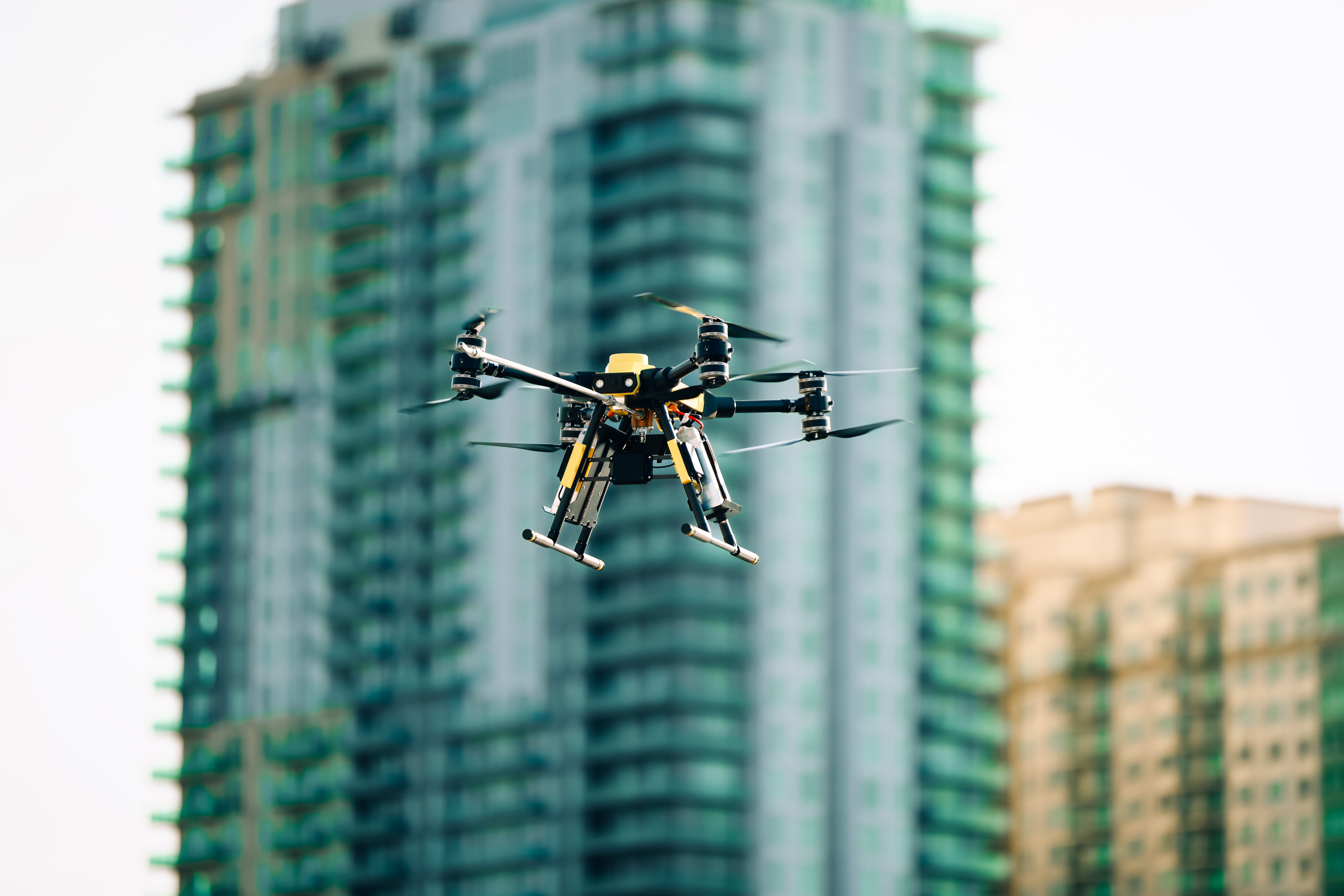
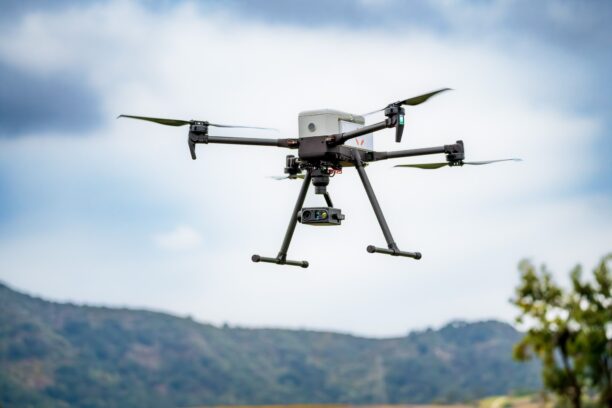
As unmanned aerial systems proliferate, airports across the country are becoming increasingly concerned over the need to keep unauthorized drones from entering restricted airspace, potentially interfering with scheduled flight traffic, forcing ground delays and posing a possible danger to manned aircraft and personnel.
However, experts say that airport operators currently are limited in the tools they can employ to deter operators from flying drones, either carelessly or deliberately, in the airspace around airports.
In a recent incident, in December officials at New York’s Stewart International Airport were forced to shut down their runways for an hour, after the FAA alerted them that an unidentified drone was spotted in the vicinity of the airport, located about 60 miles north of New York City.
In what is considered as the most significant drone-related incident at an airport, UK’s Gatwick Airport was forced to shut down for about 36 hours, after drones were reported flying near the runway. The incident resulted in the stranding of thousands of holiday travelers and estimated losses of about 50 million pounds for the airport and air carriers.
Under federal law and FAA regulations, airports in the U.S. are permitted to install drone-detection systems providing they do not interfere with the communications between the drone and its operator. “Technologies, such as radar and radio frequency (RF), electro-optic (EO), and acoustic sensors, are sometimes stand-alone or combined to perform primary and secondary validations. Detection systems do not have the ability to determine intent or the level of threat posed by UAS,” according to the FAA website.
Besides detection, the other aspect of counter-UAS technology is drone mitigation or the use of kinetic or non-kinetic technologies to disable a drone or force it to land. Non-kinetic techniques include jamming a drone’s radio signals and taking over the control of the UAV from its operator. Kinetic technologies involve physically disabling the drone to bring it down, with a projectile, laser or even some kind of net. The authority to conduct drone mitigation operations is vested in five federal agencies: the departments of Defense (DOD), Energy (DOE), Homeland Security (DHS), Justice (DOJ), and the FAA.
Three aviation and drone experts recently testified before a congressional subcommittee hearing on laws and regulations surrounding the deployment of counter-UAS technology at airports and other sensitive sites. They advocated for the passage of laws aimed at increasing the likelihood that attacks against such sites by drones operated by malicious actors could be thwarted.
In written testimony, Cathy Cahill, director of the Alaska Center for Unmanned Aircraft Systems Integration (ACUASI) at the University of Alaska Fairbanks, said that while more testing needs to be done to improve counter-UAS (C-UAS) technologies, including detect, track and identify (DTI) drones, mitigation operations should remain in the hands of federal authorities.
“The U.S. needs to develop, test, and implement safe C-UAS technologies that will allow the discrimination between authorized UAS, unauthorized UAS, and manned aircraft, allow the safe removal of rogue UAS from the [National Airspace System] by authorized individuals, and provide a sense of safety to the U.S. population,” Cahill wrote.
“State and local officials and legislators, and many members of the public, wanted state or local entities to be able to use C-UAS to shoot the ‘drones.’ In my opinion, the risk of unintended consequences from a mitigation attempt by a state or local entity is too high.”
However, Cahill stated that restrictions against the use of counter-UAS technologies in the U.S. have driven the developers of these technologies to other countries, such as Ukraine, to test the effectiveness of their systems. “The U.S. should be facilitating the availability of testing locations in the U.S. to enable C-UAS and DTI technology providers to test their systems under a wide range of environmental conditions at a much faster pace,” she wrote.
The federal government already is conducting testing of C-UAS systems at a handful of U.S. airports. In 2021, the FAA announced the selection of five host airports — Atlantic City International Airport in New Jersey; Syracuse Hancock International Airport in New York; Rickenbacker International Airport in Columbus, Ohio; Huntsville International Airport in Alabama and Seattle-Tacoma International Airport in Washington state — to evaluate technologies to detect and mitigate potential safety risks posed by unmanned aircraft.
Meanwhile, the U.S. Transportation Security Administration (TSA) has established its first two C-UAS technology “test beds” at Miami International Airport and Los Angeles International Airport.
CDA calls for expanded pilot program
At the same congressional hearing, Lisa Ellman, executive director of the Commercial Drone Alliance applauded the introduction of H.R. 4333, The Safeguarding the Homeland from the Threats Posed by Unmanned Aircraft Systems Act, in the House of Representatives. The bill would “Renew existing authorities of the Department of Homeland Security (DHS) and Department of Justice (DOJ) that allow these departments to counter threats posed by drones.” It would also establish a pilot program to allow certain state, local, tribal and territorial (SLTT) law enforcement agencies to take actions in consultation with the secretary of Transportation, “to mitigate a credible threat” from drones.
In her written remarks, Ellman said the authorities conferred in the legislation “should be expanded not only to state, local, tribal, or territorial (SLTT) law enforcement agencies, but also to certain appropriately trained private sector entities, such as critical infrastructure operators, in order to reduce the burden on law enforcement agencies.”
In addition, Ellman said the legislation should expand the number of SLTT law enforcement agencies allowed to take part in the pilot program. The bill currently calls for an initial group of 12 such agencies to take part in the pilot.
“This expansion is critical to collecting enough data from a diversity of circumstances and geographies to inform future policy. Additionally, we support limiting the program to areas with a flight restriction, as legitimate operators already know to avoid operating in those areas,” Ellman wrote.
Chris McLaughlin, executive vice president of operations at Dallas-Fort Worth International Airport (DFW), who also testified at the hearing, said airports present unique challenges in the deployment of counter-UAS technologies. “Unlike other critical infrastructure, airports must manage airspace in real-time and with high volumes of aircraft, ensuring drone operations don’t disrupt essential commercial aviation and that counter-UAS efforts don’t unintentionally jeopardize the same,” he said in his prepared remarks.
McLaughlin said DFW began partnering with TSA on the development of drone-detection technology in 2017. The airport has piloted a second system through an FAA-approved process and soon plans to install a permanent FAA-approved DTI system. “Our detection system has been effective, identifying more than 5,000 legitimate drone flights in our five-mile radius, annually. Of that, about 150 were operated inappropriately,” he wrote.
However, he said detection and information sharing with an airport’s security partners will not be enough to protect airports from inappropriately flown drones in the future. He called for greater counter-UAS authority to be given to state and local law enforcement agencies.
“State and local law enforcement agencies with advanced capabilities are better positioned physically to respond to drone incidents near airports. With proper authority, safety-tested technology, advanced training and strict federal oversight, they could supplement federal efforts, enhancing response times and improving coordination,” he wrote.
In his testimony before the subcommittee, McLaughlin said airport authorities need to have the ability to work with their state and local law enforcement partners to expand their ability to detect and track errant drones and identify the pilots. He added that, because of potential hazards to existing aviation activities, only non-kinetic forms of mitigation should be used if a decision is made to bring down a drone causing a potential hazard to an airport.
“We believe in the airport environment that non-kinetic mitigation is the safer route, because for us, the safety of aircraft will always be our number one priority,” he said.
“The thing that we think about most in airports is that first and foremost, we want to protect the airspace. And the best way to do that is to deconflict manned aircraft, crewed aircraft, that are entering or exiting our airspace,” McLaughlin said. “Once those aircraft have been safely removed, then there’s a variety of mechanisms that we can use to mitigate the drone.”
 Jim Magill is a Houston-based writer with almost a quarter-century of experience covering technical and economic developments in the oil and gas industry. After retiring in December 2019 as a senior editor with S&P Global Platts, Jim began writing about emerging technologies, such as artificial intelligence, robots and drones, and the ways in which they’re contributing to our society. In addition to DroneLife, Jim is a contributor to Forbes.com and his work has appeared in the Houston Chronicle, U.S. News & World Report, and Unmanned Systems, a publication of the Association for Unmanned Vehicle Systems International.

Miriam McNabb is the Editor-in-Chief of DRONELIFE and CEO of JobForDrones, a professional drone services marketplace, and a fascinated observer of the emerging drone industry and the regulatory environment for drones. Miriam has penned over 3,000 articles focused on the commercial drone space and is an international speaker and recognized figure in the industry. Miriam has a degree from the University of Chicago and over 20 years of experience in high tech sales and marketing for new technologies.
For drone industry consulting or writing, Email Miriam.
TWITTER:@spaldingbarker
Subscribe to DroneLife here.
Drone harassment is real—and it’s not just an airport issue. For 11 months, I’ve been targeted by drones emitting RF signals at my home. Despite repeated reports, the police and FAA have done nothing. Citizens deserve protection. It’s time the current administration made our safety a priority. #DroneSafety #PublicSecurity #SeniorRights