
As both commercial and recreational UAVs become more common, two recent events highlight the potential risk to other aircraft and onlookers. In this DRONELIFE Exclusive guest post, Dr. Ryan Wallace of Embry-Riddle Aeronautical University and the Boeing Center for Aviation and Aerospace Safety writes that drone incidents involving aircraft need to be a wake up call for the drone industry. DRONELIFE neither accepts nor makes payment for guest posts.
Why the Super Scooper Wildfire Aircraft Drone Collision Should be a Wakeup Call to the Drone Industry
by Ryan Wallace, Ed.D.,
On January 9th, the LA County Fire Department reported a collision between a Canadair CL-415 and a DJI Mini, a 249g drone, operating at low altitude in restricted airspace near the Palisades fire at around 10am. The collision resulted in a puncture to the leading edge of the plane’s left wing, with authorities reporting the plane will likely be out of commission for the remainder of Palisades fire. The aircraft is an indispensable resource to wildfire operations. Able to drop more than 1,600 gallons of water at a time, the aircraft is equipped to quickly drop its payload and refill its tanks in mere minutes by scooping from open water sources, such as nearby lakes.
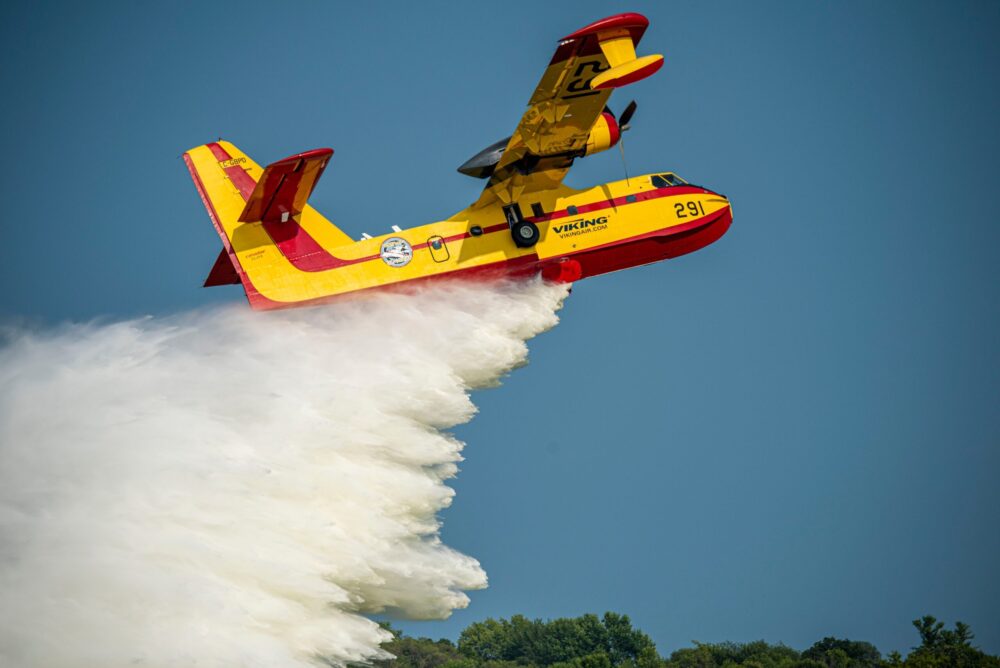
USDA Photo by Preston Keres. Original public domain image.
This incident comes at a critical juncture—the disaster taxed both firefighters and equipment—as they battled the Palisades, Eaton, and Hurst fires for nearly a month before eventually containing the blaze. At its height, the fires displaced more than 192,000 under mandatory evacuation orders and a further 140,000 under fire evacuation warnings. The fires would erase more than 17,000 structures, and tragically, claim the lives of more than 29 residents. Removing the Super Scooper aircraft from aerial [fire] attack operations stretched fire resources thin, as wildfire personnel waged an uphill battle against high winds and other hazards to save homes, businesses, and communities. We will never know the true impact taking this aircraft out of service cost in destroyed homes, or lost lives.
This is not the first time wildfire suppression efforts have been hampered by drone operations. Earlier in 2024, aerial wildfire suppression efforts were suspended due to drone activity near the Ironwood Fire in Arizona. Interruptions in aerial firefighting efforts are a key reason why some wildfires are permitted to spread unhindered and at speed. The problem became so prevalent, the U.S. Forest Service created a media campaign to combat rogue drones, highlighted by the slogan, “If you fly, we can’t.” Similarly, the National Wildfire Coordinating Group (NWCG) established a comprehensive protocol for responding to drone incursions, with limited degrees of success. According to SAFECOM, an aviation safety reporting database used by wildfire personnel, there have been more than 59 occurrences of airspace incursions, conflicts, near midair collisions, and related incidents involving drones. The Federal Aviation Administration also collects data on drone encounters with aircraft. Between November 2014 and December 2024, the FAA reported 18,891 drone sightings—nearly 155 per month—submitted by aircraft pilots, air traffic controllers, law enforcement, and other stakeholders. The Aviation Safety Reporting System, an anonymous database of aviation safety incidents managed by NASA, also collects data about drone incidents that implicate aviation safety. As of this writing, the database contains more than 800 safety incidents involving drones.
One major source of the issue is the sheer number of drones operating in the National Airspace System. As of 2024, the FAA estimated there were nearly 2.8 million small UAS (sUAS) operating in the NAS–1.83 million recreational drones and 951,000 commercial drones. Compared to the total number of civil aircraft—estimated at 215,000—drones outnumber manned aircraft nearly 13-to-one!
Moreover, operations data suggests that drone operators fly—a lot! Based on a 36-month study (2018-2021) at Dallas-Fort Worth International Airport (DFW), researchers identified 29,839 individual drone platforms that carried out 481,368 flights. This data closely aligns with the FAA’s 20-Year Aerospace Forecast sUAS Survey, in which operators reported conducting more than 18 recreational flights per year. For operators conducting non-recreational operations, the number of reported annual operations jumped ten-fold to an average of 162.9!
Further contributing to the problem is that drones are particularly difficult to see. A series of collaborative studies by Oklahoma State University and Embry-Riddle Aeronautical University (1, 2) revealed that even when pilots are aware of the presence of a drone, they remain especially difficult to spot, using visual scanning techniques. These complications are exacerbated during periods of high pilot workload, such as landing. At nighttime, drones are even harder to see, as visual cues are absent and drone lighting can be confused with other background lights. Similarly,drone pilots and visual observers are equally challenged to spot conflicting aircraft, making see-and-avoid procedures relatively ineffective.
Empirical evidence suggests that drone encounter and near midair collision (NMAC) incidents may be underreported. In a 2023 study, researchers compared RID data to Automatic Dependent Surveillance-Broadcast (ADS-B) data—aircraft self-reported geospatial information—and discovered at least 25 NMACs between drones and aircraft during a three-year sampling period near a major airport in the southern U.S. None of the NMAC incidents discovered by the telemetry analysis could be correlated with a UAS sighting report.
The FAA has made strides to improve the conspicuity of drones. In September 2023, the agency mandated that drones be equipped with Remote Identification (RID)—essentially an electronic license plate—that requires drones to transmit identification and location information over Wi-Fi or Bluetooth. Once the RID rule came into effect, however, drone operators complained that required drone broadcast modules were not readily available, causing the FAA to defer enforcement of the RID rule for a further six months. A June 2024 report by the Government Accountability Office, highlighted several issues with the new RID technology, mainly the signal’s limited range and questionable reliability. Moreover, there is not currently an established interface for law enforcement personnel to access drone registration records, which link the identity of non-compliant drone operators to RID serial numbers, which can potentially delay investigation of unauthorized drone activity.
This comes on the heels of major safety policy changes by DJI, the largest manufacturer of consumer drones, which recently announced that it would begin unlocking its geofencing system in mid-January. DJI’s Fly Safe geozones are an integral protection system designed to restrict operators from flying in designated areas, such as near airports, over prisons, critical infrastructure, and other protected sites. With the new change, the Fly Safe system would no longer restrict flight in protected locations, but would merely provide a pop-up notification warning to operators, who can elect to ignore warnings. Although this shift removes operator restrictions, it opens the door to further non-compliance and potentially-hazardous flights by clueless or careless operators.
In a separate late December drone light show accident that left a 7-year-old boy requiring emergency heart surgery, these incidents paint a much bleaker picture about the current state of safety of unmanned aircraft within the National Airspace System.
Perhaps it is time to take a step back and re-evaluate how we are protecting both people on the ground and in the air from the risk posed by unmanned aircraft. Albert Einstein famously stated, “Insanity is doing the same thing over and over and expecting different results.”

Dr. Ryan Wallace is an Associate Professor at Embry-Riddle Aeronautical University and a Faculty Affiliate with the Boeing Center for Aviation and Aerospace Safety. He holds an Ed.D. in Applied Education Studies, a M.S. in Aviation, and a B.S. in Aeronautics. His research focuses on UAS safety, security, human factors, and public policy. Dr. Wallace serves as the principal investigator for a portfolio of federal grants valued at more than $10 million. He facilitated professional training seminars for federal agencies in the areas of UAS safety, operations, and counter-UAS topics. He serves as a representative on the FAA’s Drone Safety Team. An Air Force veteran, he was a rated Air Battle Manager on the E-3 AWACS, where he accumulated more than 1,500 flight hours.
Want DRONELIFE news delivered to your inbox every weekday? Sign up here.
Read more:
- Drone Collision with Firefighting Aircraft Highlights Safety Risks in Restricted Airspace
- Drone Show Association Formed to Develop Industry Standards and Safety

Miriam McNabb is the Editor-in-Chief of DRONELIFE and CEO of JobForDrones, a professional drone services marketplace, and a fascinated observer of the emerging drone industry and the regulatory environment for drones. Miriam has penned over 3,000 articles focused on the commercial drone space and is an international speaker and recognized figure in the industry. Miriam has a degree from the University of Chicago and over 20 years of experience in high tech sales and marketing for new technologies.
For drone industry consulting or writing, Email Miriam.
TWITTER:@spaldingbarker
Subscribe to DroneLife here.
“Perhaps it is time to take a step back and re-evaluate how we are protecting both people on the ground and in the air from the risk posed by unmanned aircraft”
Actually, based on the statement that there are 13 times more drones than manned aircraft I think the drone hobby/industry is doing an incredible job of protecting people on the ground and in the air.
Remember, even though the death toll from manned aircrashes in the USA is already close to 100 for the year (and it’s only mid-February), the recreational use of multirotor drones has never caused a single fatality — ANYWHERE IN THE WORLD, EVER!
Also, on a per-capita basis, it turns out that the drone community creates far fewer “incidents” than manned aviation.
Remind me again, what is the problem we’re trying to solve?
Nothing is or will ever be “risk-free” so that is an unattainable goal. However, drones are and always will be, the safest form of aviation ever created.
Let’s not get too fixated on solving problems that don’t exist and instead focus on the reasons why 2025 is shaping up to be the worst-ever year for manned aviation safety in the USA.
Very alarming article.
As a drone observer intent on maintaining visual contact , I can attest that it is nearly impossible for a pilot to maintain safe distance from and constant visual contact of operating drones. MANDATORY DRONE ADS-B broadcast is the only reasonable approach to protect aircraft from drones. Safety Orange coloring will also be helpful in see and avoid per FARs.