
The Supercooled Water Experimental Arctic Tower creates calibrated icing conditions so researchers and students can study how ice buildup affects drone lift, control and performance.
The Alaska Center for Unmanned Aircraft Systems Integration (ACUASI) at the University of Alaska Fairbanks Geophysical Institute conducts drone icing research in a purpose-built ice tower. Formally named the Supercooled Water Experimental Arctic Tower, or SWEAT, the facility opened in early 2025. It supports research into the winter conditions drones encounter, and it also trains the next generation of drone designers and operators through the UAF College of Engineering and Mines. ACUASI recently flew human blood samples 1,000 kilometers for the International Testing Agency from its Nenana base.
“We are integrating academics, research and operations so that the students are working in all three of those domains,” said Mike Hatfield, associate professor of electrical and computer engineering and associate director for education at ACUASI. “And with ACUASI, it’s pretty natural.”
Hatfield led creation of the UAF aerospace engineering degree program, now entering its fourth academic year. Students choose among four tracks: aeronautics, unmanned aircraft systems, space systems and astrodynamics, and robotics, which launched in 2026. Students in the aeronautics and unmanned aircraft systems tracks use the ice tower directly.
“The ice tower supports aircraft icing, which happens to be an interesting aspect of drone operations,” Hatfield said. “We have to consider icing up here in the Arctic. We’ve got a lot of drone operations, and we’re looking to do advanced air cargo flights.”
Why drone icing research matters
Supercooled liquid water drops can freeze on contact with wings or rotor surfaces. The resulting ice changes airflow, reducing lift and affecting control. Drones face particular risk because of their small size, since even a modest amount of ice can significantly degrade aerodynamic performance. By comparison, an airplane cruising at 20,000 feet faces less exposure, because drier high-altitude air makes it harder for liquid water to freeze on the airframe before it blows off.
FAA icing standards also distinguish between smaller cloud droplets and larger supercooled drops found in freezing drizzle and freezing rain. Larger drops pose a greater challenge: they can shatter or spread on impact, letting water flow farther across a surface before freezing in areas that are difficult or impossible to protect.
“Batteries failing in cold temperatures is a well-researched topic, but ice accretion on drones is another challenge that is difficult to test and encompasses drones, airplanes and helicopters,” said Eyal Saiet, lead ice tower researcher at ACUASI. “Icing is a real problem.”
Inside the SWEAT ice tower
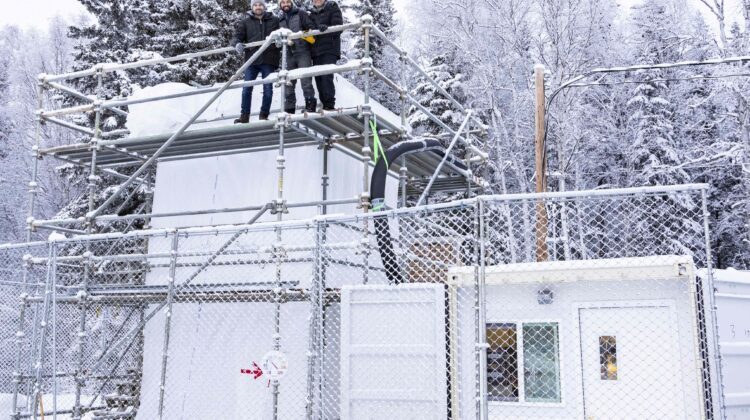
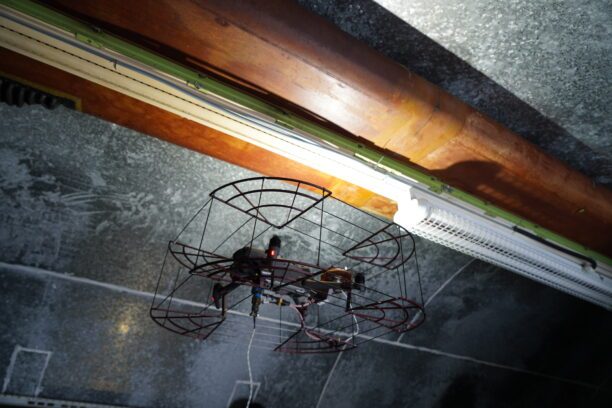
The tower works somewhat like a wind tunnel, although it is smaller and vertical. Standing about 16 feet (4.9 meters) tall in a fenced area behind the UAF Reichardt Building, it generates several types of calibrated icing conditions so drones can fly in a controlled environment that simulates real-world scenarios. However, the site currently lacks a horizontal component for creating wind conditions. Saiet, who led development of the tower, hopes to expand it to serve fixed-wing drones as well.
“I would like to see us become an aerospace icing complex,” Saiet said.
That work carries added weight as Alaska accelerates efforts to use drones for remote community deliveries and emergency response in harsh weather. The tower has also drawn interest from businesses and research agencies. “We have customers asking about it,” Saiet said. “A drone cargo company is investigating icing, because they want their drones to be able to deliver in icing conditions when the roads are bad and nobody wants to drive.”
Testing anti-icing coatings
Doctoral student Morakinyo Labiran studies ways to inhibit ice buildup on fixed-wing and rotary drones. In 2025, he led a team that used the tower for stationary and flight tests of laboratory-made coatings, analyzing their effect on ice freezing time and aerodynamic performance.
“The ice tower enabled us to make several tests, providing enough data to measure the effectiveness of these solutions,” Labiran said. “The tower’s 16-foot height provides space for hovering and observing how its flight dynamics change in real time.”
Labiran, who holds mechanical engineering degrees from the Federal University of Technology, Akure and the University of Ibadan in Nigeria, credits his advisor, UAF associate professor of mechanical engineering Miracle Oyewola, for his interest in the field. “My first thought was that it would be easy – just find a means to heat up the surface,” Labiran said. “It required more critical thinking due to the drone’s limited power capacity, its material properties and the complexity of the ice adhesion process.”
More information is available at ACUASI.
Read More
-
Cyberhawk Secures Long-Term Drone Inspection Agreement for UK Electricity Networks
-
Defense-Proven Drone Technology Moves Into the Commercial Market

Ian McNabb is a journalist focusing on drone technology and lifestyle content at Dronelife. He is based between Boston and NH and, when not writing, enjoys hiking and Boston area sports.

Leave a Reply