
After years of competing with limited resources, the Massachusetts high school team takes first place on the national stage
By DRONELIFE Features Editor Jim Magill
The results of a recent drone competition featuring middle and high school students from across the country proved that competitors don’t have to come from wealthy communities to be able to excel at designing, building and flying drones.
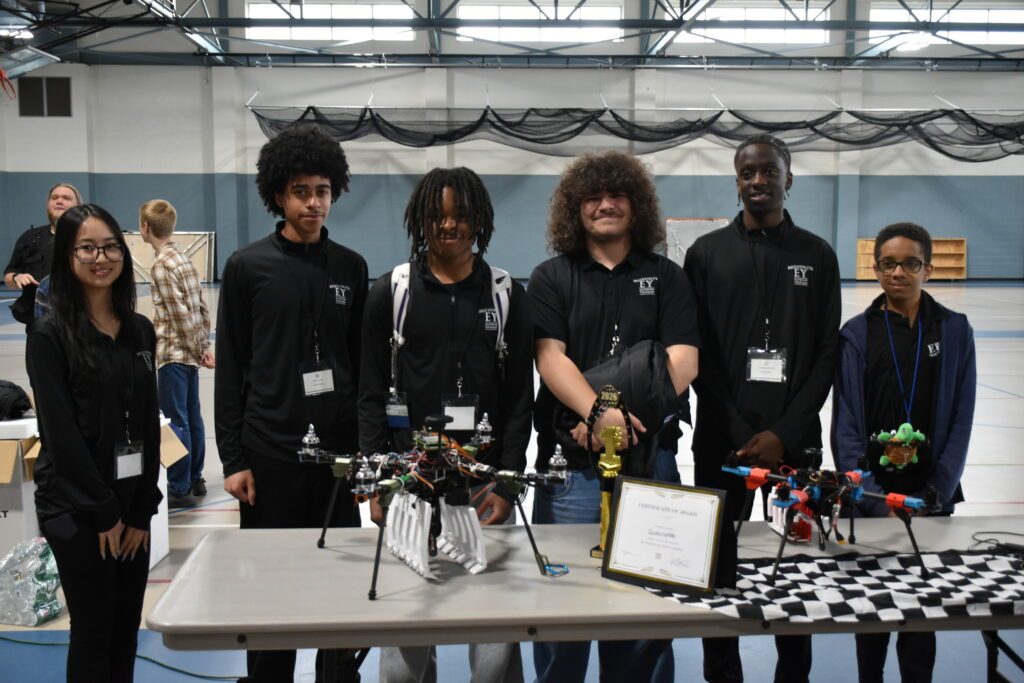
Students from Brockton High School in Massachusetts took home the first-place honors at the 2026 National STEM-ED Aerospace Robotics Competition (ARC). The national finals event, which took place in May at Saint Anselm College in Manchester, New Hampshire, pitted the students from the working-class community of Brockton against competitors from private college-prep schools and much wealthier public-school districts.
In an interview, Cedric Turner, executive director and founder of Empower Yourself, the locally based organization that sponsors the drone teams in Brockton, said the student competitors had suffered from a lack of funding in the first few years they took part in the competition.
“I strongly believe that autonomous tech knowledge is the future,” said Turner. “My goal is: how do I help to have it expanded in more urban areas where you have a lot of kids who have the will but they don’t have the means? And that gets us into a larger problem of money.”
The ARC event, sponsored by non-profit group STEM-ED Inc., challenges middle and high school students to compete in a series of challenges to build, program and fly their own uncrewed aerial vehicles. The competition also tests the students’ ability to confront the ethical challenges surrounding the development of emerging drone technologies.
Turner said the Brockton students, with the support of his organization and mentors from MIT, have come a long way since they became involved with the competition about four years ago.
“Someone from MIT said, ‘There is a type of aerial robotics competition and do you think that your kids are interested?’ And I said, ‘Sure,’” he said. MIT offered to provide financial support and enlisted two volunteers to assist the student competitors in their efforts.
“Our kids had no idea about the expectations and the work that was going to be needed,” Turner said. “Needless to say, in the first couple years, we got creamed.”
For the first several years of their participation in the competition, the Brockton teams struggled with the lack of resources for the program. “It’s a whole bunch of wealthy schools because drones are very cost-prohibitive. To maintain the drones costs a lot of money,” he said.
That’s when one of the teams’ benefactors from MIT helped the Brockton drone teams overcome some of their financial disadvantage. “He asked me, ‘You just tell me what you need for it to win.’” Turner said.
He noted that one big advantage the other teams in the competition had over the Brockton students was that they were using state-of-the-art 3D printers to fabricate their drone components. “Rather than them ordering their parts from China, they were basically having their parts printed. And they could have their parts in an hour whereas that we had to wait weeks.”
Another challenge faced by his student teams was that, unlike many of the other schools participating in the competition, the Brockton schools do not offer any in-class programs in engineering, aviation or related disciplines, at which the students can work on their drone projects.
“I tell the kids, ‘Look we’re going to have to work on Saturdays, Sundays, school vacation days, and all types of holidays,’” Turner said. “We didn’t have that luxury to have it as a type of class.”
Over the course of several years, the core group of Brockton students continued with the program and overcame their challenges to succeed in the competition.
“Our kids learned from the previous years and they understood what it actually took to win. In our third year we actually got first inside the region, and we got third in the nation. This year, in 2026, we got third in the region, but we got first in the nation.”
The Brockton schools continue to move ahead with their drone development program in partnership with MIT’s Lincoln Laboratory, Northeastern University’s College of Engineering, GreenSight, a drone and robotics company based in Charlestown, Massachusetts and the Bridgewater State School of Aviation.
ARC event promotes STEM education
Tucker Hamilton, CEO and co-founder of STEM-ED, praised Turner’s leadership of the Brockton student teams.
“He has Empower Yourself, and he basically brings all of the people together that allows his teams to really succeed and to learn, and they’ve had amazing results,” Hamilton said. “I think he is a remarkable person who pours so much into these students.”
Hamilton said the Brockton schools have the distinction of recruiting the first middle school team to enter the ARC. Since that initial event ARC has had several middle school teams participate in the drone challenges. “Brockton’s middle school won the regional for middle schools and were invited to nationals. They were the only middle school team invited to nationals. And so, by default they won the national championship.”
“The Brockton Middle School team also competed and did well against high school teams,” Hamilton said. For its part, the Brockton High School Team “exceeded in all facets,” of the competition. “And they went up against some really competitive teams in all the regions, from Silicon Valley, from San Diego and Los Angeles,” as well against teams in Brockton’s own highly competitive New England Region.
Hamilton, along with three other co-founders started ARC in 2015 and since then it has grown into a prestigious national robotics competition. “We have multiple regions, and we teach students how to code, build and fly drones,” he said.
Read more:
- Students Compete in XPRIZE Wildfire Finals With AI Drone Firefighting
- Non-Profit Student-Led Group Unveils 3D Printed Research Drone
- Final Call: UAV Empower Scholarship Opens Doors for Students Driving Social Impact with Drones

Jim Magill is a Houston-based writer with almost a quarter-century of experience covering technical and economic developments in the oil and gas industry. After retiring in December 2019 as a senior editor with S&P Global Platts, Jim began writing about emerging technologies, such as artificial intelligence, robots and drones, and the ways in which they’re contributing to our society. In addition to DroneLife, Jim is a contributor to Forbes.com and his work has appeared in the Houston Chronicle, U.S. News & World Report, and Unmanned Systems, a publication of the Association for Unmanned Vehicle Systems International
Leave a Reply